Ancient Iran–today
Zoroastrianism
Zarathustra, Iranian empires, the Avesta, the Parsis and a living diaspora: a history illustrated with ancient drawings, Persian manuscript paintings and Parsi portraits.
14 chapters8 artworks
Begin the journey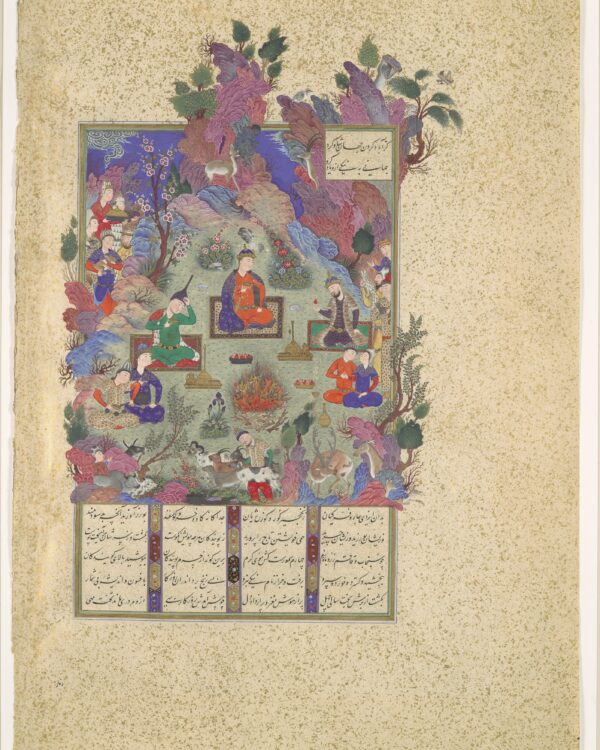
Painting attributed to Sultan Muhammad
"The Feast of Sada", Folio 22v from the Shahnama (Book of Kings) of Shah Tahmasp
ca. 1525 · Metropolitan Museum of Art
Discover the reproduction ↗The history of Zoroastrianism cannot be told as a vanished religion of fire. It is a living tradition whose scriptures, rituals and communities have crossed many political worlds. Fourteen chapters distinguish ancient evidence, later sacred memory and modern community life. Eight distinct works, all researched beyond the existing catalogue, accompany the journey. Safavid epic illustrations are identified as later interpretations, not as pictures made in ancient Zoroastrian temples.
Ancient Iranian worlds
Zarathustra and an uncertain chronology
Zarathustra, called Zoroaster in Greek-derived usage, stands at the beginning of the tradition’s sacred memory. His exact lifetime and birthplace remain debated. Linguistic evidence, later chronological traditions and archaeology do not produce a universally accepted date. Giving him a precise modern biography would conceal the limits of the evidence.
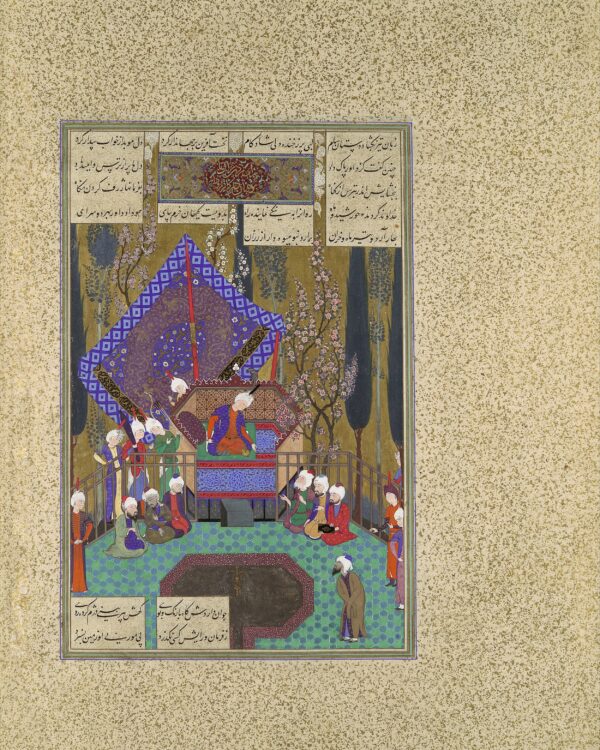
The Gathas, hymns in Old Avestan, form a particularly ancient core. Later narratives place the teacher in relation to a royal patron, Vishtaspa. A sixteenth-century painting of Iranian magi belongs to the much later reception of this world. It cannot establish what Zarathustra or his contemporaries looked like.
Painting attributed to Sultan Muhammad
"Zal Consults the Magi", Folio 73v from the Shahnama (Book of Kings) of Shah Tahmasp
ca. 1530–35 · Metropolitan Museum of Art
Discover the reproduction ↗Oral and written transmission
The Gathas and the Avesta
The Avesta is not one book composed at a single moment. It preserves different linguistic layers, hymns, ritual texts and prayers transmitted through priestly learning. Oral performance and the later writing of manuscripts are different stages in its history. The age of a surviving codex is therefore not the age of every text it contains.
The Shahnama folio shown here is not an Avesta manuscript. It illustrates an epic written in New Persian by Ferdowsi within an Islamic literary world. Placing the two textual histories beside one another helps explain how Iranian memory continued through different languages, religious settings and forms of patronage.
Painting attributed to Qadimi; Painting attributed to 'Abd al-'Aziz
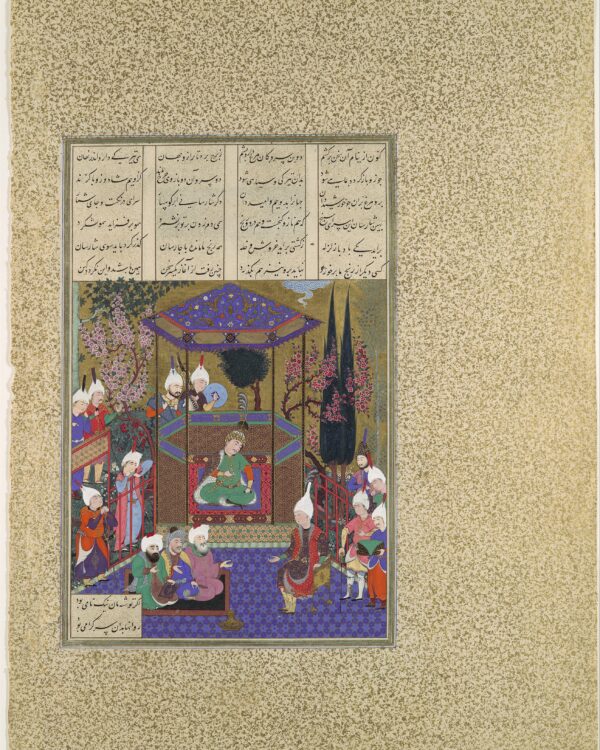
"Zal Expounds the Mysteries of the Magi", Folio 87v from the Shahnama (Book of Kings) of Shah Tahmasp
ca. 1525 · Metropolitan Museum of Art
Discover the reproduction ↗Belief and conduct
Truth, good thought and ethical choice
Ahura Mazda is central to Zoroastrian worship and theological reflection. Asha concerns truth and right order; its opposition to deceit makes conduct part of a cosmic as well as a social struggle. The familiar triad of good thoughts, good words and good deeds links belief to responsibility in daily life.
Descriptions of dualism need care. Different texts and interpreters explain the relationship between good, evil, spirit and creation in different ways; simply announcing two equal creator gods misrepresents that variety. The magi painted around Zal offer an image of deliberation in an epic setting. They are not a diagram that settles every theological disagreement.
Painting attributed to Sultan Muhammad
"Zal Consults the Magi", Folio 73v from the Shahnama (Book of Kings) of Shah Tahmasp
ca. 1530–35 · Metropolitan Museum of Art
Discover the reproduction ↗c. 550–330 BCE
Kings and the evidence of inscriptions
Achaemenid royal inscriptions invoke Ahura Mazda, but historians debate how their religion relates to the practices documented in other Zoroastrian sources. The evidence for one ruler should not be silently extended to every subject or every later doctrine. Cyrus, in particular, should not be given an unquestioned religious biography from assumptions about his successors.
There is no Achaemenid painting in this group. The later Persian manuscript accompanies a discussion of how Iranian kingship was imagined long afterward. Its luxurious clothing and architecture belong to the Safavid workshop’s visual language. The distinction between an ancient inscription and a later epic painting is essential to reading both responsibly.
Painting attributed to Qadimi; Painting attributed to 'Abd al-'Aziz
"Zal Expounds the Mysteries of the Magi", Folio 87v from the Shahnama (Book of Kings) of Shah Tahmasp
ca. 1525 · Metropolitan Museum of Art
Discover the reproduction ↗224–651
Sasanian power and religious plurality
The Sasanian period gave Zoroastrian institutions an important relationship with royal authority. Priests, sacred fires and theological learning became part of an imperial landscape that also contained Christians, Jews, Manichaeans and other communities. Relations changed by reign and region; neither uninterrupted tolerance nor uninterrupted persecution describes the whole period.
The later Sogdian drawing opens another window onto Iranian religious imagery. Its figures have been interpreted through several divine identities, including Nana and Daena. Such interpretations need their scholarly qualifications. A richly populated Iranian religious world cannot be reduced to a single symbol, and an image from Dunhuang should not be labelled a Sasanian court painting.

Unidentified artist
Sogdian Deities from Dunhuang
10th century · Bibliothèque nationale de France
Discover the reproduction ↗10th century
Iranian traditions on the Silk Roads
Sogdian-speaking traders and communities helped carry Iranian languages and religious practices across Central Asia. Their world involved exchanges with Buddhism, local cults and other traditions. Movement did not mean that every community shared one unchanged creed.
The Dunhuang drawing makes these exchanges tangible. Two female figures, animals, clothing and ritual objects invite close comparison with other images, but the identification of a deity remains an argument supported by context, not merely by visual resemblance. Here the archive’s proposed Zoroastrian associations are retained as interpretations. The drawing’s own date and geographical setting remain visible alongside them.
Unidentified artist
Sogdian Deities from Dunhuang
10th century · Bibliothèque nationale de France
Discover the reproduction ↗7th century onward
After the Islamic conquests
The fall of the Sasanian state did not make Zoroastrian communities disappear. Conversion, taxation, migration, local relationships and the preservation of priestly learning unfolded over centuries. Conditions differed across regions and political periods. A narrative of instantaneous replacement would erase that long social history.
Later Muslim patrons also supported Persian literature about pre-Islamic Iran. This does not make the Shahnama a Zoroastrian scripture or prove that all relations were harmonious. It shows that political conquest, religious identity and cultural memory do not follow identical timelines. The magi’s continued presence in illustrated epics is one trace of that more complicated afterlife.
Painting attributed to Qadimi; Painting attributed to 'Abd al-'Aziz
"Zal Expounds the Mysteries of the Magi", Folio 87v from the Shahnama (Book of Kings) of Shah Tahmasp
ca. 1525 · Metropolitan Museum of Art
Discover the reproduction ↗Medieval Gujarat
The Parsis and the story of Sanjan
Zoroastrian migration from Iran to India established the communities known as Parsis. The exact chronology is debated. The Qissa-ye Sanjan was written centuries after the early migration and preserves collective memory rather than a contemporary passenger list. Its account must be compared with other evidence; a single precise arrival year is not secure.
The familiar milk-and-sugar story expresses a remembered ideal of coexistence. It should be introduced as a tradition, not silently converted into a documented negotiation. The much later album image of a Sindhi and a Parsi shows another way communities were distinguished in India, through inscriptions and dress. It cannot reconstruct the clothing of the first migrants.

Unidentified artist
A Sindhi and a Parsi
c. 1850 · Historical Punjab album documented by Wikimedia Commons
Discover the reproduction ↗Ritual and epic
Fire, Sada and sacred attention
Fire occupies a central place in Zoroastrian ritual. Calling the tradition merely fire worship conceals its theology, ethical life and differentiated ritual practices. Sacred fires have classifications and histories; the observances around them are not interchangeable with every domestic or festive flame.
The Feast of Sada presents the epic celebration associated with the discovery of fire. The crowded sixteenth-century scene is a painted interpretation of a story, not a transparent record of an ancient ceremony. Its animals, musicians and landscape create a courtly vision of a remote past. Its colours belong to the historical image; gold in the original manuscript is not a promise of gold leaf in a canvas reproduction.
Painting attributed to Sultan Muhammad
"The Feast of Sada", Folio 22v from the Shahnama (Book of Kings) of Shah Tahmasp
ca. 1525 · Metropolitan Museum of Art
Discover the reproduction ↗Community practice
Priests, initiation and everyday commitments
Priestly training and household practice preserve prayers and ritual knowledge. Initiation, called navjote in Parsi usage and sudreh-pushi in Iranian settings, connects the sacred shirt and cord with a religious commitment. Local customs and explanations vary. A short list of objects cannot replace the meanings given to them by practitioners.
Colesworthey Grant’s 1844 image of Parsi priests belongs to a colonial portrait album. It is useful evidence for how an observer represented the community, while its categories and composition need scrutiny. The figures’ presence does not authorize a universal account of who may enter every fire temple or perform every rite today.

Colesworthey Grant (1813–1880)
Parsi Priests in Calcutta — Oriental Heads
1844 · British Library, digitized book collection
Discover the reproduction ↗Purity and renewal
Care for creation, death and renewal
Purity practices connect human action with care for elements of creation. Funerary traditions historically sought to limit pollution of earth, water and fire. Their forms have changed with environment, law, infrastructure and community decisions. It would be misleading to represent every modern Zoroastrian funeral through a single sensational image of a tower of silence.
The older priestly illustration accompanies a discussion of ritual responsibility, not a depiction of a funeral. Beliefs about judgment and the eventual renovation of the world also give death a place within a larger moral horizon. These ideas have their own textual histories and should not be flattened into a modern slogan or a claim that all communities explain them identically.
Colesworthey Grant (1813–1880)
Parsi Priests in Calcutta — Oriental Heads
1844 · British Library, digitized book collection
Discover the reproduction ↗19th century
Parsi Bombay: work, trade and patronage
The portraits of Jamsetjee Bomanjee Wadia and Nowrojee Jamsetjee Wadia document one prominent Parsi shipbuilding family. Plans, a ship visible through a window, textiles and furniture connect individual status with the maritime economy and British imperial power. They are not portraits of priests, nor a description of every Parsi household’s wealth.
The uncertain suggestion of J. Dorman as painter remains uncertain. It must not be turned into a firm attribution or confused with the sitters’ names. Read together, these companion pictures show how a community’s public history includes skilled labour, commerce and philanthropy alongside worship. The father’s portrait is understood as probably posthumous; its date should not be mistaken for the date of the shipbuilding activity shown.

Unidentified artist
Jamsetjee Bomanjee Wadia, Parsi Shipbuilder
c. 1830 · Royal Asiatic Society of Great Britain and Ireland
Discover the reproduction ↗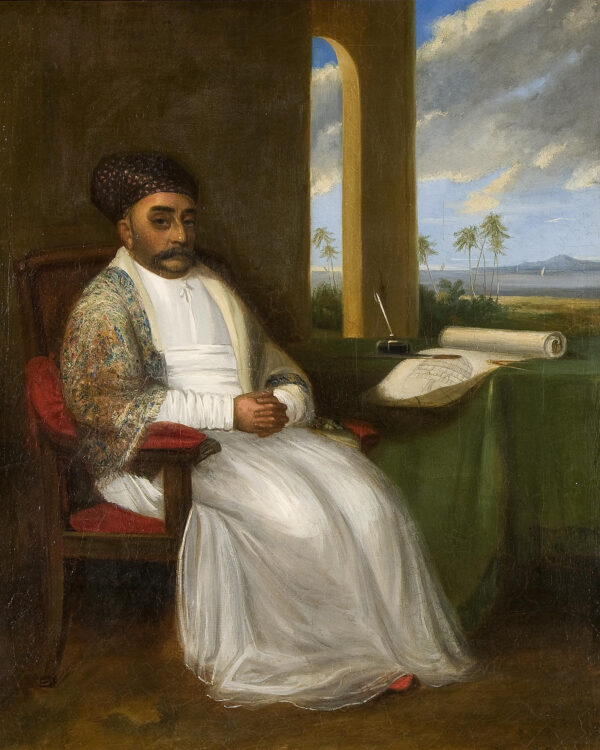
Unidentified artist
Nowrojee Jamsetjee Wadia, Parsi Shipbuilder
c. 1830 · Royal Asiatic Society of Great Britain and Ireland
Discover the reproduction ↗19th–20th centuries
Iranian communities and reform networks
Zoroastrian communities in Iran preserved their own institutions and traditions under changing conditions. Nineteenth-century connections with Parsis in India supported education, relief and advocacy. Manekji Limji Hataria became an important figure in these exchanges. The history concerns practical institutions and negotiations as well as theological continuity.
An Indian Parsi portrait accompanies this chapter as an image of the wider world in which such networks operated; it does not portray Hataria. The distinction prevents an attractive but incorrect identification. Iranian and Parsi histories are related, but neither should be treated as a minor copy of the other. Their languages, calendars, social settings and debates developed along intersecting paths.
Unidentified artist
Nowrojee Jamsetjee Wadia, Parsi Shipbuilder
c. 1830 · Royal Asiatic Society of Great Britain and Ireland
Discover the reproduction ↗Today
A living diaspora and open questions
Zoroastrian communities now live across many countries, maintaining centres, festivals, education and charitable work. Questions of descent, marriage, conversion and participation receive different answers in different institutions and families. A single rule should not be presented as the uncontested position of every Zoroastrian worldwide.
The old paintings do not end the history. They preserve particular ways of imagining wise counsel, representing community and remembering individuals. The original-collection and archive links keep those objects connected to their documentation. Their reproductions offer an encounter with historical art, while the living tradition continues beyond the period and social world of any one image.
Painting attributed to Sultan Muhammad
"The Feast of Sada", Folio 22v from the Shahnama (Book of Kings) of Shah Tahmasp
ca. 1525 · Metropolitan Museum of Art
Discover the reproduction ↗Unidentified artist
A Sindhi and a Parsi
c. 1850 · Historical Punjab album documented by Wikimedia Commons
Discover the reproduction ↗Keep exploring