15th century–today
Sikhism
From Guru Nanak’s Punjab to a worldwide community: sixteen chapters of poetry, service, scripture, sovereignty and remembrance, accompanied by historical paintings.
16 chapters20 artworks
Begin the journey
Unidentified artist
An Imaginary Meeting of the Ten Sikh Gurus
c. 1780 · Los Angeles County Museum of Art
Discover the reproduction ↗A manuscript leaf can hold several times at once: the age of a Guru, the memory of later devotees and the workshop that gave that memory a visible form. This journey follows those layers through twenty distinct works. Sikhism is a tradition with its own scriptures and institutions; its exchanges with neighbouring communities do not make it a simple mixture of other religions. Dates of paintings are always distinguished from the lives and stories they depict.
1469–1539
Punjab and the birth of Nanak
The story begins in the Punjab, a region linked by farming, trade, pilgrimage and several languages. Nanak was born in 1469 at Talwandi, now Nankana Sahib in Pakistan. His teaching developed in a world shaped by Muslim political rule, varied Hindu traditions, devotional poets and Sufi networks. Those encounters matter, but they do not erase the distinct voice of the hymns attributed to him.
The birth scene shown here belongs to a later Janamsakhi manuscript. Its household, clothing and arrangement of witnesses tell us how a community chose to remember its founder. They cannot be read as a photograph of fifteenth-century Punjab. The distance between event and image is part of the history, rather than a defect to hide.

Unidentified artist
The Birth of Guru Nanak
17th–19th century · Government Museum and Art Gallery, Chandigarh
Discover the reproduction ↗Youth and memory
A teacher, a question, a household
Janamsakhi stories present the young Nanak questioning the purpose of learning. Their episodes were collected and retold in different manuscript traditions; historians compare versions rather than treating every detail as a single contemporary biography. A classroom scene gives a visual form to the conviction that learning should transform the person, not merely display mastery of letters.
Marriage images introduce another essential dimension. Sikh teaching does not require withdrawal from family life as the normal road to devotion. Work, relationships and remembrance of the divine can belong together. The wedding preparations show a populated social world, while also reminding us that a painter’s arrangement is an interpretation. Neither the school scene nor the marriage leaf establishes an exact date for the events it portrays.

Unidentified artist
Guru Nanak at School
17th–19th century · Government Museum and Art Gallery, Chandigarh
Discover the reproduction ↗
Unidentified artist
Preparations for Guru Nanak’s Wedding
16th–18th century; archive dating is broad · Government Museum and Art Gallery, Chandigarh
Discover the reproduction ↗Janamsakhi traditions
Journeys, encounters and sacred storytelling
Traditions about Nanak’s journeys carry him across religious and geographical boundaries. The Mecca episode makes the presence of the divine impossible to confine to one direction or enclosure. Its importance within Sikh remembrance should be distinguished from the historian’s separate question of which itineraries can be independently reconstructed.
The meeting with Prahlada makes the distinction still clearer. Prahlada belongs to a different sacred narrative and a different imagined age; the image does not document a meeting of contemporaries. It brings devotional exemplars together to make an argument about faithful remembrance. Such paintings let us study how Sikh storytellers addressed an audience familiar with several bodies of sacred literature, without assuming that every tradition understood those stories in the same way.

Unidentified artist
Guru Nanak in Mecca — Janamsakhi Illustration
18th–19th century · Khanuja Family Collection
Discover the reproduction ↗
Unidentified artist
Guru Nanak Meets the Devotee Prahlada
18th–19th century; later Janamsakhi tradition · Historical Janamsakhi documented by Wikimedia Commons
Discover the reproduction ↗The spoken and sung word
Hymns, Mardana and the divine Name
The Sikh tradition gives central importance to the divine word, heard and sung. The musical companion Bhai Mardana, remembered as a Muslim, stands beside Nanak in many later images. Their relationship offers a powerful visual language of companionship across inherited boundaries; it does not mean that historical differences simply disappeared.
The opening affirmation Ik Oankar expresses divine oneness. Remembering the Name, honest labour and sharing with others connect spiritual attention to ordinary conduct. Kirtan, the musical rendering of scriptural hymns, continues to shape worship. An image of a seated Guru surrounded by listeners therefore points beyond portraiture: the gathering is a place of listening. Painting makes the assembly visible, while the authority of the teaching resides in the word rather than in a supposedly miraculous likeness.

Unidentified artist
Guru Nanak — Royal Collection Series
c. 1800–1840 · Royal Collection
Discover the reproduction ↗Unidentified artist
An Imaginary Meeting of the Ten Sikh Gurus
c. 1780 · Los Angeles County Museum of Art
Discover the reproduction ↗1539–1581
A community takes lasting form
Nanak’s successors transformed a circle of disciples into an enduring community. Guru Angad is associated with the development and transmission of Gurmukhi writing; Guru Amar Das strengthened networks of congregations and service; Guru Ram Das is linked with the growth of the settlement that became Amritsar. Succession involved teaching, organization and contested relationships as well as devotion.
Langar, the communal meal, gives equality a practical setting: people prepare, serve and share food. The ideal challenges distinctions of status, although the existence of an ideal should not be confused with the disappearance of caste or gender inequalities in lived society. The later portrait of Amar Das and the imaginary assembly of all ten Gurus visualize continuity. They join different generations in a single field of remembrance, not at one historical banquet.

Unidentified artist
Guru Amar Das — Royal Collection Series
c. 1800–1840 · Royal Collection
Discover the reproduction ↗Unidentified artist
An Imaginary Meeting of the Ten Sikh Gurus
c. 1780 · Los Angeles County Museum of Art
Discover the reproduction ↗1581–1606
Guru Arjan, Amritsar and the Adi Granth
Guru Arjan’s period brought major developments in the sacred centre at Amritsar and the compilation of the Adi Granth in 1604. The collection includes compositions by Sikh Gurus alongside voices from other devotional backgrounds. Its ordering as a body of hymns is inseparable from musical performance and from the community’s understanding of revealed teaching.
Arjan was executed in 1606 under the Mughal emperor Jahangir. Sikh remembrance understands his death as martyrdom; historians also examine imperial politics, patronage and the growing community’s position. This episode should not be turned into an explanation in which every Muslim and every Sikh always occupied opposing camps. Two later portraits, from Lahore and Chandigarh, offer different visual languages of calm authority. Their peaceful settings are acts of remembrance, not documentary pictures of the execution.

Unidentified artist
Guru Arjan with an Ascetic
c. 1800 · Lahore Museum
Discover the reproduction ↗
Unidentified artist
Guru Arjan — Chandigarh Portrait
c. 1800 · Government Museum and Art Gallery, Chandigarh
Discover the reproduction ↗1606–1644
Spiritual responsibility and temporal authority
Guru Hargobind’s leadership is remembered through miri and piri, the relation between temporal and spiritual responsibilities. The Akal Takht at Amritsar became an important seat of communal authority. Armed protection developed within a changing political landscape; it did not simply replace the earlier emphasis on devotion, work and service.
The later portrait sets Hargobind within a highly decorated album leaf. Its border makes the image precious and establishes a courtly language, while the gathering around the Guru emphasizes relationship and instruction. Historical Sikh art could borrow pictorial conventions also used at other north Indian courts. Shared techniques do not make the work’s religious identity interchangeable, and the image should not be mistaken for a photograph of one seventeenth-century event.

Unidentified artist
Guru Hargobind — Royal Collection Series
c. 1800–1840 · Royal Collection
Discover the reproduction ↗1644–1664
Har Rai and Har Krishan: care and succession
The seventh and eighth Gurus, Har Rai and Har Krishan, belong to a period of Mughal succession struggles and delicate relationships between religious communities and imperial power. Sikh accounts also remember care for the vulnerable and service to the ill. These traditions broaden a history too often told only through rulers and battles.
The companion album portraits were painted much later, around 1800–1840. Similar floral borders and formats create visual continuity, while differences in the central figures and surrounding space keep the works distinct. A child’s short life and a teacher’s longer leadership cannot be reconstructed from costume alone. Reading the portraits together shows how a later collection made a succession intelligible and memorable without requiring the viewers to have witnessed any of its original events.

Unidentified artist
Guru Har Rai — Royal Collection Series
c. 1800–1840 · Royal Collection
Discover the reproduction ↗
Unidentified artist
Guru Har Krishan — Royal Collection Series
c. 1800–1840 · Royal Collection
Discover the reproduction ↗1664–1675
Tegh Bahadur and freedom of conscience
Guru Tegh Bahadur was executed in Delhi in 1675 under Aurangzeb. Sikh tradition especially remembers his defence of people facing religious coercion, including Kashmiri Pandits. The historical circumstances and the meanings assigned to the event have been discussed in different bodies of evidence; the community’s remembrance remains central to Sikh accounts of conscience and sacrifice.
Three later portraits provide three ways to see that memory: an ornate album setting, a Pahari figure and a seated Guru beneath a canopy. The family-workshop attribution attached to the last is not a secure personal attribution to Nainsukh, and its proposed dates differ. None of these paintings depicts the execution itself. Their stillness is a chosen way of representing spiritual authority after violent loss.

Unidentified artist
Guru Tegh Bahadur — Royal Collection Series
c. 1800–1840 · Royal Collection
Discover the reproduction ↗
Unidentified artist
Guru Tegh Bahadur — Pahari Portrait
c. 1800 · Lahore Museum
Discover the reproduction ↗
Family workshop of Nainsukh of Guler
Guru Tegh Bahadur Seated beneath a Canopy
c. 1790–1820; proposed datings differ · Historical collection documented by Wikimedia Commons
Discover the reproduction ↗1675–1708
Guru Gobind Singh and the Khalsa
At Vaisakhi in 1699, Guru Gobind Singh inaugurated the Khalsa, a community bound through initiation, discipline and mutual commitment. The five beloved ones, the Panj Piare, occupy a foundational place in its remembrance. The five Ks are especially associated with initiated, or Amritdhari, Sikhs; Sikh lives and outward observances are not all identical.
The equestrian miniature was made around 1800, long after the tenth Guru’s death. Horse, attendant and parasol give his figure a language of sovereign dignity. It would be misleading to assign every associated workshop painting directly to Nainsukh or to treat the costume as eyewitness evidence of 1699. The image instead shows how later patrons and painters represented the relation between spiritual leadership, protection and collective responsibility.
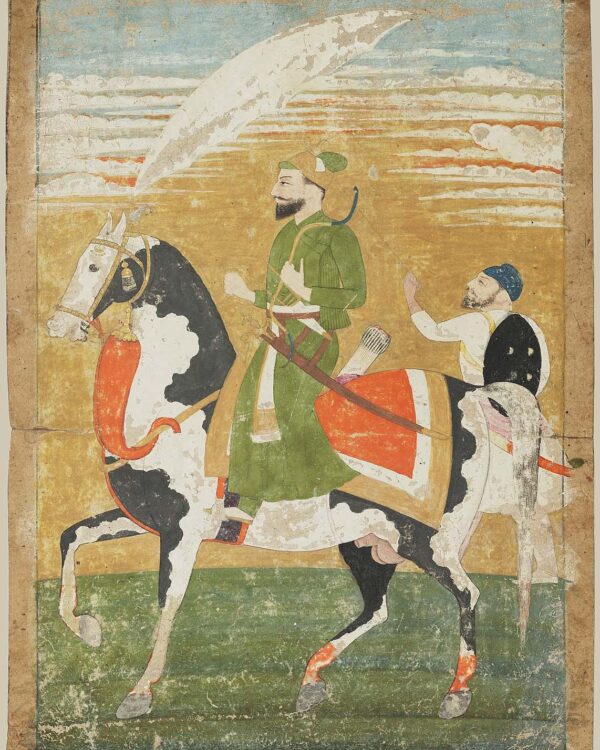
Unidentified artist
Guru Gobind Singh on Horseback with a Parasol Bearer
c. 1800 · Museum of Fine Arts, Boston
Discover the reproduction ↗1708 and after
The Guru Granth Sahib and the Panth
The succession after Guru Gobind Singh did not continue as another line of ten human Gurus. Mainstream Sikh authority centres on the Guru Granth Sahib and the Guru Panth, the community in its collective dimension. The scripture is approached with the reverence due to the living Guru; it is not simply a historical book displayed as a museum curiosity.
An imaginary meeting of all ten Gurus helps explain continuity, but its arrangement cannot document a real gathering: the figures lived in different generations. The painting’s patron, painter, identifying inscriptions and later owners are separate parts of its history. The status of the scripture also explains why art should not be described as a replacement for its word. Looking and listening meet within Sikh life without becoming identical forms of authority.
Unidentified artist
An Imaginary Meeting of the Ten Sikh Gurus
c. 1780 · Los Angeles County Museum of Art
Discover the reproduction ↗Unidentified artist
Guru Nanak — Royal Collection Series
c. 1800–1840 · Royal Collection
Discover the reproduction ↗18th century–1839
Confederacies and the kingdom of Lahore
The eighteenth century saw armed Sikh groups and regional confederacies, usually called misls, develop amid the weakening of Mughal authority and repeated warfare. This was not a single, unchanged Sikh state. Ranjit Singh took Lahore in 1799 and built a kingdom that drew on Sikh leadership alongside Muslim, Hindu and other officials, soldiers and specialists.
Bishan Singh’s elaborate court scene was painted around 1863–1864, after the ruler’s death and the kingdom’s annexation. Its crowded assembly reconstructs a remembered court rather than recording a session witnessed in 1864. The work is valuable precisely as historical imagination: rank, placement and architecture turn lost sovereignty into a visible social order. Religious history and political history overlap here, while neither should be allowed to stand for every Sikh’s experience.
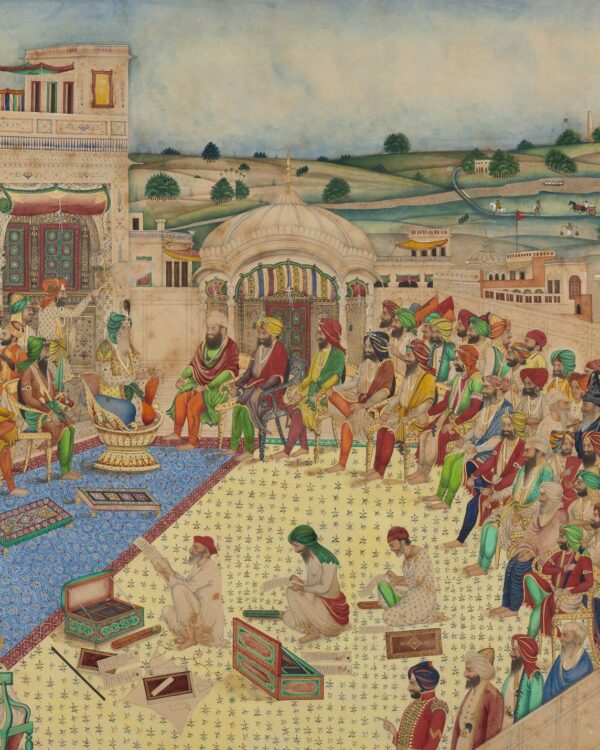
Bishan Singh
The Court of Maharaja Ranjit Singh
c. 1863–1864 · Toor Collection
Discover the reproduction ↗19th century
Nobles, workshops and a changing visual world
Portraiture travelled between workshops, courts and albums. A standing or seated noble might be represented through opaque colour, delicate wash or an economical outline, with dress and accessories communicating social position. These are individual visual choices, not a fixed religious template. A named Sikh sitter does not automatically identify the painter’s own religious affiliation.
The two museum works here demonstrate that range. One is a quiet seated figure, the other a small portrait on a surviving paper leaf. The leaf’s marks and margins belong to the historical object; the frame chosen for a modern reproduction is a separate purchase choice. Their original museum measurements are likewise distinct from the larger canvas formats offered today. Fine historical art can be modest, intimate and unfinished-looking rather than uniformly sumptuous.

Unidentified artist
Portrait of a Seated Man
c. 1830–1850 · Cleveland Museum of Art
Discover the reproduction ↗
Unidentified Indian artist
Portrait of a Sikh Noble
early 19th century · Metropolitan Museum of Art
Discover the reproduction ↗1849–1925
Colonial annexation and Sikh reform
British annexation in 1849 ended the independent kingdom of Lahore, but did not end Sikh religious life. Military recruitment, new educational institutions, print culture and migration altered the circumstances in which communities described themselves. Reform movements were diverse: the Singh Sabha, Nirankari and Namdhari histories cannot be collapsed into a single position.
Debates about gurdwara management culminated in major institutional changes, including the Sikh Gurdwaras Act of 1925. These developments shaped modern understandings of community authority and conduct. The retrospective court painting serves here as a contrast with a lost political order, not as an illustration of a reform meeting. Art collections themselves also changed under empire, as albums and paintings moved into private and institutional holdings far from their original settings.
Bishan Singh
The Court of Maharaja Ranjit Singh
c. 1863–1864 · Toor Collection
Discover the reproduction ↗Unidentified artist
Guru Amar Das — Royal Collection Series
c. 1800–1840 · Royal Collection
Discover the reproduction ↗1947–1984 and after
Partition, violence and contested memory
The partition of British India in 1947 divided the Punjab between India and Pakistan, producing mass displacement and violence affecting Sikhs, Muslims and Hindus. Sacred places and family landscapes were separated by a new border. The memory of Nanak’s birthplace, now in Pakistan, acquired another dimension within a geography of migration.
In 1984 the Indian army’s assault on the Golden Temple complex and subsequent anti-Sikh mass violence left profound wounds. Their causes, responsibilities and remembrance require their own documentary sources; no eighteenth- or nineteenth-century painting can serve as an eyewitness image of these events. The older portrait shown here accompanies a discussion of continuing memory and identity. It does not illustrate modern violence, and spiritual history should not be reduced to a sequence of conflicts.
Unidentified artist
Guru Nanak — Royal Collection Series
c. 1800–1840 · Royal Collection
Discover the reproduction ↗Today
A living worldwide tradition
Today Sikh communities sustain gurdwaras, learning, kirtan and service across many countries. Langar and seva make religious commitment visible through shared labour, while families negotiate language, migration, gender, caste and public recognition in different circumstances. The turban and uncut hair are important signs for many Sikhs, but appearance alone does not describe every person’s practice or conviction.
The art gathered here is therefore an opening into a living tradition, not an attempt to freeze it in the Punjab of a royal court. Its pictures hold several histories at once: sacred narrative, workshop invention, collecting and contemporary looking. Choosing a reproduction also means choosing a particular historical object. The collection and archive links allow that object to remain connected to the place where its original and documentation can be studied.
Unidentified artist
An Imaginary Meeting of the Ten Sikh Gurus
c. 1780 · Los Angeles County Museum of Art
Discover the reproduction ↗Unidentified artist
Guru Nanak at School
17th–19th century · Government Museum and Art Gallery, Chandigarh
Discover the reproduction ↗Keep exploring