CHAPTER 01 / 20
The Bible and Jewish roots
Before cathedrals and councils, a history rooted in Judaism and the Mediterranean world.
Biblical narratives · first century
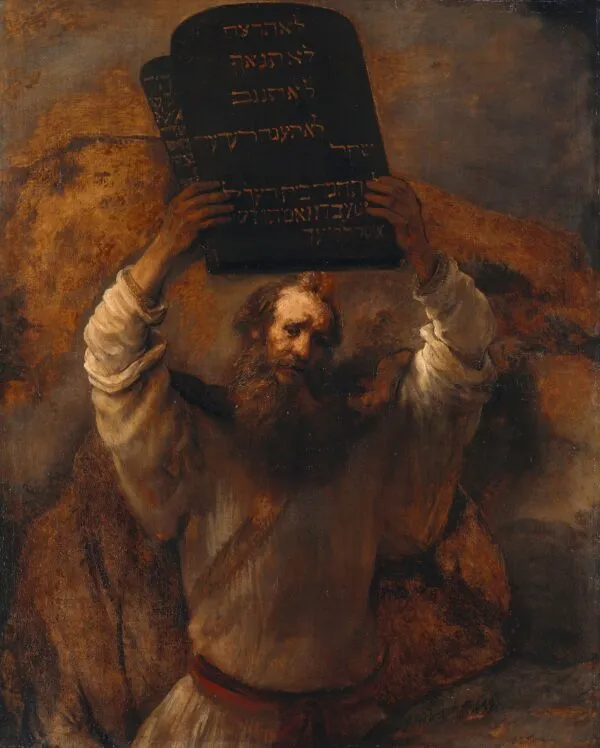
Moses Smashing the Tablets of the Law
Rembrandt
1659 · painting date
01
Begin before Christianity
Jesus, his earliest disciples and the settings in which the Gospels took shape belonged to the Jewish world of the first century. References to Moses, the prophets, Jerusalem’s Temple and scripture were not later decoration: they supplied the language through which early communities understood their experience. The stories of Abraham, Esther and Exodus nevertheless have histories of their own, earlier than and independent of Christian readings.
The boundaries between Judaisms and Christianities developed gradually and differently from place to place. Modern confessional divisions cannot simply be projected onto every New Testament figure. Historical study compares texts, their transmission and their social settings; a seventeenth-century painting is not contemporary evidence of Moses.
Moses Smashing the Tablets of the Law
Rembrandt
1659 · painting date
Gemäldegalerie Berlin
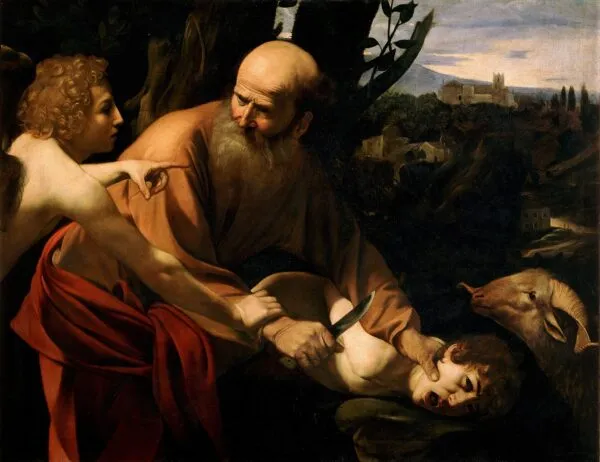
Sacrifice of Isaac
Caravaggio
1603–1604 · painting date
Uffizi Gallery
02
Scripture and different reading traditions
Christians bring together an Old and a New Testament. Catholic, Orthodox and Protestant churches do not always recognise precisely the same collection of books. They share many narratives while differing in translation, interpretation and liturgical use. Judaism, meanwhile, is not defined as an unfinished preparation for Christianity.
Christian art sometimes interprets an earlier narrative as anticipating a Gospel event: this is typology. Abraham’s meeting with Melchizedek, for example, may acquire Eucharistic significance. That connection belongs to a Christian interpretive tradition; it does not exhaust either the biblical text or its Jewish interpretations.

Ahasuerus and Haman at the Feast of Esther
Rembrandt
1660 · painting date
Pushkin Museum of Fine Arts
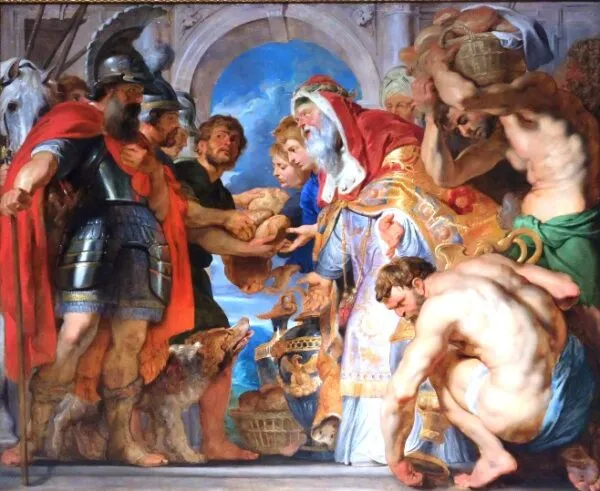
The Meeting between Abraham and Melchizedek
Peter Paul Rubens
1616 · painting date
Musée des Beaux-Arts de Caen
03
Look without collapsing the centuries
Rembrandt turns Moses’ gesture and Esther’s silence into human drama; Caravaggio concentrates the sacrifice of Isaac around a sudden interruption. Rubens lends the meeting of two figures ceremonial grandeur. Their choices of light, gesture and composition also speak of the European societies that commissioned or encountered these paintings.
The comparison invites readers to recognise different interpretations, not to justify collective accusations against Jews or erase Jewish traditions. For the modern Catholic position, Nostra aetate is an important primary document on relationships with Judaism and the rejection of discrimination.
RESEARCH & FURTHER READING
Sources for this chapter
Museum links accompanying the paintings lead to institutional collection information. Display, loans and access can change; consult the museum before visiting.