CHAPTER 02 / 20
Annunciation, birth and first encounters
A room, a star and a displaced family: how painters give the Incarnation a visible form.
Gospel infancy narratives

Annunciation
Fra Angelico
1425–1426 · painting date
01
The narratives have distinct voices
The Annunciation to Mary, the shepherds and the manger belong to Luke’s account; the Magi and the flight into Egypt to Matthew’s. Painters often combine them within a single image or cycle. This visual synthesis suggests a continuous story without removing the differences between the texts.
For Christians, the Incarnation means that Christ enters human life. Historians can investigate the narratives, their uses and the festivals associated with them; accepting their religious meaning is a matter of faith. Renaissance dress and an Italian landscape cannot directly reconstruct a home in ancient Judaea.
Annunciation
Fra Angelico
1425–1426 · painting date
Museo del Prado
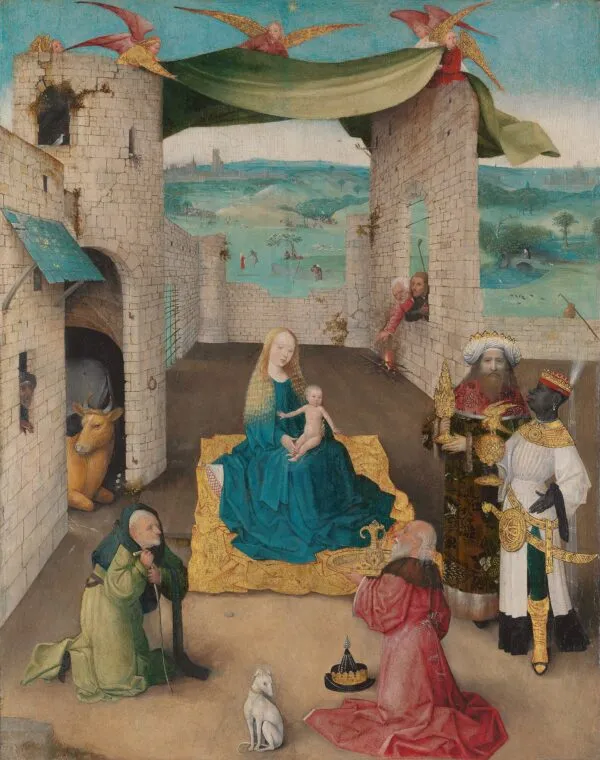
The Adoration of the Magi
Hieronymus Bosch
1475 · painting date
Metropolitan Museum of Art
02
Intimacy becomes a pictorial language
Fra Angelico arranges the meeting of Gabriel and Mary in an ordered space where architecture and gesture guide the eye. Bosch gathers figures whose details invite close examination. El Greco transforms the Nativity through light, while Caravaggio gives a resting family bodily and musical presence.
Looking at hands, glances and distances between figures reveals how a theological idea becomes a sensory experience. A painting might support prayer, instruction or a patron’s standing. These functions can coexist rather than exclude one another.

Nativity
El Greco
1597 · painting date
Hospital de la Caridad de Illescas

Rest on the Flight into Egypt
Caravaggio
1597 · painting date
Galleria Doria Pamphilj
03
Mary, the Magi and displacement
Mary occupies a prominent place in Catholic and Orthodox traditions. Protestant communities recognise her Gospel role but differ concerning later devotions and dogmatic formulations. An Annunciation painting therefore does not establish that every community uses it in the same way.
The flight into Egypt also places a vulnerable family at the centre of the narrative. It can prompt reflection on displacement and hospitality, provided contemporary readings are distinguished from ancient settings. These paintings interpret the texts through the decisions of artists across centuries, not through a single definitive illustration.
RESEARCH & FURTHER READING
Sources for this chapter
Museum links accompanying the paintings lead to institutional collection information. Display, loans and access can change; consult the museum before visiting.