A faith perspective
In Christian belief, these narratives express the Incarnation. The Catholic document Dei Verbum affirms their witness to Jesus; we identify this affirmation as a confessional perspective.
From Gospel narratives to icons, from the Renaissance to the Reformations: discover how painters gave shape to faith, and how different Christian traditions approach these images.
This first journey is selective, not an exhaustive history of Christianity. Painting dates and perspectives are identified separately.
Christianity took shape within the Jewish world of the first century. The Gospels preserve accounts of Jesus’s life that would become an enormous source of subjects for painters centuries later. This Nativity belongs to that religious memory: its fifteenth-century Catalan painter was not depicting an event he had witnessed.
Look closely. Look at the gestures and the position of the child. These are compositional decisions that make a narrative visible, not an archaeological reconstruction of Bethlehem.
Jaume Ferrer the Younger
c. 1457 · artwork date
In Christian belief, these narratives express the Incarnation. The Catholic document Dei Verbum affirms their witness to Jesus; we identify this affirmation as a confessional perspective.
University scholarship examines the texts, their composition and the communities that transmitted them. This approach is distinct from theological interpretation.
The cross and Resurrection occupy a central place in Christian imagery. Two paintings distinguish the moments: Christ on the cross in El Greco’s work, followed by Johann König’s image of the risen Christ. Both paintings were made in the seventeenth century, not during Jesus’s lifetime.
Look closely. Move from the elongated body to the movement of the second composition. A difference in narrative becomes a difference in pictorial movement.
El Greco
c. 1600–1610 · artwork date
Johann König
1622 · artwork date
What an artwork represents and when it was made are separate pieces of information. The captions maintain this distinction throughout the journey.
Paul belongs to the history of the earliest Christians and to New Testament literature. The conversion attributed to him in Christian tradition also became a subject for painters. Caravaggio gives this memory a dramatic form: the painting belongs to early modern art, not to a visual archive of the first century.
Look closely. The composition invites us to consider what the figure can see, what he cannot see and what the painter makes visible to the viewer.
Caravaggio
In Byzantium, the religious use of images became a subject of conflict. The council of Nicaea in 787 defended their veneration; their restoration in 843 became a major landmark. The Cretan icon shown here was painted much later. It introduces a visual tradition that survived these debates, without pretending to be an object from the controversy itself.
Look closely. Mother and child touch cheeks. The gold ground and tender gesture offer a different way of looking from the illusion of a window onto the world.
Attributed to Angelos Akotantos
c. 1425–50 · artwork date
In the Orthodox teaching cited here, the icon belongs to liturgical life and points towards the person represented. It is not simply decoration.
The catechism distinguishes veneration of an image from the worship due to God. That distinction prevents every religious use of images from being reduced to idolatry.
Berlinghiero’s Madonna and Child follows a Byzantine formula: Mary points to her son. This visual language travelled between painting traditions around the Mediterranean. Comparing this Italian work with the Cretan icon reveals a visual relationship without erasing their different contexts and uses.
Look closely. The pointing finger matters as much as the gaze. An image can teach through a gesture.
Berlinghiero
possibly 1230s · artwork date
Oriental Orthodox Churches, Churches of Byzantine tradition and Catholic Churches cannot be reduced to two painting styles. This selective journey opens paths; their individual histories call for additional chapters.
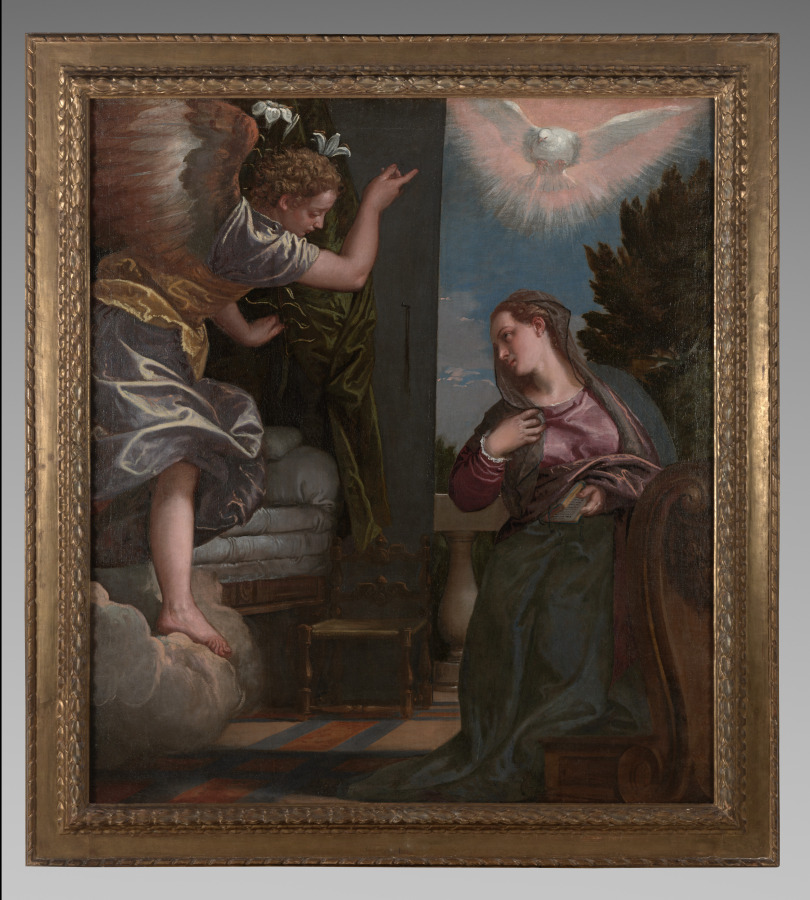
Veronese and his workshop bring the angel and Mary close together in this Annunciation. The subject is ancient, but its staging belongs to late sixteenth-century Venetian painting. The work draws its strength from that dialogue: an inherited narrative, with bodies, fabrics and light newly imagined.
Look closely. Follow the movement between the figures, then the dove above them. The museum also identifies the lily as a symbol of purity associated with Mary.
Paolo Veronese and workshop
c. 1580 · artwork date
The sixteenth-century Reformations changed the role of images. Portraits of Luther helped to spread the Reformation, although Protestant traditions did not all adopt the same attitude towards art. In Catholic settings, the response to the Reformations reaffirmed the value of religious images. Luther’s portrait and the Last Supper offer two starting points for this period of change.
Look closely. A reformer’s portrait serves a different purpose from a scene that brings a biblical narrative before the viewer. Looking at their uses helps us understand their differences.
Workshop of Lucas Cranach the Elder
probably 1532 · artwork date
Jacopo Tintoretto
The Augsburg Confession allows saints to be remembered as examples of faith and good works, while rejecting their invocation. This text does not speak for every Protestant tradition.
Sacred images can direct the viewer towards the person represented; their material substance is not itself the object of worship.
Works circulated within religious and political settings. Neither Catholic nor Protestant names a single style: artists, patrons and uses also matter.
Saints and Marian subjects continued to inspire different forms. Sassetta painted Saint Francis before the cross; Murillo gave the Immaculate Conception an expansive, luminous composition. Later, Gauguin placed Christ in a Breton landscape, using an almost unreal yellow. The religious narrative remains recognisable, while its pictorial language changes.
Look closely. Compare gold, light and colour. These works illuminate artistic transformations; they do not replace a complete history of modern Churches.
Sassetta
1437–1444 · artwork date
Bartolomé Esteban Murillo
c. 1680 · artwork date
Paul Gauguin
The Nativity, Immaculate Conception and Assumption are not three names for the same subject. Titles and catalogue entries stay attached to their respective works; doctrinal distinctions require their own sourced explanations.
Historical and confessional sources are identified to distinguish their approaches. Each artwork also retains the link to its catalogue entry.