6th century BCE–today
Confucian Traditions
From the ancient teachers to China, Korea and Japan: learning, ritual, family, government and the many visual lives of a philosophical tradition.
14 chapters15 artworks
Begin the journey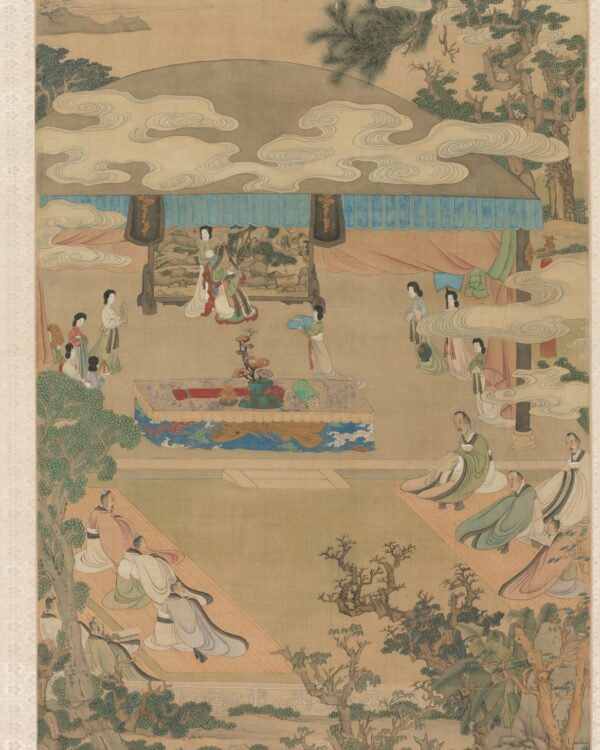
Chen Hongshou (Chinese, 1598/99–1652)
Lady Xuanwen Giving Instruction on the Rites of Zhou
1638 · Cleveland Museum of Art
Discover the reproduction ↗Confucian traditions do not form one church with one universally binding creed. They include ethics, ritual, education, institutions and forms of religious life. These fourteen chapters follow changing interpretations through fifteen paintings, prints and calligraphic works. The pictures are historical objects with their own dates: a Ming portrait of Confucius is evidence of Ming remembrance, not a likeness made in antiquity.
Ancient China
Religion, philosophy, or a way of learning?
The word Confucianism gathers practices that were not always understood as one system. Ru specialists cultivated ritual, music and classical learning. In later settings, reverence for Confucius coexisted with ethical argument, ancestral rites and official education. Calling the whole tradition simply secular misses its ritual life; calling it a uniform religion misses its disagreements.
The three teachers in the Ming painting stand for Buddhist, Daoist and Confucian traditions. Their symbolic encounter expresses a later desire to understand relationships between teachings. It does not show three founders meeting in historical time.

Unidentified Chinese artist
Shakyamuni, Laozi and Confucius
Ming dynasty, 1368–1644 · National Museum of Asian Art, Smithsonian Institution
Discover the reproduction ↗551–479 BCE, traditional dates
Confucius in a fractured political world
Kong Qiu, remembered as Master Kong or Confucius, lived in the late Zhou world of competing states. The conventional dates 551–479 BCE frame a life reconstructed from texts written and edited across generations. The Analects preserve conversations, remembered gestures and judgments rather than a modern continuous biography.
Later portraits present the teacher as an exemplary presence. The Qufu image belongs to the Ming period, many centuries after his life. Its authority comes from a continuing culture of remembrance and teaching, not from an independently verified physical likeness.
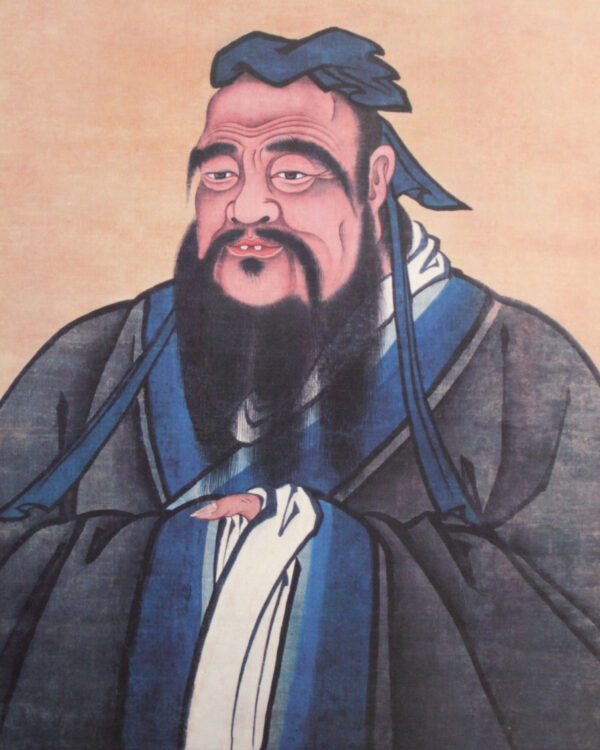
Unidentified Chinese artist
Portrait of Confucius from the Kong Family Mansion
Ming dynasty, 1368–1644 · Kong Family Mansion, Qufu
Discover the reproduction ↗
Unidentified illustrator; associated with publisher Hu Wenhuan
Confucius Leaves Lu — Shou Yue Chuan Xing
16th–17th century · Historical illustrated edition documented by Wikimedia Commons
Discover the reproduction ↗Classical teaching
Learning through practice and example
Learning concerns the formation of a person, not only the accumulation of information. The teacher asks how conduct, attention and judgment can become better through repeated practice. The exemplary person, or junzi, is therefore an ethical aspiration rather than merely a hereditary rank.
The Apricot Altar became a powerful image of teaching. Kanō Tan’yū’s seventeenth-century ensemble translates that memory into Japanese painting. Its companion panels are distinct works within one visual conversation. They show the long afterlife of an ideal classroom, rather than the literal arrangement of Confucius’s original school.

Kanō Tan’yū (1602–1674)
Confucius at the Apricot Altar
Mid-17th century · Museum of Fine Arts, Boston
Discover the reproduction ↗
Kanō Tan’yū (1602–1674)
Huizi at the Apricot Altar
Mid-17th century · Museum of Fine Arts, Boston
Discover the reproduction ↗
Kanō Tan’yū (1602–1674)
Yanzi at the Apricot Altar
Mid-17th century · Museum of Fine Arts, Boston
Discover the reproduction ↗Ethical vocabulary
Humaneness, rightness and ritual
Ren, often translated as humaneness, concerns the quality of relationships. Yi asks what is fitting or right; li concerns ritual forms and appropriate conduct; trustworthiness gives relationships durability. These terms overlap without becoming synonyms. Ritual can train attention and respect, rather than merely enforce empty ceremony.
Harunobu’s prints put ethical titles into the commercial world of eighteenth-century Edo. Benevolence and Righteousness do not depict ancient philosophers: they connect virtues with particular urban figures and activities. The displacement is historically revealing. Classical words could circulate in settings far removed from the schoolroom or imperial court.

Suzuki Harunobu (Japanese, 1724–1770)
Benevolence, from The Five Virtues
1767 · Cleveland Museum of Art
Discover the reproduction ↗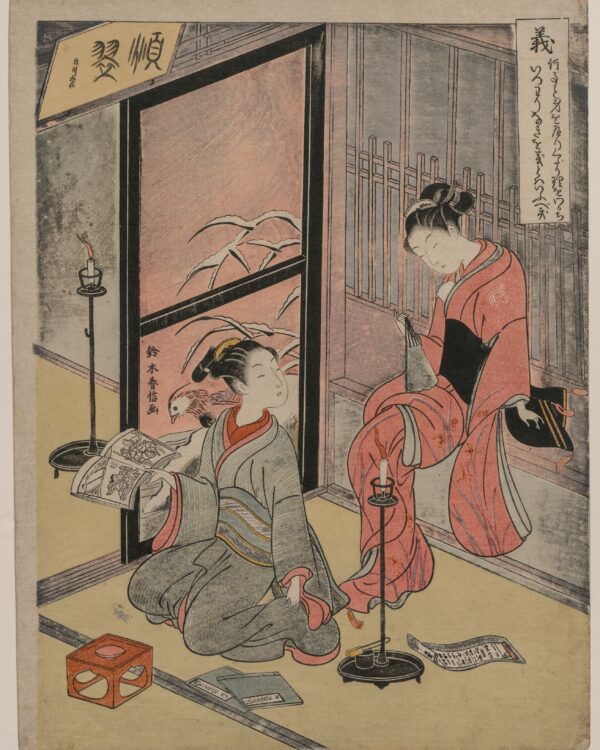
Suzuki Harunobu (Japanese, 1724–1770)
Righteousness, from The Five Virtues
1767 · Cleveland Museum of Art
Discover the reproduction ↗4th century BCE
Mencius and the beginnings of compassion
Mengzi, known in Europe as Mencius, defended the possibility of moral development. His account of human goodness is not the claim that every action is already good. It concerns capacities that need cultivation and can be damaged by circumstances. Political authority is likewise judged by what it does for people’s lives.
The remembered mother of Mencius became an exemplar of educational care. Wu Shien’s later painting shows a household on the move with books. The story makes environment matter: learning has material conditions and depends on other people’s labour. It is exemplary biography, not a contemporary portrait of the philosopher’s childhood.

Unidentified Chinese artist
Mencius — Portrait of an Ancient Sage
Yuan dynasty, 1279–1368 · National Palace Museum, Taipei
Discover the reproduction ↗
Wu Shien (15th–16th century)
Educating a Son — Mencius and His Mother
15th–16th century · Chester Beatty, Dublin
Discover the reproduction ↗3rd century BCE
Xunzi: deliberate effort and transformation
Xunzi gave a different account of human dispositions. Untrained desires can produce conflict; teachers, ritual and deliberate effort make transformation possible. The familiar opposition between good and bad human nature needs interpretation: the dispute concerns what nature means and how moral capacities emerge, not a simple contest between optimism and despair.
There is no claim that the later woodcut shown here portrays Xunzi. It depicts a transmitted story of Confucius teaching beneath a tree. It accompanies this chapter as an image of teaching under pressure. Both Mencius and Xunzi made education essential, even as they offered different explanations of its work.

Unidentified illustrator; associated with publisher Hu Wenhuan
Confucius Teaches beneath a Tree — Xi Li Fa Tan
16th–17th century · Historical illustrated edition documented by Wikimedia Commons
Discover the reproduction ↗Han–Tang
Classics, government and public authority
Under the Han and later dynasties, classical scholarship gained institutional support, but political practice remained more varied than the label Confucian state suggests. Rulers combined traditions of law, administration, ritual and cosmology. The great examination system developed over a long period; it was not invented fully formed by Confucius or by a single Han emperor.
The Classics connected learning to office and historical memory. Their interpretation was never wholly fixed. A later image of an authoritative teacher therefore belongs to a history of argument over who may explain the past and advise the present. Scholarly authority could support government and also become a language for criticizing it.
Unidentified Chinese artist
Portrait of Confucius from the Kong Family Mansion
Ming dynasty, 1368–1644 · Kong Family Mansion, Qufu
Discover the reproduction ↗Household and lineage
Filial care, hierarchy and women’s learning
Filial responsibility connected care for parents, ancestral remembrance and the formation of social obligations. These ideals could support affection and mutual responsibility, but their historical use also sustained unequal hierarchies. Women taught and wrote within this world even when institutions restricted their opportunities. An ideal of harmony cannot substitute for examining who held power.
Chen Hongshou’s Lady Xuanwen Giving Instruction on the Rites of Zhou places an elderly woman at the centre of classical transmission. Painted in 1638 for a family occasion, it is not a straightforward picture of equal educational access. It nevertheless makes a learned woman’s authority visible and complicates an exclusively male history of teaching.
Chen Hongshou (Chinese, 1598/99–1652)
Lady Xuanwen Giving Instruction on the Rites of Zhou
1638 · Cleveland Museum of Art
Discover the reproduction ↗Wu Shien (15th–16th century)
Educating a Son — Mencius and His Mother
15th–16th century · Chester Beatty, Dublin
Discover the reproduction ↗960–1279
Song renewal and Zhu Xi
Song thinkers reworked classical learning in dialogue and dispute with Buddhist and Daoist thought. Zhu Xi developed an influential synthesis linking ethical cultivation, the investigation of things, cosmic pattern and the material life of the world. His Four Books curriculum became especially important in later education and examinations.
Tani Bunchō’s portrait dates to 1796 in Japan, long after Zhu Xi’s lifetime of 1130–1200. Its presence here documents intellectual transmission, not direct observation. The imagined relation between later viewer and earlier teacher was one way a tradition crossed languages, political borders and centuries without remaining unchanged.

Tani Bunchō (1763–1841)
Portrait of Zhu Xi
1796 · Metropolitan Museum of Art
Discover the reproduction ↗15th–16th centuries
Other paths: Wang Yangming and moral knowing
The Song and Ming inheritance did not produce one uncontested school. Wang Yangming emphasized moral knowing and the relation between knowledge and action. His work renewed questions about where ethical understanding is found and how it is enacted. Differences within later Confucian thought are part of its vitality, not minor deviations from a timeless formula.
The portrait of Zhu Xi returns as the image of an influential interlocutor, not as a portrait of Wang. Keeping that distinction prevents the gallery from manufacturing a likeness it does not possess. The history of ideas includes disagreement between thinkers who looked to many of the same inherited texts.
Tani Bunchō (1763–1841)
Portrait of Zhu Xi
1796 · Metropolitan Museum of Art
Discover the reproduction ↗Joseon, 1392–1910
Korea: academies, debate and calligraphy
In Korea, especially under Joseon, classical learning informed government, academies, family rites and debates over ethical cultivation. Yi Hwang and Yi I became major voices within a diverse intellectual field. Neither Korean society nor its Confucian traditions can be reduced to a direct copy of Chinese institutions.
Poem on Plum is a later copy after Yi Hwang. The surviving object dates to the eighteenth or nineteenth century; the thinker lived in the sixteenth. The distinction matters because copying could preserve, reinterpret and honour an earlier hand. Calligraphy carried intellectual memory through rhythm, scale and bodily gesture as well as through the words being transmitted.

copy after Yi Hwang (Korean, 1501–1570)
Poem on Plum
1700s–1800s · Cleveland Museum of Art
Discover the reproduction ↗Edo, 1603–1868
Japan: scholars, portraits and the city
Japanese thinkers adopted and contested several classical traditions. Schools associated with Zhu Xi, ancient learning and other approaches offered competing accounts of knowledge, order and ethical action. Dazai Shundai belonged to this argumentative world; Tani Bunchō’s explicitly imaginary portrait remembers him after his death.
Harunobu’s prints show another arena of reception. Ethical names entered the city’s commercial image culture, with social meanings that differ from a scholar’s treatise. The scholar portrait and the colour woodcut belong to the same broad historical period without expressing a single uniform ideology. Looking at both resists the temptation to make every Japanese image an illustration of one official doctrine.

Tani Bunchō (Japanese, 1763–1841)
Imaginary Portrait of Shundai Dazai
late 1700s–1800s · Cleveland Museum of Art
Discover the reproduction ↗Suzuki Harunobu (Japanese, 1724–1770)
Righteousness, from The Five Virtues
1767 · Cleveland Museum of Art
Discover the reproduction ↗Suzuki Harunobu (Japanese, 1724–1770)
Benevolence, from The Five Virtues
1767 · Cleveland Museum of Art
Discover the reproduction ↗Across East Asia
Vietnam, shared texts and different settings
Classical learning also shaped institutions and intellectual life in Vietnam. Its importance did not make all Vietnamese people exclusively Confucian. Household practice, Buddhism, local cults and state institutions could intersect without fitting modern boundaries between separate religious memberships.
The Ming image of the Three Teachings is Chinese, not Vietnamese. It accompanies the discussion as a comparative image of coexistence, with its geographical origin kept explicit. Shared characters and texts made exchanges possible, but each setting transformed what it received. A history across East Asia must therefore follow translation, selection and local agency, rather than describing one culture merely spreading unchanged over others.
Unidentified Chinese artist
Shakyamuni, Laozi and Confucius
Ming dynasty, 1368–1644 · National Museum of Asian Art, Smithsonian Institution
Discover the reproduction ↗1905–today
Criticism, revival and living questions
The abolition of China’s imperial examinations in 1905, revolution and twentieth-century criticism changed the institutional world of classical learning. Some critics linked Confucian inheritance to hierarchy and exclusion; new interpreters asked how ethical cultivation could speak to democracy, science and contemporary life. Cultural Revolution attacks and later revivals belong to different political settings, not one continuous policy.
Today the name Confucian can describe scholarship, ritual renewal, family practices or state rhetoric, which should not be confused. The learned woman in Chen Hongshou’s painting returns as a question: who teaches, who is heard, and who may interpret the tradition? Historical artworks offer material for reflection rather than a ready-made answer to every modern dispute.
Chen Hongshou (Chinese, 1598/99–1652)
Lady Xuanwen Giving Instruction on the Rites of Zhou
1638 · Cleveland Museum of Art
Discover the reproduction ↗Keep exploring