CHAPTER 09 / 20
Monks, manuscripts and transmission
Desert, book and community: ways of life that transform art and learning.
Fourth–thirteenth centuries · religious lives

Temptation of Saint Anthony
Hieronymus Bosch
1501 · painting date
01
Withdrawal and shared life
Christian monastic traditions developed in different forms around the Mediterranean, notably in Egypt. An ascetic’s solitude and community life are not the same model, although aspirations may overlap. Western rules and religious houses diversified over time; Benedict’s rule played a major role without encompassing all monasticism.
Monasteries were also social institutions. They received gifts, managed property, welcomed travellers and dealt with political powers. Tension between ideals of poverty and institutional wealth generated criticism and reforms, often from within Christianity.
Temptation of Saint Anthony
Hieronymus Bosch
1501 · painting date
National Museum of Ancient Art

Saint Benedict
El Greco
1577–1579 · painting date
Museo del Prado
02
Books for work and worship
Copying, reading, singing and commenting on texts are not interchangeable activities. Manuscripts served liturgy, study, private prayer and community organisation. Women as well as men participated in producing and transmitting knowledge, under varying conditions.
Digitised libraries allow readers to examine material witnesses rather than general statements about books. The Vatican Apostolic Library and Europeana’s reading-history resources offer starting points. A library link does not imply that every painting in this chapter is kept there.
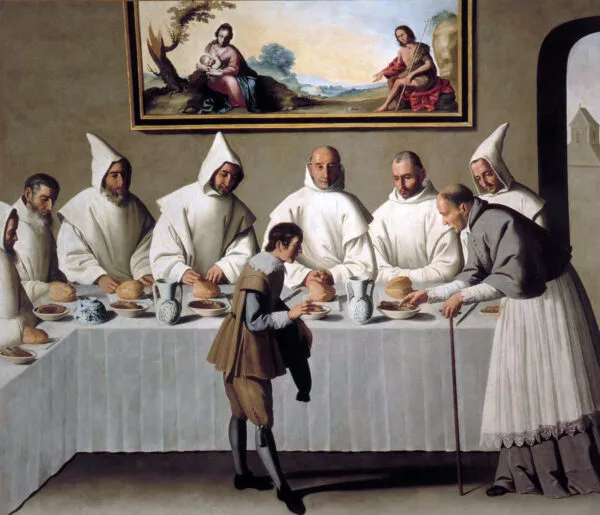
Saint Hugh in the Carthusian Refectory
Francisco de Zurbarán
1655 · painting date
Museo de Bellas Artes de Sevilla

Saint Jerome Writing
Caravaggio
1607–1608 · painting date
Heritage Malta
03
Saints at work, at table and in the desert
Paintings of Anthony make spiritual struggle visible through imagery that is not eyewitness evidence of ancient events. Benedict and Jerome represent the authority of a rule or the labour of reading. Jerome should not be made synonymous with every monastic model; his life has its own trajectory.
Zurbarán makes the refectory a space linking narrative, community and everyday objects. Caravaggio gives Jerome’s concentration bodily presence. Together, these paintings show how later artists gave shape to memories of religious lives.
RESEARCH & FURTHER READING
Sources for this chapter
Museum links accompanying the paintings lead to institutional collection information. Display, loans and access can change; consult the museum before visiting.