CHAPTER 16 / 20
Africa, Asia and ancient Christianities
Christian histories that do not everywhere begin with European missions.
Fourth century–early modern period · connected histories

The Baptism of the Eunuch
Rembrandt
1626 · painting date
01
Beyond an exclusively European history
Egypt, North Africa, Ethiopia, Syria and other Asian regions belong to Christianity’s early history. Aksum adopted Christianity in the fourth century, long before modern colonial empires. Coptic, Ethiopian, Syriac and Armenian traditions have their own languages, liturgies, memories and artistic expressions.
Relations with other societies included travel, trade, translation and debate. These traditions are not merely peripheral copies of the West. A travelling motif does not erase local invention, and religious communion does not impose one cultural organisation everywhere.
The Baptism of the Eunuch
Rembrandt
1626 · painting date
Museum Catharijneconvent, Utrecht
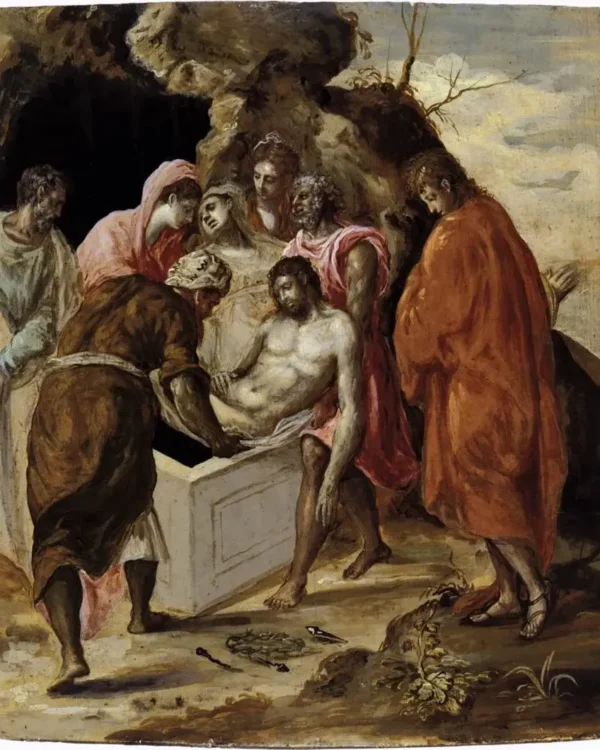
The Entombment of Christ
El Greco
1570 · painting date
National Gallery of Athens
02
Shared narratives and situated images
The Ethiopian baptism narrative in Acts has received varied interpretations. Rembrandt’s selected painting belongs to European reception: it does not reconstruct the historical establishment of Christianity in Ethiopia. Paul and Luke likewise evoke traditions of transmission without making their painters African artists.
El Greco’s works also suggest movement between Crete and Western artistic worlds. They do not replace study of African and Asian churches’ local production. Naming an image’s viewpoint prevents it from being confused with the culture it evokes.

St. Luke
El Greco
1608–1614 · painting date
Newfields — Indianapolis Museum of Art

Saint Paul
El Greco
1608–1614 · painting date
Museo del Prado
03
Look at local witnesses
Cleveland’s Ethiopian manuscript leaf portraying Saint Luke provides direct access to a work produced within that tradition. It is linked as a museum document, without inventing an unchecked sale page. The Met’s Africa & Byzantium exhibition resources extend the comparison.
These collections challenge histories in which Africa becomes visible only with European arrival. Distinctions between Eastern Orthodoxy, Oriental Orthodoxy and the Church of the East remain important. Relationships with Judaisms and Islams require attention to complex histories rather than a single permanent confrontation.
RESEARCH & FURTHER READING
Sources for this chapter
Museum links accompanying the paintings lead to institutional collection information. Display, loans and access can change; consult the museum before visiting.