CHAPTER 18 / 20
Enlightenment, revolutions and conscience
Criticising institutions, retaining faith or reconsidering it: images do not all lead to the same conclusion.
Eighteenth–nineteenth centuries · criticism and change
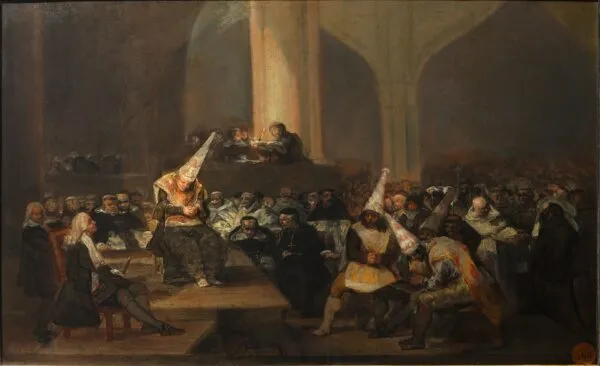
The Inquisition Tribunal
Francisco Goya
1812 · painting date
01
More than religion versus reason
The Enlightenment and political transformations opened debates about authority, knowledge, institutions and rights. Relationships with Christianity differed. Believers could criticise religious authorities; institutions could adapt or resist; religious lives could continue while changing.
The French Revolution and other changes of government altered relationships between churches, states and societies. Their histories include destruction, confiscation, conflict and new arrangements. Describing the period as religion’s complete disappearance would obscure its continuities.
The Inquisition Tribunal
Francisco Goya
1812 · painting date
Royal Academy of Fine Arts of San Fernando

A Procession of Flagellants
Francisco Goya
1814–1816 · painting date
Royal Academy of Fine Arts of San Fernando
02
Goya is not an administrative record
Goya’s Inquisition Tribunal and Procession of Flagellants give religious and social scenes a critical form. Bodies, groups and atmosphere shape the reading. These paintings cannot be treated without examination as documentary accounts of a particular trial.
Nikolai Ge’s Christ and Pilate places a question about truth within a visual confrontation. Bellini’s Saint Mark’s Square procession comes from a much earlier period: comparison reveals ways of making a community visible in public space, not contemporaneous events.
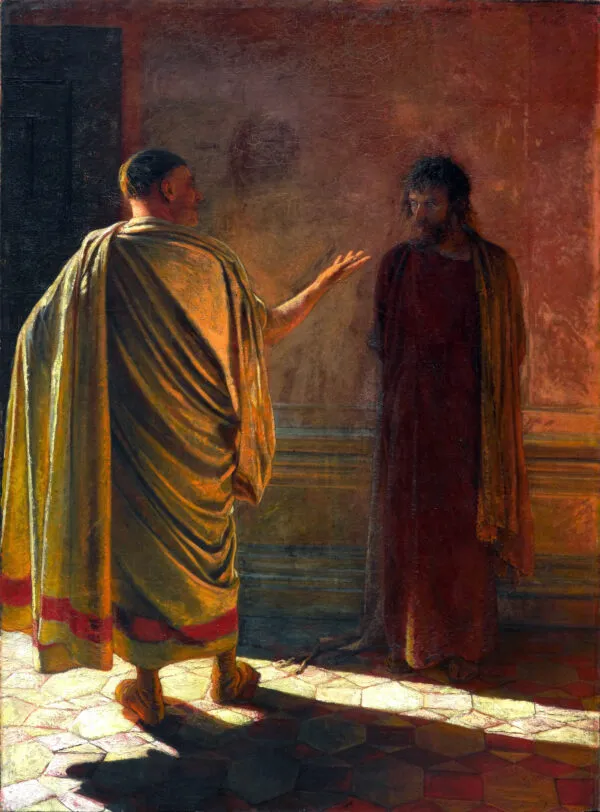
"What is truth?" Christ and Pilate
Nikolai Ge
1890 · painting date
Tretyakov Gallery
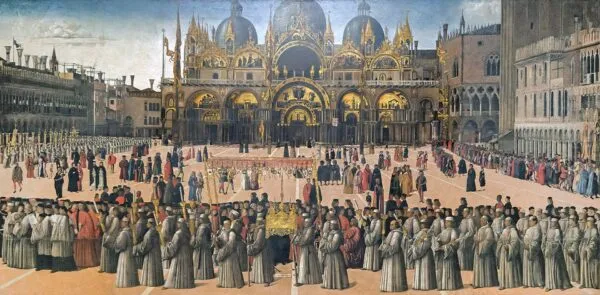
Procession in St. Mark's Square
Gentile Bellini
c. 1496 · painting date
Gallerie dell'Accademia
03
Conscience and its protections
Freedom of conscience, toleration and religious freedom do not have unchanging meanings throughout history. Texts and archives reveal rights, limits and minority experiences. A stated principle does not establish its actual application.
Christian positions also changed. The Catholic declaration Dignitatis humanae, adopted in 1965, is an important modern primary document on religious freedom. It is a dated position, not evidence that all earlier institutions held the same view.
RESEARCH & FURTHER READING
Sources for this chapter
Museum links accompanying the paintings lead to institutional collection information. Display, loans and access can change; consult the museum before visiting.