CHAPTER 08 / 20
Byzantium, icons and light
What an image may represent, what it may receive and why these questions generated lasting disputes.
Eighth–fifteenth centuries · images and Byzantium
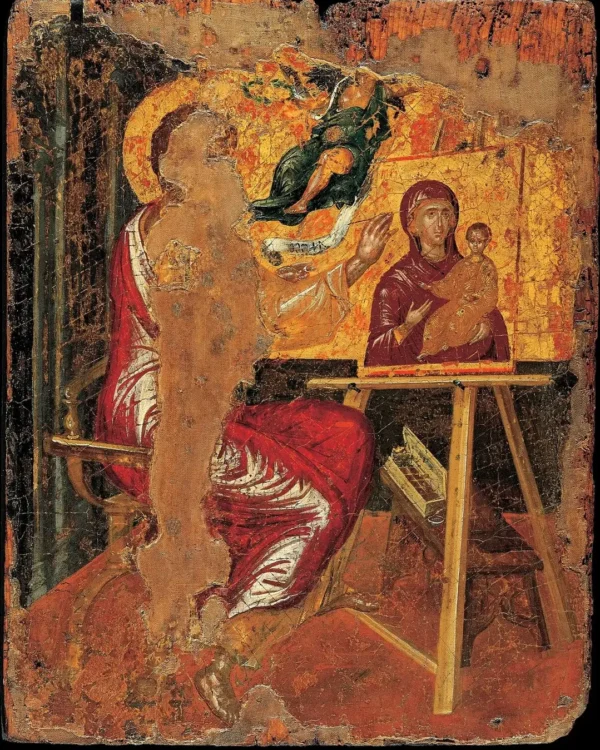
St Luke painting the Virgin
El Greco
1560–1567 · painting date
01
An empire that understood itself as Roman
Byzantium is historians’ name for an empire whose inhabitants considered themselves Romans. Constantinople was a major political and religious centre, but Byzantine life extended beyond its capital. Neighbouring societies, languages and routes contributed to the movement of objects and forms.
The iconoclastic disputes of the eighth and ninth centuries concerned religious images and their veneration, involving theology, authority and practice. They cannot be explained by one cause or reduced to the claim that one religion simply borrowed another’s prohibition.
St Luke painting the Virgin
El Greco
1560–1567 · painting date
Benaki Museum

Saint Luke Drawing the Virgin
Rogier van der Weyden
c. 1435–1440 · painting date
Museum of Fine Arts Boston
02
Veneration is not worship of material in this theology
Orthodox theology understands honour given to an icon as referring to the person represented. Wood and paint are not described as a deity. This is a specific confessional explanation: it helps readers understand believers’ actions without imposing that interpretation on every visitor.
The term icon does not designate every religious painting in every tradition. Icons may have liturgical, domestic or processional uses. Composition, inscriptions and a figure’s stance support recognition; aesthetic interpretation benefits from understanding these purposes rather than treating the icon as decoration alone.
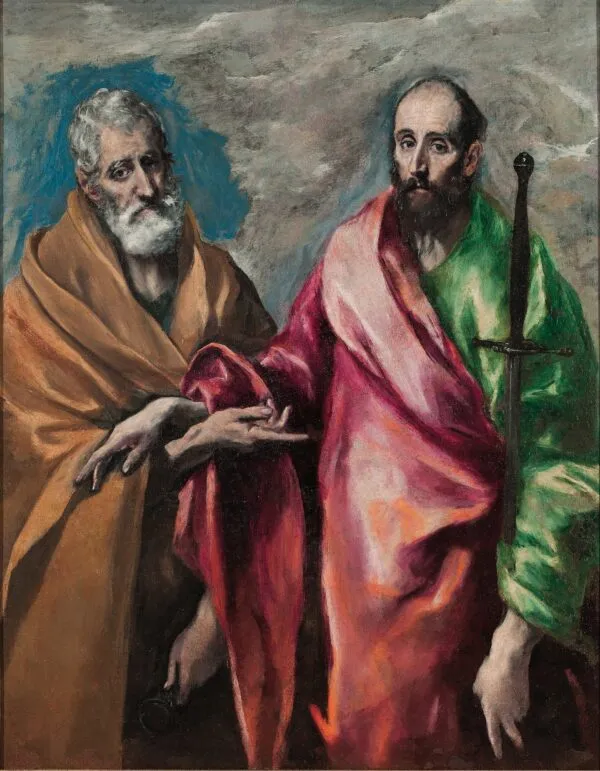
Saint Peter and Saint Paul
El Greco
1595 · painting date
Museu Nacional d'Art de Catalunya

Christ on the Cross
El Greco
1600 · painting date
Cleveland Museum of Art
03
El Greco and movement between worlds
El Greco offers a way to consider movement between Cretan training, Eastern traditions of imagery and Western painting. His Saint Luke Painting the Virgin prompts reflection on the religious legitimacy of images. It does not prove that the evangelist painted the work before us.
Comparison with Rogier van der Weyden and apostolic figures shows how subjects travel and change. Each selected work has its own date; none is described as an unchanged survival from antiquity. Museum entries also help distinguish prototypes, copies and interpretations.
RESEARCH & FURTHER READING
Sources for this chapter
Museum links accompanying the paintings lead to institutional collection information. Display, loans and access can change; consult the museum before visiting.