1844–today
The Bahá’í Faith
From nineteenth-century Iran to a worldwide community: revelation, exile, scripture, institutions and the art of Mishkín-Qalam, explored through thirty-seven distinct compositions.
14 chapters37 artworks
Begin the journey
Mishkín-Qalam (c. 1826–1912)
Golden Calligraphic Rooster on Blue — Mishkín-Qalam, Archive 40
19th–early 20th century; before 1912 · Historical work reproduced in the Society for Persian Letters and Arts archive
Discover the reproduction ↗The Bahá’í faith emerged from nineteenth-century Iran and understands itself as an independent world religion. Its history includes the Bábí movement, the exiles of Bahá’u’lláh, a distinctive succession of authority and the growth of communities across the world. This journey uses historical calligraphy rather than invented scenes or commercial portraits of the founders. Mishkín-Qalam’s works reveal the power of writing as image, while their original inscriptions are distinguished from modern descriptive titles.
19th-century Iran
An Iranian beginning in a changing world
Qajar Iran contained religious learning, mercantile networks, court patronage and vigorous debate about authority. Shi‘i expectations concerning the return of the hidden Imam formed part of the setting in which the Bábí movement emerged. That context matters without making the later Bahá’í faith simply another name for Shi‘i Islam.
Persian and Arabic calligraphy already had long histories. Mishkín-Qalam inherited technical skills, scripts and ornamental possibilities that were not created from nothing by a new religion. His later work shows how a developing community could use an existing art to express new religious attachments. The date of an individual undated composition is not supplied merely from the date of a historical event discussed beside it.

Mishkín-Qalam (c. 1826–1912)
Broad Black Strokes on Marbled Paper — Mishkín-Qalam, Archive 01
19th–early 20th century; before 1912 · Historical work reproduced in the Society for Persian Letters and Arts archive
Discover the reproduction ↗
Mishkín-Qalam (c. 1826–1912)
Sweeping Diagonals on a Floral Ground — Mishkín-Qalam, Archive 02
19th–early 20th century; before 1912 · Historical work reproduced in the Society for Persian Letters and Arts archive
Discover the reproduction ↗
Mishkín-Qalam (c. 1826–1912)
Vertical Black Calligraphic Composition — Mishkín-Qalam, Archive 27
19th–early 20th century; before 1912 · Historical work reproduced in the Society for Persian Letters and Arts archive
Discover the reproduction ↗1844–1850
The Báb and the opening of a movement
In 1844, Siyyid ‘Ali-Muhammad of Shiraz announced a religious mission and became known as the Báb, meaning the Gate. Followers understood his writings and claims as a transformation of inherited expectations. The movement attracted committed supporters and encountered fierce opposition. His execution in Tabriz in 1850 became a foundational event in Bábí and later Bahá’í remembrance.
The meaning of revelation belongs here to the believers’ understanding; the historian can describe the texts, claims, relationships and consequences without declaring a theological verdict. The calligraphic leaves accompany that history through the culture of sacred writing. They do not portray the declaration of 1844 or the execution of 1850.

Mishkín-Qalam (c. 1826–1912)
Illuminated Vertical Calligraphic Leaf — Mishkín-Qalam, Archive 03
19th–early 20th century; before 1912 · Historical work reproduced in the Society for Persian Letters and Arts archive
Discover the reproduction ↗
Mishkín-Qalam (c. 1826–1912)
Red-ruled Calligraphic Leaf — Mishkín-Qalam, Archive 22
19th–early 20th century; before 1912 · Historical work reproduced in the Society for Persian Letters and Arts archive
Discover the reproduction ↗
Mishkín-Qalam (c. 1826–1912)
Golden-toned Manuscript Leaf — Mishkín-Qalam, Archive 23
19th–early 20th century; before 1912 · Historical work reproduced in the Society for Persian Letters and Arts archive
Discover the reproduction ↗1850s
Persecution, expectation and different paths
The Báb’s death did not produce one immediate and uncontested succession. Communities faced repression, dispersed networks and different interpretations of the promised future figure. Many eventually recognized Bahá’u’lláh, while others did not. Bábí and Bahá’í should therefore not be used as interchangeable labels for every person in the earlier movement.
Later community narratives organize this period around revelation and perseverance; historians also examine communication, texts and conflict. Holding those perspectives apart allows them to be understood rather than confused. The juxtaposed calligraphies show different arrangements of writing, not portraits of the movement’s different groups. A visual resemblance is not sufficient evidence to identify an inscription’s precise text.

Mishkín-Qalam (c. 1826–1912)
Calligraphy within Blue Floral Borders — Mishkín-Qalam, Archive 04
19th–early 20th century; before 1912 · Historical work reproduced in the Society for Persian Letters and Arts archive
Discover the reproduction ↗
Mishkín-Qalam (c. 1826–1912)
Banded Calligraphy with a Pink Border — Mishkín-Qalam, Archive 05
19th–early 20th century; before 1912 · Historical work reproduced in the Society for Persian Letters and Arts archive
Discover the reproduction ↗1852–1863
Bahá’u’lláh: imprisonment and Baghdad
Mirza Husayn-‘Ali, known as Bahá’u’lláh, was imprisoned in Tehran in 1852 and subsequently exiled to Baghdad. Bahá’í accounts understand the imprisonment as a decisive moment in his awareness of a divine mission. The historical account distinguishes that religious interpretation from the observable itinerary of imprisonment and exile.
The Baghdad years were important for writings and relationships within the displaced community. Texts associated with this period, including the Hidden Words, connect spiritual instruction with a concentrated literary form. Mishkín-Qalam’s copying and artistic treatment of writing belong to the larger history of how texts became available, cherished and visually present. Individual archival plates are not automatically identified as pages from one particular book.

Mishkín-Qalam (c. 1826–1912)
Diagonal Lines on a Tall Marbled Leaf — Mishkín-Qalam, Archive 07
19th–early 20th century; before 1912 · Historical work reproduced in the Society for Persian Letters and Arts archive
Discover the reproduction ↗
Mishkín-Qalam (c. 1826–1912)
Sloping Script with Coloured Marbling — Mishkín-Qalam, Archive 08
19th–early 20th century; before 1912 · Historical work reproduced in the Society for Persian Letters and Arts archive
Discover the reproduction ↗
Mishkín-Qalam (c. 1826–1912)
Red and Black Calligraphy on Marbled Paper — Mishkín-Qalam, Archive 36
19th–early 20th century; before 1912 · Historical work reproduced in the Society for Persian Letters and Arts archive
Discover the reproduction ↗1863–1868
Ridván, Edirne and the road to Acre
Bahá’u’lláh’s declaration in the garden of Ridván in 1863 occupies a central place in Bahá’í sacred history. Further banishments took him through Constantinople and Adrianople, now Istanbul and Edirne, before confinement at Acre in 1868. These moves connected the new religion’s development with the politics and geography of the Ottoman world.
Exile also affected followers, households and the circulation of letters. Mishkín-Qalam’s own journey did not exactly duplicate the founder’s: he was sent to Cyprus. A single romantic story of an artist following freely from place to place would conceal confinement and separation. The compositions displayed here are the artist’s historical works, not illustrated maps or eyewitness scenes of each stage.

Mishkín-Qalam (c. 1826–1912)
Long Horizontal Stroke on a Pale Ground — Mishkín-Qalam, Archive 28
19th–early 20th century; before 1912 · Historical work reproduced in the Society for Persian Letters and Arts archive
Discover the reproduction ↗
Mishkín-Qalam (c. 1826–1912)
Calligraphy on Rose-coloured Paper — Mishkín-Qalam, Archive 29
19th–early 20th century; before 1912 · Historical work reproduced in the Society for Persian Letters and Arts archive
Discover the reproduction ↗
Mishkín-Qalam (c. 1826–1912)
Calligraphy with a Rounded Lower Curve — Mishkín-Qalam, Archive 30
19th–early 20th century; before 1912 · Historical work reproduced in the Society for Persian Letters and Arts archive
Discover the reproduction ↗c. 1826–1912
Mishkín-Qalam: the artist and the believer
Mishkín-Qalam, the Musk-scented Pen, was an accomplished Persian calligrapher whose religious commitment shaped his later life. He knew courtly artistic environments and became associated with Bahá’u’lláh and the copying of Bahá’í writings. Exile in Famagusta and later work in Acre and India belong to a life of both artistic skill and community service.
The archive preserves many compositions rather than one repeated emblem. Here coloured, architectural and interlaced forms reveal a range of invention. The modern descriptive titles identify what can be seen; they do not pretend to translate unread inscriptions. Nor does the artist’s Bahá’í identity prove that every work he ever produced contained an exclusively Bahá’í text.

Mishkín-Qalam (c. 1826–1912)
Layered Black Calligraphy on Pink and Blue — Mishkín-Qalam, Archive 09
19th–early 20th century; before 1912 · Historical work reproduced in the Society for Persian Letters and Arts archive
Discover the reproduction ↗
Mishkín-Qalam (c. 1826–1912)
Architectural Calligraphy on a Golden Ground — Mishkín-Qalam, Archive 15
19th–early 20th century; before 1912 · Historical work reproduced in the Society for Persian Letters and Arts archive
Discover the reproduction ↗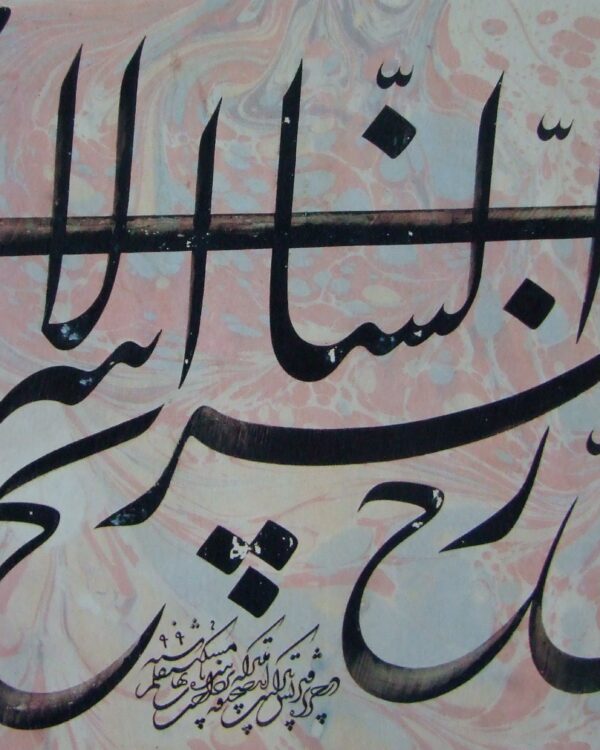
Mishkín-Qalam (c. 1826–1912)
Interlaced Diagonal Calligraphy — Mishkín-Qalam, Archive 16
19th–early 20th century; before 1912 · Historical work reproduced in the Society for Persian Letters and Arts archive
Discover the reproduction ↗
Mishkín-Qalam (c. 1826–1912)
Tall Letterforms above Fine Script — Mishkín-Qalam, Archive 31
19th–early 20th century; before 1912 · Historical work reproduced in the Society for Persian Letters and Arts archive
Discover the reproduction ↗Art and interpretation
When writing becomes a bird
In figural calligraphy the letters do more than fill a surface: they help build a body, wing, branch or ornamental silhouette. Mishkín-Qalam’s birds belong to an established world of Persian and wider Islamic calligraphic invention, transformed by his own work. They should not be mistaken for natural-history illustrations.
Scholarship associates his rooster with dawn and light, including religious associations that predate the Bahá’í movement. The golden rooster on blue, paired birds and the bird among branches are different compositions. Crops of a single bird from a larger original have not been counted as additional independent artworks. Their lettering deserves study in its original language, rather than a guessed translation supplied to make a product title more dramatic.

Mishkín-Qalam (c. 1826–1912)
Two Calligraphic Birds above an Open Book — Mishkín-Qalam, Archive 06
19th–early 20th century; before 1912 · Historical work reproduced in the Society for Persian Letters and Arts archive
Discover the reproduction ↗
Mishkín-Qalam (c. 1826–1912)
Facing Calligraphic Birds and a Central Tree — Mishkín-Qalam, Archive 10
19th–early 20th century; before 1912 · Historical work reproduced in the Society for Persian Letters and Arts archive
Discover the reproduction ↗
Mishkín-Qalam (c. 1826–1912)
Calligraphic Bird among Branches — Mishkín-Qalam, Archive 21
19th–early 20th century; before 1912 · Historical work reproduced in the Society for Persian Letters and Arts archive
Discover the reproduction ↗Mishkín-Qalam (c. 1826–1912)
Golden Calligraphic Rooster on Blue — Mishkín-Qalam, Archive 40
19th–early 20th century; before 1912 · Historical work reproduced in the Society for Persian Letters and Arts archive
Discover the reproduction ↗Devotion and visual form
The Greatest Name and the limits of identification
The invocation Ya Baha’u’l-Abha, often rendered as an address to the Glory of the All-Glorious, has a particular place in Bahá’í devotion. Mishkín-Qalam is closely associated with the familiar calligraphic form of the Greatest Name. That association does not authorize the labelling of every ornamental composition as the same invocation.
Symmetry, long horizontal bars and repeated vertical stems give writing a spatial presence. Some forms recall gates, screens or architectural elevations. The archive numbers preserve the identity of each image when a precise textual reading has not been established. This distinction lets viewers appreciate the art without receiving an invented religious interpretation or a claim that every similar-looking word has the same meaning.

Mishkín-Qalam (c. 1826–1912)
Symmetrical Calligraphic Emblem I — Mishkín-Qalam, Archive 19
19th–early 20th century; before 1912 · Historical work reproduced in the Society for Persian Letters and Arts archive
Discover the reproduction ↗
Mishkín-Qalam (c. 1826–1912)
Symmetrical Calligraphic Emblem II — Mishkín-Qalam, Archive 20
19th–early 20th century; before 1912 · Historical work reproduced in the Society for Persian Letters and Arts archive
Discover the reproduction ↗
Mishkín-Qalam (c. 1826–1912)
Parallel Stems and Layered Curves — Mishkín-Qalam, Archive 32
19th–early 20th century; before 1912 · Historical work reproduced in the Society for Persian Letters and Arts archive
Discover the reproduction ↗
Mishkín-Qalam (c. 1826–1912)
Interwoven Letterforms on a Marbled Field — Mishkín-Qalam, Archive 33
19th–early 20th century; before 1912 · Historical work reproduced in the Society for Persian Letters and Arts archive
Discover the reproduction ↗Beliefs
Unity and progressive revelation
Bahá’í teaching understands the major religious messengers through progressive revelation: divine guidance is renewed in relation to humanity’s development. This is the faith’s own theological account, not a neutral definition that other religions must accept. Jewish, Christian, Muslim and other traditions have their own understandings of revelation and authority.
The oneness of humanity and the rejection of prejudice connect spiritual conviction with social aims. Unity is not simply visual sameness. The different calligraphic arrangements provide an artistic analogy for diversity, but the analogy is ours as viewers, not a proven translation of the inscriptions. Neither an attractive pattern nor a curatorial caption can replace the texts through which believers explain their convictions.

Mishkín-Qalam (c. 1826–1912)
Illuminated Calligraphy in Two Registers — Mishkín-Qalam, Archive 11
19th–early 20th century; before 1912 · Historical work reproduced in the Society for Persian Letters and Arts archive
Discover the reproduction ↗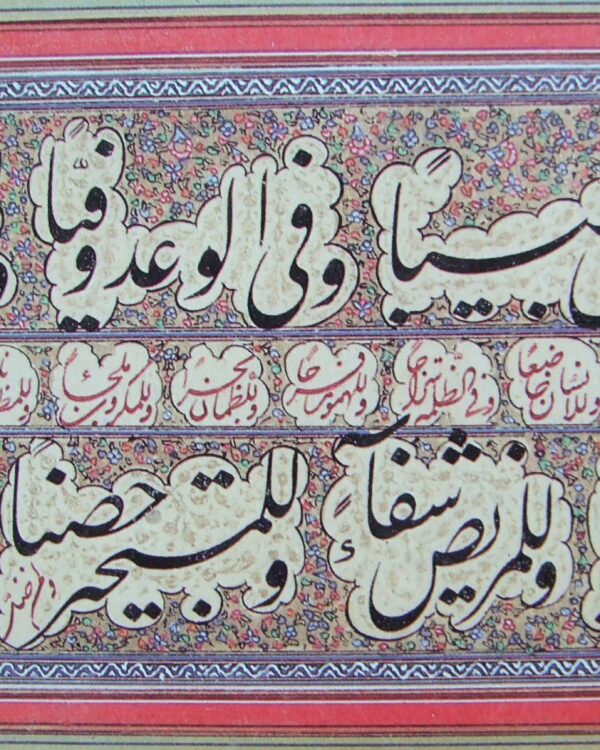
Mishkín-Qalam (c. 1826–1912)
Two Lines of Calligraphy with Red Accents — Mishkín-Qalam, Archive 12
19th–early 20th century; before 1912 · Historical work reproduced in the Society for Persian Letters and Arts archive
Discover the reproduction ↗
Mishkín-Qalam (c. 1826–1912)
Calligraphy with Gold-toned Floral Ornament — Mishkín-Qalam, Archive 13
19th–early 20th century; before 1912 · Historical work reproduced in the Society for Persian Letters and Arts archive
Discover the reproduction ↗Scripture and practice
Prayer, education, justice and service
The Bahá’í writings address prayer, spiritual qualities, justice, education and relations between persons and society. Believers connect worship with service, rather than treating devotion only as an inward feeling. Claims about the harmony of science and religion or the equality of women and men also generate questions about interpretation and lived institutional practice.
Calligraphy makes the material life of writing visible: copying, arranging, preserving and circulating a text are forms of skilled work. The historical leaf and its ornament remain distinct from the canvas or printed reproduction offered today. The original’s paper, ink or gilding is not silently promised as a material of the new object. The archive links support study of the source alongside appreciation of its composition.

Mishkín-Qalam (c. 1826–1912)
Calligraphy with a Red Outer Border — Mishkín-Qalam, Archive 14
19th–early 20th century; before 1912 · Historical work reproduced in the Society for Persian Letters and Arts archive
Discover the reproduction ↗
Mishkín-Qalam (c. 1826–1912)
Black Calligraphy with Long Upper Bar — Mishkín-Qalam, Archive 34
19th–early 20th century; before 1912 · Historical work reproduced in the Society for Persian Letters and Arts archive
Discover the reproduction ↗
Mishkín-Qalam (c. 1826–1912)
Dense Calligraphic Lattice — Mishkín-Qalam, Archive 35
19th–early 20th century; before 1912 · Historical work reproduced in the Society for Persian Letters and Arts archive
Discover the reproduction ↗1892–1921
‘Abdu’l-Bahá and the Covenant
After Bahá’u’lláh’s death in 1892, his son ‘Abdu’l-Bahá became the appointed leader and authorized interpreter of the teachings. The Covenant has a central role in Bahá’í accounts of continuity and authority. Describing its intended protection of unity does not require pretending that no disputes or dissent ever occurred.
‘Abdu’l-Bahá’s travels in Europe and North America in 1911–1913 broadened public contact with the religion. Mishkín-Qalam lived until 1912 and continued work associated with the community. The older compositions shown here accompany this period through artistic continuity. They are not depictions of those Western journeys or portraits of their audiences, and their exact dates are not invented to make them fit the chronology.

Mishkín-Qalam (c. 1826–1912)
Alternating Red and Black Inscriptions — Mishkín-Qalam, Archive 37
19th–early 20th century; before 1912 · Historical work reproduced in the Society for Persian Letters and Arts archive
Discover the reproduction ↗
Mishkín-Qalam (c. 1826–1912)
Flowing Script with Red Interlinear Writing — Mishkín-Qalam, Archive 38
19th–early 20th century; before 1912 · Historical work reproduced in the Society for Persian Letters and Arts archive
Discover the reproduction ↗
Mishkín-Qalam (c. 1826–1912)
Three Registers of Red and Black Calligraphy — Mishkín-Qalam, Archive 39
19th–early 20th century; before 1912 · Historical work reproduced in the Society for Persian Letters and Arts archive
Discover the reproduction ↗1921–1957
Shoghi Effendi and the growth of institutions
Shoghi Effendi served as Guardian after ‘Abdu’l-Bahá’s death. His work included interpretation, translation, correspondence and the development of a worldwide administrative order. Local and national spiritual assemblies became important institutions. The absence of an ordained clergy does not mean the absence of organization or binding authority.
Historical calligraphy continued to circulate as a shared visual inheritance after its maker’s death. The architectural composition shown here predates this later institutional period; it is not an image of an assembly meeting. The connection is one of memory and material transmission. An inherited work can acquire new audiences without changing its original date or becoming evidence of events it never depicted.
Mishkín-Qalam (c. 1826–1912)
Architectural Calligraphy on a Golden Ground — Mishkín-Qalam, Archive 15
19th–early 20th century; before 1912 · Historical work reproduced in the Society for Persian Letters and Arts archive
Discover the reproduction ↗
Mishkín-Qalam (c. 1826–1912)
Diamond-grid Calligraphic Composition — Mishkín-Qalam, Archive 70
19th–early 20th century; before 1912 · Historical work reproduced in the Society for Persian Letters and Arts archive
Discover the reproduction ↗1963 onward
The Universal House of Justice
The first election of the Universal House of Justice took place in 1963. Bahá’ís understand it as part of the institutional order set out in their sacred writings. Its authority differs from the interpretive functions held by ‘Abdu’l-Bahá and Shoghi Effendi. Distinguishing these roles is more informative than treating every stage as the same kind of leadership.
The institution’s history belongs to the twentieth century, after Mishkín-Qalam. His symmetrical emblems and geometric writing therefore appear here as an earlier artistic inheritance, not contemporary documentary illustrations. A long religious history can be accompanied by older art without falsely moving that art into a later date. The source record keeps the distinction available to every visitor.
Mishkín-Qalam (c. 1826–1912)
Symmetrical Calligraphic Emblem I — Mishkín-Qalam, Archive 19
19th–early 20th century; before 1912 · Historical work reproduced in the Society for Persian Letters and Arts archive
Discover the reproduction ↗Mishkín-Qalam (c. 1826–1912)
Symmetrical Calligraphic Emblem II — Mishkín-Qalam, Archive 20
19th–early 20th century; before 1912 · Historical work reproduced in the Society for Persian Letters and Arts archive
Discover the reproduction ↗
Mishkín-Qalam (c. 1826–1912)
Tree-shaped Calligraphic Composition — Mishkín-Qalam, Archive 85
19th–early 20th century; before 1912 · Historical work reproduced in the Society for Persian Letters and Arts archive
Discover the reproduction ↗Today
A worldwide community and the work of remembrance
Bahá’í communities now sustain devotional gatherings, education and social initiatives in many countries. Their circumstances differ, including experiences of severe persecution in Iran. Community accounts and independent documentation have different roles in describing those conditions; a decorative artwork cannot serve as evidence for a current political event.
The journey ends with the historical art rather than an assertion that the history is finished. Thirty-seven distinct compositions open many ways to look at line, colour and writing. Repeated photographs and isolated crops have not been counted as new originals. Each image leads to its reproduction page, while a separate archive link preserves the route back to the documented source. Understanding the religion and appreciating its artistic inheritance remain related, distinct activities.
Mishkín-Qalam (c. 1826–1912)
Golden Calligraphic Rooster on Blue — Mishkín-Qalam, Archive 40
19th–early 20th century; before 1912 · Historical work reproduced in the Society for Persian Letters and Arts archive
Discover the reproduction ↗Mishkín-Qalam (c. 1826–1912)
Broad Black Strokes on Marbled Paper — Mishkín-Qalam, Archive 01
19th–early 20th century; before 1912 · Historical work reproduced in the Society for Persian Letters and Arts archive
Discover the reproduction ↗Mishkín-Qalam (c. 1826–1912)
Sweeping Diagonals on a Floral Ground — Mishkín-Qalam, Archive 02
19th–early 20th century; before 1912 · Historical work reproduced in the Society for Persian Letters and Arts archive
Discover the reproduction ↗Mishkín-Qalam (c. 1826–1912)
Tree-shaped Calligraphic Composition — Mishkín-Qalam, Archive 85
19th–early 20th century; before 1912 · Historical work reproduced in the Society for Persian Letters and Arts archive
Discover the reproduction ↗Keep exploring