The Painter
Taras Shevchenko
1814–1861 · Russian · Romanticism
Ukrainian serf-born painter trained under Briullov: portraits, etchings of Ukrainian monuments, and watercolours of the Aral Sea shore made in exile.
Taras Shevchenko was born on 9 March 1814 in Moryntsi, in the Kyiv Governorate, into a family of serfs, and lost both parents while still a boy. In 1828 he became a household servant of his owner, Pavel Engelhardt, who took him to Vilnius and then to Saint Petersburg, where he trained for about four years with the painter Vasily Shiriaev. Through the Ukrainian student Ivan Soshenko he met Alexey Venetsianov and Karl Briullov. A portrait of the poet Vasily Zhukovsky, painted by Briullov and raffled for the imperial family, raised the 2,500 roubles that bought his freedom on 5 May 1838. He then entered the Imperial Academy of Arts as Briullov's pupil and graduated in 1845. Arrested in April 1847 for belonging to the Brotherhood of Saints Cyril and Methodius, he spent ten years in military exile, was released in 1857, and died in Saint Petersburg on 10 March 1861 (26 February, Old Style).
Today Shevchenko is known first as Ukraine's national poet, but he was also a trained academic artist who made portraits, genre and historical scenes, landscapes and architectural views in oil, watercolour, sepia, pencil and etching. About 835 of his works survive and about 270 are lost. His oil Katerina (1842, National Shevchenko Museum, Kyiv) illustrates his own poem: a young woman abandoned by a Russian officer walks home along a dusty road. In 1844 he planned Picturesque Ukraine, an album of etchings of Ukrainian historic sites, of which only six plates were printed. Though Nicholas I forbade him to write or paint in exile, he kept drawing in secret, joined the Aral Sea expedition of 1848-49 as its artist, and made more than a hundred watercolours and drawings at Novopetrovsk. After his return he drew the actor in Portrait of Ira Aldridge (1858).
On 2 September 1860 the Imperial Academy of Arts named Shevchenko an academician for his etching, a recognition that came only months before his death. His grave on the hill near Kaniv became a place of pilgrimage, and his surviving pictures are gathered above all in the National Shevchenko Museum in Kyiv, founded in 1949; Oleksii Novytsky published the first major study of his art in 1914. No pupils are documented, though he gave drawing lessons to the children of friends in his last years. His work offers a painter in oils a restrained academic palette, soft modelling of faces and long, low horizons of road, grass and sky that are best built in thin, patient layers.
Reproducing this painter
Romantic painting was made fast and in high contrast, against an academy that wanted drawing and restraint. The loose handling is the argument, so tidying it into a careful finish is the surest way to kill the picture.
Biographical details on Wikipedia.
Works by Taras Shevchenko we reproduce
-

Mother's Head
Taras Shevchenkofrom €85,00 – €719,00 -

Corner of Smolensk cemetery in St. Petersburg
Taras Shevchenkofrom €101,00 – €851,00 -

At apiary
Taras Shevchenkofrom €101,00 – €838,00 -

Portrait of P.V. Engelhardt
Taras Shevchenkofrom €94,00 – €775,00 -

Portrait of Nikolai Alexandrovich Lunin
Taras Shevchenkofrom €101,00 – €838,00 -

Portrait of an unknown with necklace
Taras Shevchenkofrom €96,00 – €806,00 -
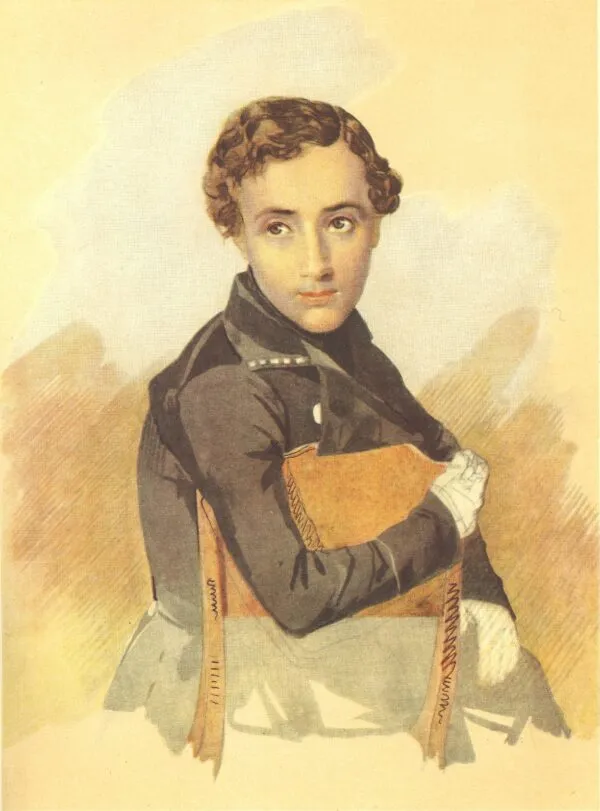
Portrait of an unknown
Taras Shevchenkofrom €103,00 – €851,00 -

Pochayiv Lavra from south
Taras Shevchenkofrom €101,00 – €845,00 -

Bohdan Khmelnytsky's Church in Subotiv
Taras Shevchenkofrom €116,00 – €971,00 -

Gate house, monastery, Nikolai
Taras Shevchenkofrom €114,00 – €958,00 -

In Dustin Traditional church
Taras Shevchenkofrom €119,00 – €983,00 -

In Hustyn: Church of Peter and Paul
Taras Shevchenkofrom €114,00 – €952,00
Paintings by Taras Shevchenko available to order
Any of these can be painted for you by hand. Tell us which one and the size you want, and we will send a quote within 48 hours.
- Self-portrait of Shevchenko (winter 1840/1841)
- Kateryna
- Self-Portrait
- Self-portrait
- Mother's Head
- Q12099559
- Corner of Smolensk cemetery in St. Petersburg
- Q12154530