The Painter
Peter Paul Rubens
1577–1640 · Flemish · Flemish Baroque painting, Baroque
Flemish Baroque painter of Antwerp altarpieces, the Marie de' Medici cycle for Paris, mythologies and portraits, with a large workshop behind him.
Peter Paul Rubens was born on 28 June 1577, most probably in Siegen in Westphalia, to the Antwerp lawyer Jan Rubens and Maria Pypelinckx, whose family had left Antwerp for Cologne for religious reasons; he was baptised in Cologne. After his father's death the family returned to Antwerp, around 1589, and the boy received a humanist education before training under the landscape painter Tobias Verhaecht, then Adam van Noort and Otto van Veen. He became a master of the Antwerp Guild of St Luke in 1598. In 1600 he left for Italy, where until 1608 he served Vincenzo I Gonzaga, Duke of Mantua, worked in Rome, Genoa and Venice, and travelled to Spain on a diplomatic mission in 1603. Recalled by his mother's last illness, he settled in Antwerp, became court painter to Archduke Albert and Infanta Isabella in 1609, and died there on 30 May 1640, worn down by gout.
Rubens combined the Venetian colour of Titian and the muscular energy of Michelangelo, both studied in Italy, with a Flemish feeling for flesh and surface. Back in Antwerp he painted Samson and Delilah (about 1609-10, National Gallery, London) for the mayor Nicolaas Rockox, using the strong contrasts of light and shadow he had seen in Caravaggio, and then The Elevation of the Cross (1610-11, Antwerp Cathedral), the altarpiece that made him the city's leading painter. Between 1622 and 1625 he painted in Antwerp the twenty-four canvases of the Marie de' Medici cycle for the Luxembourg Palace in Paris, now in the Louvre, and installed them himself. Married to Hélène Fourment in 1630, he painted her in several late pictures, and later mythologies such as The Judgement of Paris (about 1632-35, National Gallery, London) show the same ease with the nude.
Rubens ran one of the most productive workshops in Europe, with about twenty assistants and pupils identified. Anthony van Dyck worked with him around 1617-20, while Jacob Jordaens, Frans Snyders and Jan Brueghel the Elder collaborated on his pictures, and engravers such as Lucas Vorsterman and Paulus Pontius spread his compositions across Europe. Michel Jaffé's catalogue lists 1,403 works by his own hand. He was knighted by Charles I in 1630, after Philip IV of Spain had ennobled him in 1624. His example shaped Van Dyck, Watteau and Delacroix, and the later quarrel between the colourist Rubenists and the draughtsmen Poussinists took his name. For a painter in oils who reproduces him, this body of work offers warm, luminous flesh, saturated reds and golds, and a lively play of light against shadow.
Reproducing this painter
Baroque painting is built from the dark end forward: a deep ground, then the lit passages placed into it, then glazes to keep the shadows luminous rather than flat. Get the shadows wrong and the drama goes with them.
Biographical details on Wikipedia.
Works by Peter Paul Rubens we reproduce
-

The Elevation of the Cross
Peter Paul Rubensfrom €103,00 – €857,00 -

The Rape of the Daughters of Leucippus
Peter Paul Rubensfrom €80,00 – €668,00 -

The Descent from the Cross
Peter Paul Rubensfrom €91,00 – €750,00 -

Samson and Delilah
Peter Paul Rubensfrom €83,00 – €694,00 -

The Three Graces
Peter Paul Rubensfrom €94,00 – €769,00 -

Rubens and Isabella Brant in the honeysuckle bower
Peter Paul Rubensfrom €101,00 – €838,00 -

Romulus and Remus
Peter Paul Rubensfrom €76,00 – €630,00 -
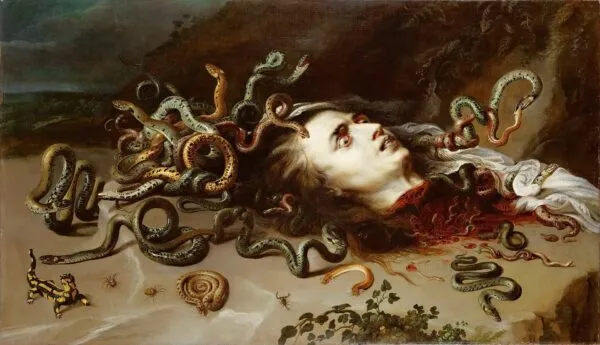
Head of Medusa
Peter Paul Rubensfrom €131,00 – €1 097,00 -

The Fall of Man
Peter Paul Rubensfrom €98,00 – €812,00 -

Helena Fourment in a Fur Robe
Peter Paul Rubensfrom €161,00 – €1 349,00 -

The Garden of Love
Peter Paul Rubensfrom €108,00 – €913,00 -

The Fall of the Damned
Peter Paul Rubensfrom €98,00 – €806,00
Paintings by Peter Paul Rubens available to order
Any of these can be painted for you by hand. Tell us which one and the size you want, and we will send a quote within 48 hours.
- The Elevation of the Cross
- The Rape of the Daughters of Leucippus
- The Descent from the Cross
- The Three Graces
- Samson and Delilah
- Rubens and Isabella Brant in the honeysuckle bower
- Romulus and Remus
- The Fall of Man