The Painter
Jean-Auguste-Dominique Ingres
1780–1867 · French · Romanticism, Neoclassicism
French neoclassical painter of nudes, odalisques and society portraits, defined by a pure, flowing outline and a smooth enamel-like finish.
Jean-Auguste-Dominique Ingres was born on 29 August 1780 in Montauban, the eldest child of Jean-Marie-Joseph Ingres, a painter, sculptor and decorative craftsman who taught him the basics and had him learn the violin. From 1791 he studied at the Academy of Toulouse, where Guillaume-Joseph Roques fired his admiration for Raphael. He moved to Paris around 1797 and joined the studio of Jacques-Louis David. In 1801 he won the Prix de Rome with The Ambassadors of Agamemnon in the Tent of Achilles, but political and financial troubles delayed his departure until October 1806. He stayed in Rome until 1820, living largely from portraits, then worked in Florence until 1824. Back in Paris he became a member of the Institut in 1825. He directed the French Academy in Rome from 1835 to 1841 and died in Paris on 14 January 1867, aged eighty-six.
Ingres built his art on line: a firm, supple contour, very smooth paint and a deliberate distortion of anatomy in the name of elegance. In Rome he painted The Valpinçon Bather (1808, Louvre, Paris), a nude seen from behind in a closed, softly lit interior, and La Grande Odalisque (1814, Louvre, Paris), whose elongated back and orientalist trappings later divided critics. The Vow of Louis XIII (1824, Montauban Cathedral), shown at the Salon that year, made him the leading voice of classicism against Delacroix and the Romantics. His portraits, from the early Roman sitters to Madame Moitessier (begun 1844 and completed 1856, National Gallery, London), join a precise likeness to a luxurious treatment of silk, jewels and flowered fabric.
Ingres trained a large following of pupils, among them Hippolyte Flandrin, Théodore Chassériau, Henri Lehmann and Amaury-Duval, and he insisted that drawing came before colour. Edgar Degas admired him and reached his example through Ingres's followers, while Picasso and Matisse acknowledged their debt in the twentieth century; The Turkish Bath (signed 1862, Louvre, Paris) is often linked to Picasso's Les Demoiselles d'Avignon. Montauban's Musée Ingres keeps much of the drawings he left to his native town. For a painter working in oils, his work offers a lesson in thin, even layers, cool pearly flesh tones set against saturated blues, reds and golds, and an almost invisible brushstroke over a precise underdrawing.
Reproducing this painter
Romantic painting was made fast and in high contrast, against an academy that wanted drawing and restraint. The loose handling is the argument, so tidying it into a careful finish is the surest way to kill the picture.
Biographical details on Wikipedia.
Works by Jean-Auguste-Dominique Ingres we reproduce
-

Grande Odalisque
Jean-Auguste-Dominique Ingresfrom €136,00 – €1 128,00 -

The Source
Jean-Auguste-Dominique Ingresfrom €151,00 – €1 260,00 -

The Valpinçon Bather
Jean-Auguste-Dominique Ingresfrom €114,00 – €938,00 -

Napoleon I on his Imperial Throne
Jean-Auguste-Dominique Ingresfrom €124,00 – €1 033,00 -

Madame Moitessier
Jean-Auguste-Dominique Ingresfrom €98,00 – €826,00 -
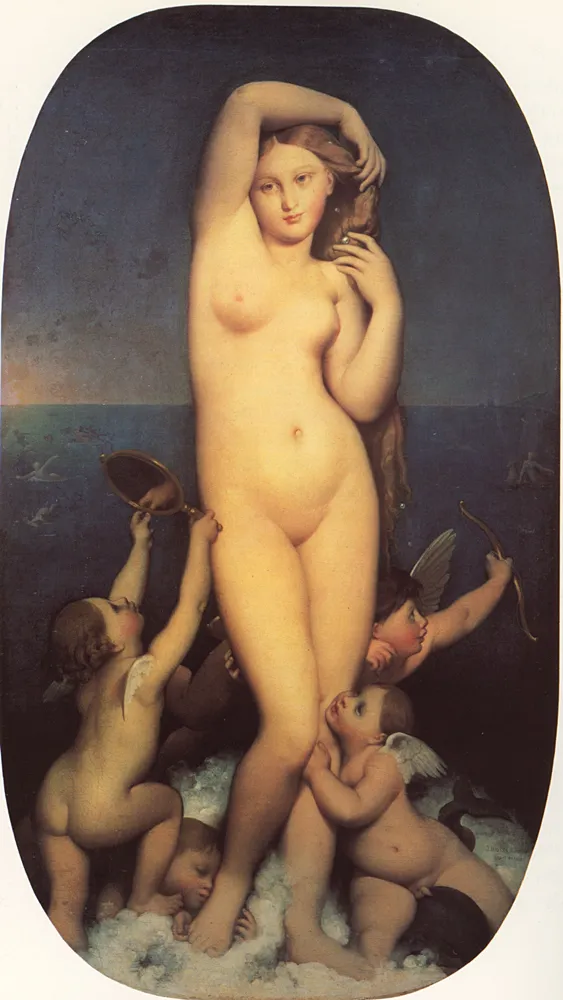
Vénus Anadyomène
Jean-Auguste-Dominique Ingresfrom €133,00 – €1 122,00 -

Portrait of Monsieur Bertin
Jean-Auguste-Dominique Ingresfrom €94,00 – €775,00 -
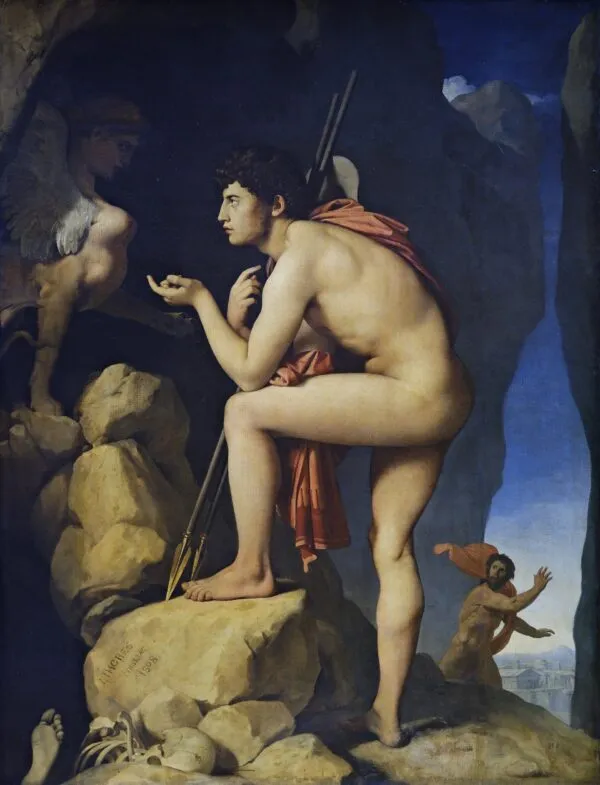
Oedipus and the Sphinx
Jean-Auguste-Dominique Ingresfrom €98,00 – €826,00 -

The Apotheosis of Homer
Jean-Auguste-Dominique Ingresfrom €101,00 – €845,00 -

Joséphine-Éléonore-Marie-Pauline de Galard de Brassac de Béarn (1825–1860), Princesse de Broglie
Jean-Auguste-Dominique Ingresfrom €101,00 – €838,00 -

Jupiter and Thetis
Jean-Auguste-Dominique Ingresfrom €94,00 – €787,00 -

The Ambassadors of Agamemnon in the tent of Achilles
Jean-Auguste-Dominique Ingresfrom €96,00 – €800,00
Paintings by Jean-Auguste-Dominique Ingres available to order
Any of these can be painted for you by hand. Tell us which one and the size you want, and we will send a quote within 48 hours.
- Grande Odalisque
- The Source
- The Turkish Bath
- The Valpinçon Bather
- Napoleon I on his Imperial Throne
- Madame Moitessier
- Vénus Anadyomène
- Portrait of Monsieur Bertin