The Painter
Jacques-Louis David
1748–1825 · French · Neoclassicism
Painter of the Oath of the Horatii, the Death of Marat and the Coronation of Napoleon, who gave the Revolution and the Empire their images.
Jacques-Louis David was born in Paris on 30 August 1748 into a Parisian family of modest means; his father died when he was about nine, and relatives from a family of builders and architects helped raise him. He trained under Joseph-Marie Vien, a painter who had moved away from the Rococo towards antique models. After several failed attempts he won the Prix de Rome in 1774 with Erasistratus Discovering the Cause of Antiochus's Disease, and in October 1775 he travelled to Italy with Vien, newly appointed director of the French Academy in Rome. He came back to Paris in July 1780 and joined the Academy in 1783. A supporter of the Revolution, he was elected to the National Convention in 1792, was imprisoned after Robespierre's fall, then became Napoleon's court painter. After the Restoration he went into exile in Brussels, where he died on 29 December 1825 after being struck by a carriage.
David broke with the Rococo of Boucher and the Van Loos and drew on Poussin, Raphael and the antique, which he studied in Rome and during a visit to Naples in 1779. The Oath of the Horatii (1784-85, Louvre, Paris), begun in Paris and finished in Rome, made him the head of the new classical school; its figures are drawn with straight, hard lines against a plain, shallow architectural background. The Death of Socrates (1787, Metropolitan Museum of Art, New York) followed for a private patron. Under the Revolution he painted The Death of Marat (1793, Royal Museums of Fine Arts of Belgium, Brussels), a bare, quiet image of a murdered politician lit like a martyr. Under the Empire his colour grew warmer and his scale larger in The Coronation of Napoleon (1805-07, Louvre), a canvas of more than six metres by nine, painted from a commission of September 1804.
David's studio, which counted about forty pupils at its height, trained Antoine-Jean Gros, François Gérard, Anne-Louis Girodet, Jean-Germain Drouais and Jean Auguste Dominique Ingres. In exile in Brussels he taught François-Joseph Navez and Ignace Brice, painted portraits of local sitters and, in 1822-24, his last large canvas, Mars Disarmed by Venus and the Three Graces. His influence on French academic painting reached well into the nineteenth century, and the largest collection of his paintings and drawings is in the Louvre. For a painter working in oils, these canvases offer a lesson in restraint: sober tonal contrasts in the Revolutionary years, flesh and drapery modelled with clear edges, and, under Napoleon, the warmer Venetian reds and golds of the Empire.
Reproducing this painter
Neoclassical painting hides its own making: the brushwork is polished away, the contour precise, the colour subordinate to the drawing. Any visible stroke reads as a mistake, which makes it unforgiving work.
Biographical details on Wikipedia.
Works by Jacques-Louis David we reproduce
-

The Death of Socrates
Jacques-Louis Davidfrom €114,00 – €952,00 -

The Oath of the Horatii
Jacques-Louis Davidfrom €98,00 – €812,00 -

The Death of Marat
Jacques-Louis Davidfrom €98,00 – €812,00 -

The Coronation of Napoleon
Jacques-Louis Davidfrom €121,00 – €1 014,00 -

The Intervention of the Sabine Women
Jacques-Louis Davidfrom €101,00 – €838,00 -

The Emperor Napoleon in His Study at the Tuileries
Jacques-Louis Davidfrom €124,00 – €1 033,00 -

Mars Being Disarmed by Venus
Jacques-Louis Davidfrom €91,00 – €750,00 -

Portrait of Madame Récamier
Jacques-Louis Davidfrom €106,00 – €882,00 -

The Lictors Bring to Brutus the Bodies of His Sons
Jacques-Louis Davidfrom €98,00 – €826,00 -

Erasistratus Discovering the Cause of Antiochus' Disease
Jacques-Louis Davidfrom €96,00 – €806,00 -

Leonidas at Thermopylae
Jacques-Louis Davidfrom €103,00 – €857,00 -
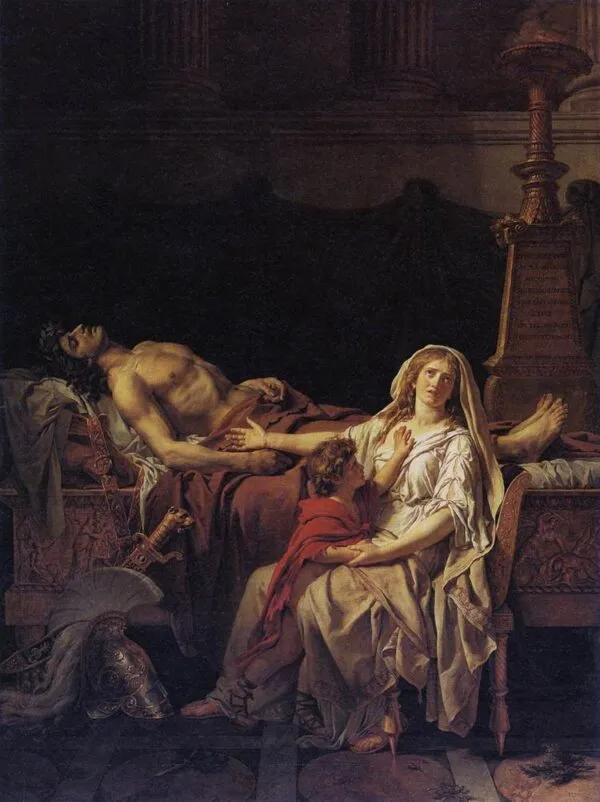
Andromache Mourning Hector
Jacques-Louis Davidfrom €101,00 – €845,00
Paintings by Jacques-Louis David available to order
Any of these can be painted for you by hand. Tell us which one and the size you want, and we will send a quote within 48 hours.
- The Death of Socrates
- The Oath of the Horatii
- The Death of Marat
- The Coronation of Napoleon
- The Intervention of the Sabine Women
- The Emperor Napoleon in His Study at the Tuileries
- Mars Being Disarmed by Venus
- Portrait of Madame Récamier