The Painter
J. M. W. Turner
1775–1851 · British · English painting, Romanticism
English painter of Thames shipping, Alpine and Venetian light, storms at sea and steam trains, who left his pictures to the nation.
Joseph Mallord William Turner was born, probably on 23 April 1775, in Maiden Lane, Covent Garden, London, the son of William Turner, a barber and wig-maker, and Mary Marshall, who died in Bethlem Hospital in 1804. As a boy he worked as a draughtsman for the architect Thomas Hardwick and studied perspective and topography with Thomas Malton, whom he later called his real master. He entered the Royal Academy Schools on 11 December 1789, aged fourteen, showed watercolours at the Academy from 1790 and his first oil in 1796, and by 1794 was copying drawings at Dr Thomas Monro's evening academy beside his friend Thomas Girtin. He became an Associate of the Royal Academy in 1799, an Academician in 1802 and Professor of Perspective in 1807, travelled to the Alps in 1802 and to Italy in 1819, and died in Chelsea, London, on 19 December 1851. He was buried in the crypt of St Paul's Cathedral.
Turner started in the topographical tradition of the eighteenth century, then learned from Dutch marine painters such as Willem van de Velde and from Claude and Richard Wilson. Fishermen at Sea (1796, Tate Britain) was his first oil exhibited at the Academy. Dido Building Carthage (1815, National Gallery, London) answers Claude's classical harbours with his own architecture, haze and sun. In The Fighting Temeraire (exhibited 1839, National Gallery), the old warship's last tow to the breakers, in 1838, passes under a sky built from thin glazes and scumbled clouds. Rain, Steam and Speed (1844, National Gallery) shows a train crossing the Maidenhead Railway Bridge, its forms barely recognisable as rain, steam and light dissolve the scene. Across these decades his handling grew looser and his colour more intense, until light, not drawing, held the picture together.
Turner left no formal school, but others carried his reputation. John Ruskin, who defended him in print at seventeen and met him in 1840, published the first volume of Modern Painters in 1843, and Claude Monet and Camille Pissarro, who studied his pictures in London in 1870, took lessons from his colour and light. His will of 1829 provided for a chair and a gold medal for landscape painting at the Academy and asked that two pictures, including Dido Building Carthage, hang beside Claude at the National Gallery. After his death the nation accepted the Turner Bequest in 1856, about a hundred finished oils and nearly 19,000 drawings and sketches, now largely at Tate Britain. For a painter in oils, this work offers a lesson in thin, layered paint, in skies built from glazes and scumbles, and in warm yellows set against cool blues.
Reproducing this painter
Romantic painting was made fast and in high contrast, against an academy that wanted drawing and restraint. The loose handling is the argument, so tidying it into a careful finish is the surest way to kill the picture.
Biographical details on Wikipedia.
Works by J. M. W. Turner we reproduce
-

Rain, Steam and Speed
J. M. W. Turnerfrom €101,00 – €845,00 -
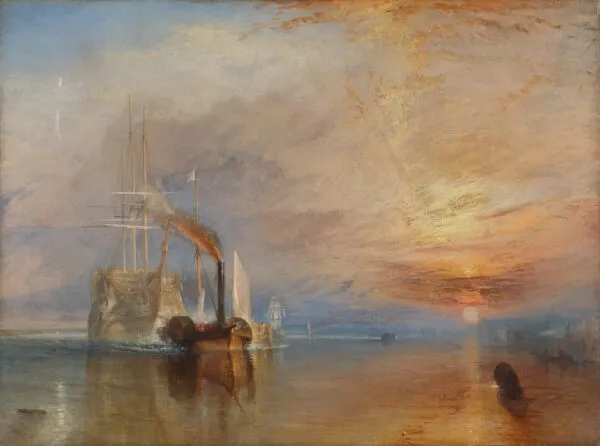
The Fighting Temeraire
J. M. W. Turnerfrom €101,00 – €851,00 -
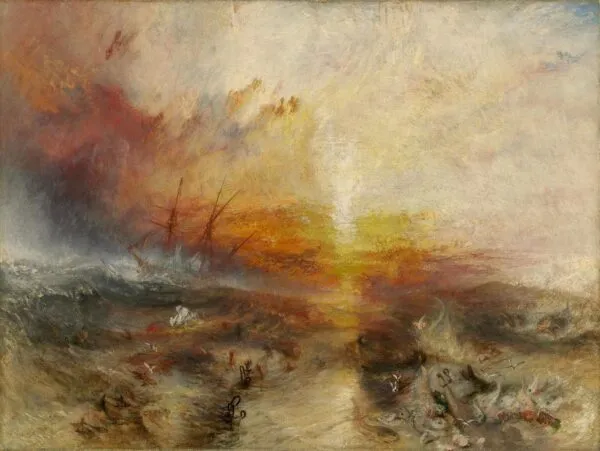
The Slave Ship
J. M. W. Turnerfrom €101,00 – €838,00 -

Dido building Carthage
J. M. W. Turnerfrom €114,00 – €938,00 -

The Battle of Trafalgar
J. M. W. Turnerfrom €108,00 – €895,00 -
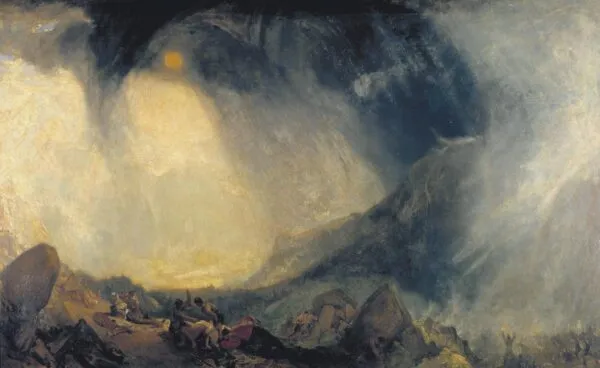
Snow Storm: Hannibal and his Army Crossing the Alps
J. M. W. Turnerfrom €124,00 – €1 027,00 -
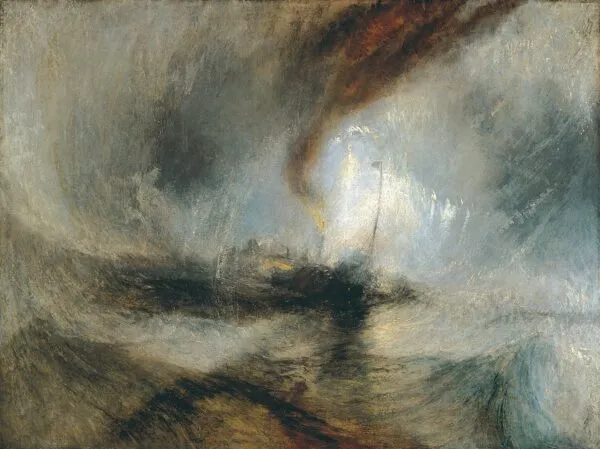
Snow Storm: Steam-Boat off a Harbour's Mouth
J. M. W. Turnerfrom €101,00 – €845,00 -

Ulysses deriding Polyphemus
J. M. W. Turnerfrom €121,00 – €1 008,00 -
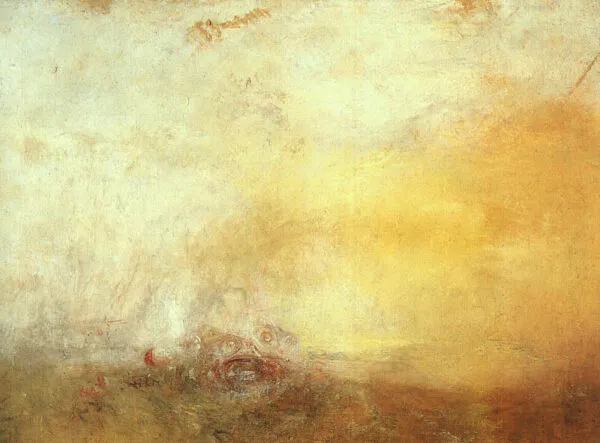
Sunrise with Sea Monsters
J. M. W. Turnerfrom €103,00 – €851,00 -

Fishermen at Sea
J. M. W. Turnerfrom €101,00 – €851,00 -

Dolbadarn Castle
J. M. W. Turnerfrom €103,00 – €863,00 -

Light and Colour (Goethe's Theory)
J. M. W. Turnerfrom €78,00 – €643,00
Paintings by J. M. W. Turner available to order
Any of these can be painted for you by hand. Tell us which one and the size you want, and we will send a quote within 48 hours.
- Rain, Steam and Speed – The Great Western Railway
- The Fighting Temeraire
- Dido building Carthage
- The Slave Ship
- The Battle of Trafalgar
- Snow Storm: Hannibal and his Army Crossing the Alps
- Snow Storm: Steam-Boat off a Harbour's Mouth
- Fishermen at Sea