Description
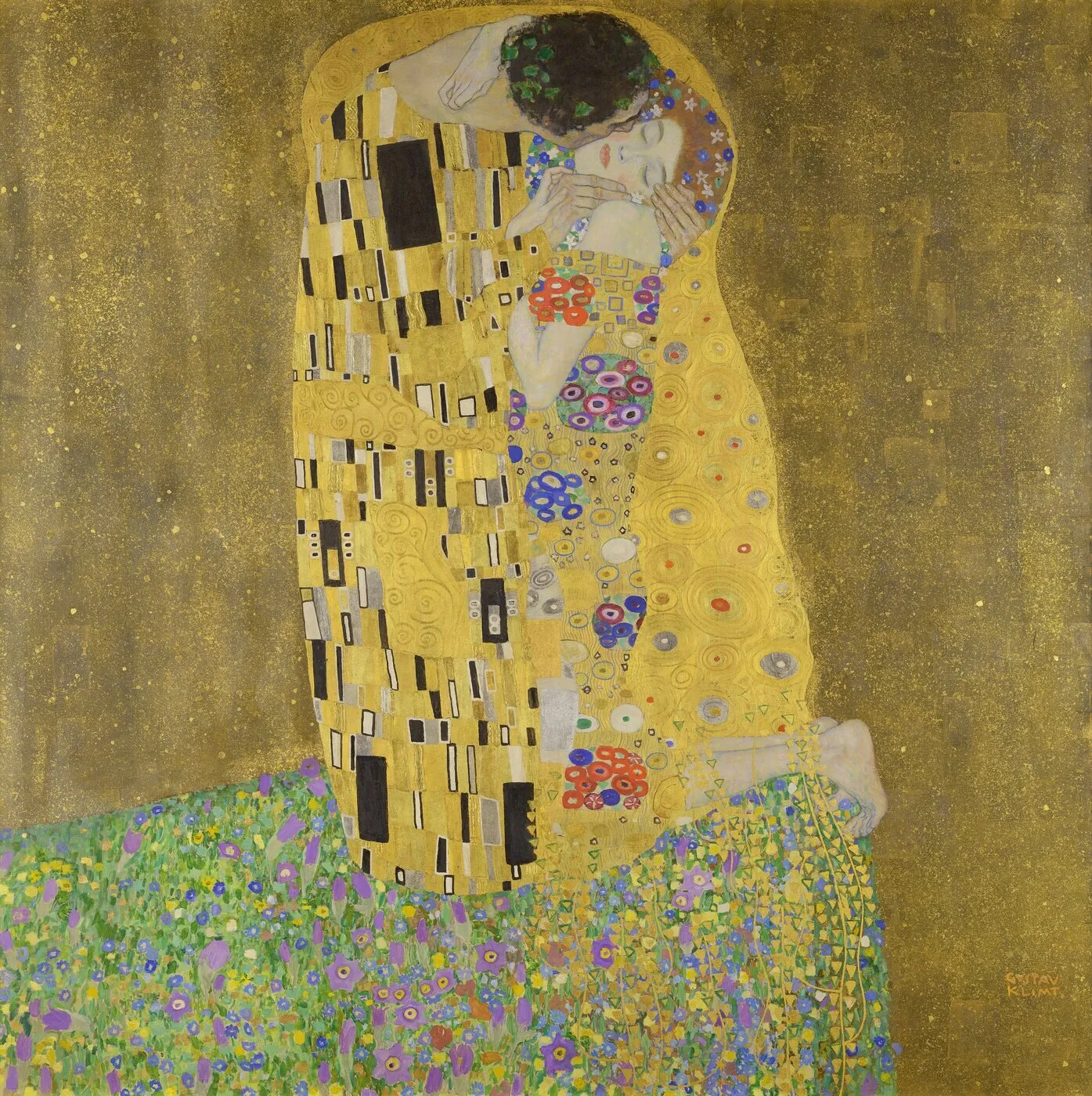
There is all that gold, and then the eye settles on a cheek. On fingers around a face, a hand resting on another hand, bare feet still touching the flowers. These small areas of skin give warmth and weight to an image whose ornament could otherwise swallow everything.
The bodies are difficult to separate beneath their clothes. Dark rectangles on one side and rounded shapes on the other help us find them, but the golden covering draws them into a single large silhouette. The embrace has two scales at once: a touch we can imagine close to us, and a presence large enough to hold an entire wall.
Where the flowers end
One small detail unsettles the comfort. At the right, near the woman’s feet, the flowered ground comes to an abrupt edge. The gold continues beyond it. That boundary can make the intimacy feel fragile: the couple seem sheltered inside their own shape, while the ground available to them looks so slight.
The Belvedere’s collection catalogue dates the work to around 1907–1909. Its account of Klimt’s use of gold helps explain the light: the original’s real metal leaf also draws attention to the surface of the painting. Space contracts around the cut edge of meadow and the large, patterned shape of the two bodies.
Lovers before The Kiss
The record explains that the picture was exhibited as Lovers in 1908, before a 1909 catalogue named it The Kiss. The Klimt Foundation’s account of the Golden Period places it among the works of those years. The first title leaves room for a whole relationship; the second asks us to attend to a moment.
The hands and the inclination of the heads hold that moment open. The woman closes her eyes. The painting gives us every reason to look, while keeping something of the encounter for the couple alone.


Reviews
There are no reviews yet.