CHAPTER 07 / 20
Councils and Eastern Christianities
Defining belief, translating its language and understanding divisions beyond Rome versus Constantinople.
Fourth–seventh centuries · definitions and divisions
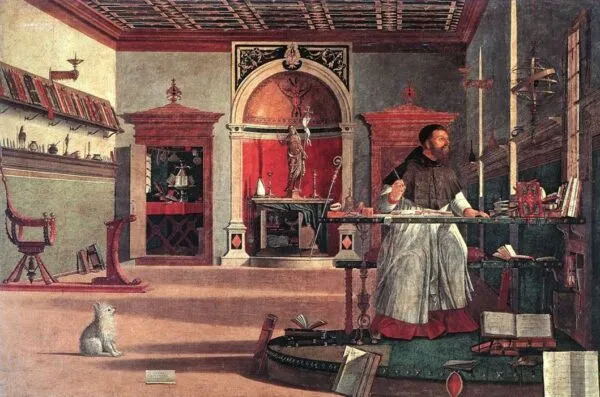
St. Augustine in His Study
Vittore Carpaccio
1502 · painting date
01
Why councils matter
Councils sought to address debates about Christ, God, scripture and ecclesiastical authority. Nicaea in 325, Constantinople in 381, Ephesus in 431 and Chalcedon in 451 are important markers, but reception was neither immediate nor identical everywhere. Theological formulations belong to particular languages, institutions and conflicts.
These gatherings did not simply invent belief from nothing. They selected formulations, debated interpretations and established norms. Imperial authorities also intervened. Doctrinal questions must therefore be distinguished from political and institutional dimensions.
St. Augustine in His Study
Vittore Carpaccio
1502 · painting date
Scuola di San Giorgio degli Schiavoni
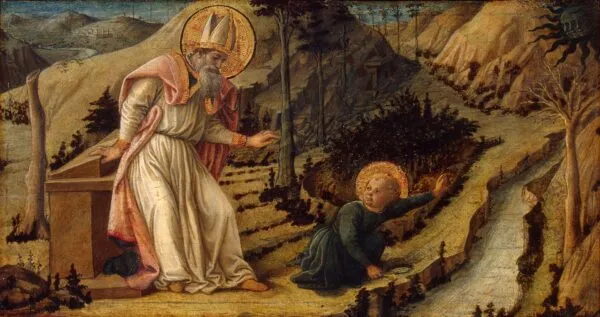
Vision of St Augustine
Filippo Lippi
1452 · painting date
Hermitage Museum
02
Different church families
Eastern Orthodox churches of Byzantine tradition are not identical to Oriental Orthodox churches, including Coptic, Armenian and Syriac traditions. Reception of Chalcedon is central to this distinction. The Church of the East has another historical trajectory. Older polemical labels do not always fairly represent these communities’ own descriptions of their faith.
Relations between these families have changed through disagreement, exchange, coexistence and dialogue. Their history does not begin with the medieval division between Rome and Constantinople, nor can all be grouped under one uniform Eastern identity.

Saint Catherine of Alexandria
Caravaggio
1598 · painting date
Thyssen-Bornemisza Museum

Saint Jerome in the Wilderness
Leonardo da Vinci
1480–1482 · painting date
Pinacoteca Vaticana
03
Painted thinkers are not council records
Augustine, Jerome and Catherine appear through Renaissance and later paintings. Books, workspaces and attributes stage learning, vision or reasoning. They can prompt reflection on texts without reconstructing a fourth- or fifth-century gathering of bishops.
Confessional sources explain a tradition from within. Museum scholarship and church documents do not replace one another. Comparing them clarifies distinctions between doctrine, reception and artistic interpretation.
RESEARCH & FURTHER READING
Sources for this chapter
Museum links accompanying the paintings lead to institutional collection information. Display, loans and access can change; consult the museum before visiting.