Ancient Japan → today
Shinto: kami, mountains and the life of places
Follow sacred narratives, shrine landscapes and the changing relationship between kami, Buddhism and the Japanese state.
12 chapters15 artworks
Begin the journey
Katsushika Hokusai (Japanese, 1760–1849)
South Wind, Clear Sky, from Thirty-Six Views of Mount Fuji
early 1830s · Cleveland Museum of Art
Discover the reproduction ↗Shinto is not an unchanged religion sealed off from history. Kami worship, court ritual, village festivals and modern institutions have taken different forms over time. Medieval paintings frequently combine Buddhist and kami presences; nineteenth-century prints transform sacred places and myths for new audiences. In this journey, belief, political history and artistic interpretation remain connected without being confused.
Ancient practices
Kami: more than a translation of “gods”
Kami may be associated with places, natural phenomena, ancestors or extraordinary presences. Translating the term as either “god” or “spirit” can be useful, but neither word captures every historical use. Worship developed through local relations, offerings and ritual expertise rather than through one founder and a single universal creed.
The medieval image of Fujiwara no Muchimaro brings together a historical ancestor and a sacred setting. It reminds us that kami history is not only about dramatic mountains or abstract “nature”. Families, institutions and remembered persons also matter. Its medieval date should not be confused with the lifetime of the eighth-century courtier it represents.

Maker not recorded — Japan, Kamakura period (1185–1333)
Fujiwara no Muchimaro
1200s or 1300s · Cleveland Museum of Art
Discover the reproduction ↗712 and 720
The Kojiki and Nihon shoki: stories at court
The Kojiki, completed in 712, and Nihon shoki, completed in 720, gather genealogies, myths and accounts of rulers. They are major sources for kami narratives and the political imagination of the early Japanese court. Their accounts of divine beginnings are not straightforward archaeological records of prehistory.
Later painters and printmakers returned to these stories through new literary and performance cultures. Hokkei’s 1825 Cave Door of Spring series is one such reception. Its vivid figures belong to early nineteenth-century visual culture, not to an eyewitness view of the age of the gods. That gap between compilation, story and image is part of the history.

Totoya Hokkei (Japanese, 1780–1850)
Ama no Tajikara no Mikoto from The Cave Door of Spring
1825 · Cleveland Museum of Art
Discover the reproduction ↗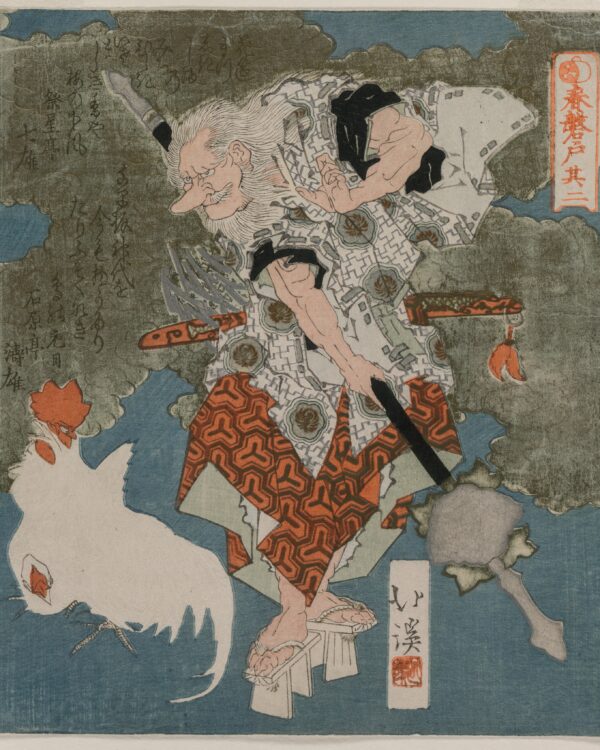
Totoya Hokkei (Japanese, 1780–1850)
Sarutahiko from The Cave Door of Spring
1825 · Cleveland Museum of Art
Discover the reproduction ↗Sacred narrative
Amaterasu’s cave: darkness, dance and return
In the cave narrative, Amaterasu withdraws and the world loses her light. Other kami devise a way to draw her out; Ame no Uzume’s performance and the action of Tajikarao become central to later retellings. Versions differ in detail, and the story should be introduced as a sacred narrative rather than a historically datable eclipse.
Hokkei’s separate figures invite viewers to reconstruct a shared scene across several prints. Dancers and musicians make sound imaginable on silent paper. This is also a history of performance: religious myth, poetry and theatrical gestures can meet without each print being a direct record of a shrine ritual.

Totoya Hokkei (Japanese, 1780–1850)
Uzume no Mikoto from The Cave Door of Spring
1825 · Cleveland Museum of Art
Discover the reproduction ↗Totoya Hokkei (Japanese, 1780–1850)
Ama no Tajikara no Mikoto from The Cave Door of Spring
1825 · Cleveland Museum of Art
Discover the reproduction ↗
Totoya Hokkei (Japanese, 1780–1850)
Drummer from The Cave Door of Spring
1825 · Cleveland Museum of Art
Discover the reproduction ↗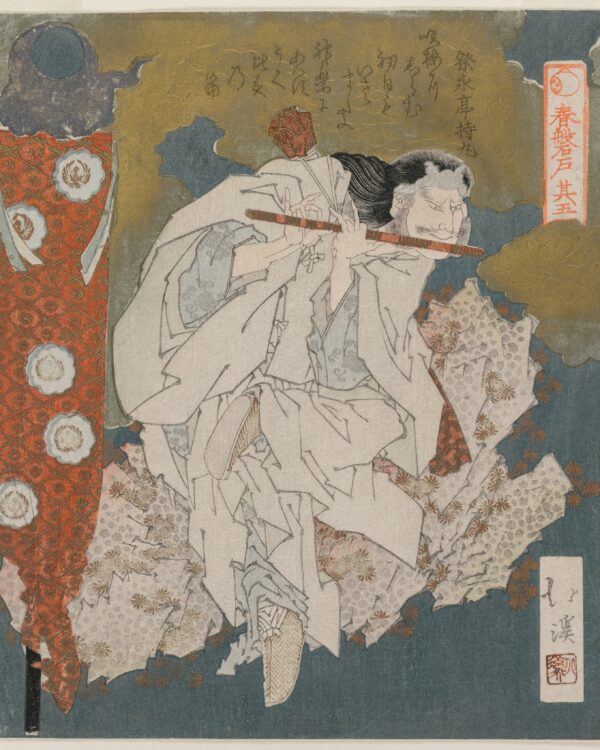
Totoya Hokkei (Japanese, 1780–1850)
Flautist from The Cave Door of Spring
1825 · Cleveland Museum of Art
Discover the reproduction ↗7th–10th centuries
Courts, clans and the ordering of shrines
As early Japanese states developed, court institutions systematized selected rites and relationships with shrines. Local practices did not disappear into one perfectly uniform national religion. Ritual texts and administrative arrangements reveal both the reach of political power and the persistence of regional relationships.
The Kasuga shrine painting comes from a later world, when courtly family histories and Buddhist institutions were deeply connected. Its buildings and surrounding terrain make sacred order visible. A medieval representation can help us explore the continuing importance of court-linked shrines, but it must not be used as a literal plan of an eighth-century site.

Maker not recorded — Japan, Kamakura period (1185–1333)
Kasuga Shrine Mandala
early 1300s · Cleveland Museum of Art
Discover the reproduction ↗Maker not recorded — Japan, Kamakura period (1185–1333)
Fujiwara no Muchimaro
1200s or 1300s · Cleveland Museum of Art
Discover the reproduction ↗Medieval Japan
Buddhas and kami on the same surface
For much of premodern Japanese history, kami worship and Buddhist practice were interwoven. Honji suijaku interpretations described relationships between Buddhist “original grounds” and local manifestations. These explanations were varied and contested, not one doctrine accepted identically everywhere.
The descent of luminaries at Kasuga and the shrine mandala place local sacred sites within wider cosmological relationships. They challenge a modern expectation that every image must belong exclusively to either Buddhism or Shinto. Their classification should preserve that complexity instead of erasing inconvenient figures. The political separation of the nineteenth century would later make these earlier combinations more difficult to sustain.

Maker not recorded — Japan, Nanbokuchō period (1336–92)
Descent of the Nine Luminaries and the Seven Stars at Kasuga
mid- to late 1300s · Cleveland Museum of Art
Discover the reproduction ↗Maker not recorded — Japan, Kamakura period (1185–1333)
Kasuga Shrine Mandala
early 1300s · Cleveland Museum of Art
Discover the reproduction ↗Medieval period onward
Mountains, ascetics and paths of encounter
Japanese sacred mountains gathered practices associated with kami, Buddhist institutions and mountain ascetics. Shugendo histories concern specific lineages, disciplines and places rather than a vague universal “nature spirituality”. Mountains could be demanding environments of practice as well as powerful forms in art.
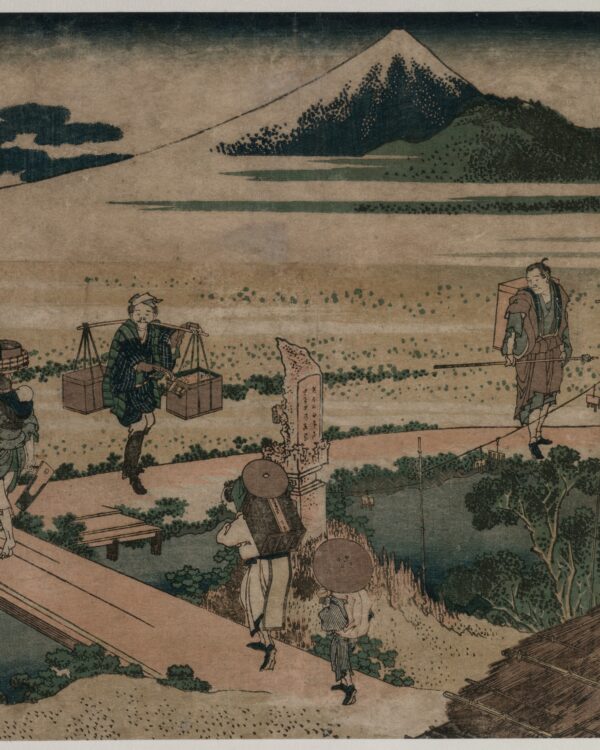
Fuji became a major place of pilgrimage, with routes, shrines, lodging houses and associations connecting summit and settlements. The prints here show its visual circulation in the nineteenth century. Not every traveller in a Fuji print is a pilgrim, and not every view was made as an object of worship. Sacred significance and commercial landscape imagery could nevertheless interact.
Katsushika Hokusai (Japanese, 1760–1849)
A View of Mount Fuji and Travellers by a Bridge
ca. 1835 · Cleveland Museum of Art
Discover the reproduction ↗
Utagawa Hiroshige (Japanese, 1797–1858)
The Fuji River in the Snow
1841 · Cleveland Museum of Art
Discover the reproduction ↗Local calendars
Matsuri: a place becomes an event
Matsuri bring offerings, processions, music, performance and collective labour into locally distinctive calendars. Their meaning depends on a shrine’s relationships, the kami honoured and the histories of participants. Celebration and ritual obligation can coexist; a festival is not simply secular entertainment added to religion.
Hiroshige’s Hotohoto Festival at Izumo Grand Shrine turns a gathering into an atmospheric image of place. Figures, trees and architecture establish the scale of an event that belongs to a named site. The print is also a marketed view from a nineteenth-century series. It offers an artistic perspective, not an exhaustive account of every practice at Izumo.

Utagawa Hiroshige (Japanese, 1797–1858)
Hotohoto Festival at Izumo Grand Shrine, from the series Views of Famous Places in the Sixty-odd Provinces
1853 · Cleveland Museum of Art
Discover the reproduction ↗Totoya Hokkei (Japanese, 1780–1850)
Drummer from The Cave Door of Spring
1825 · Cleveland Museum of Art
Discover the reproduction ↗Totoya Hokkei (Japanese, 1780–1850)
Flautist from The Cave Door of Spring
1825 · Cleveland Museum of Art
Discover the reproduction ↗Ritual practice
Purification and renewed relationships
Harae and misogi refer to important practices of purification, which may involve ritual implements or water. Their meanings cannot be translated exactly into Christian ideas of original sin or confession. Concerns about pollution, disruption and restoration belong to particular histories of bodies, places and community life.
Water appears throughout Japanese religious landscapes, but a painted river is not automatically a picture of misogi. The Fuji River image is shown here as a landscape opening a conversation about water, travel and sacred geography. Its documented subject remains the river in snow. Preserving that distinction prevents a thematic connection from becoming a false identification.
Utagawa Hiroshige (Japanese, 1797–1858)
The Fuji River in the Snow
1841 · Cleveland Museum of Art
Discover the reproduction ↗18th–19th centuries
Fuji enters the world of the print
Edo-period publishing carried famous places and religious narratives into a large urban market. Hokusai and Hiroshige transformed Fuji through changing viewpoints, weather, scale and colour. A sacred mountain could also become an artistic experiment and a widely recognizable commercial image.
The red mountain, the storm below its summit and the view across Lake Misaka do not show one fixed identity of Fuji. The series invites comparison. Its relation to sacred geography is real, but individual prints should not all be labelled devotional paintings. Materials and production also matter: these are colour woodblock prints, here offered as canvas interpretations rather than as original Edo impressions.
Katsushika Hokusai (Japanese, 1760–1849)
South Wind, Clear Sky, from Thirty-Six Views of Mount Fuji
early 1830s · Cleveland Museum of Art
Discover the reproduction ↗
Katsushika Hokusai (Japanese, 1760–1849)
Rain Below the Mountain (from the series Thirty-six Views of Mt. Fuji)
early 1830s · Cleveland Museum of Art
Discover the reproduction ↗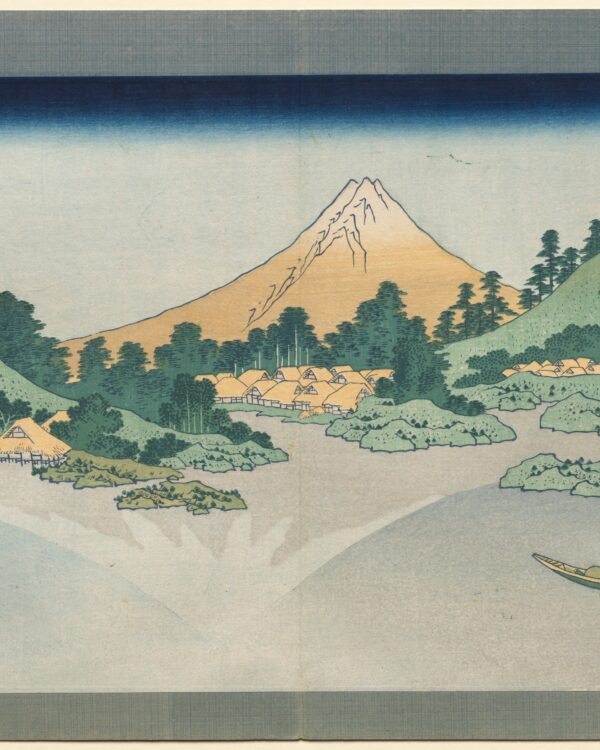
Katsushika Hokusai (Japanese, 1760–1849)
Thirty-Six Views of Mt. Fuji: The Surface of Lake Misaka in Kai Province
early 1830s · Cleveland Museum of Art
Discover the reproduction ↗
Utagawa Hiroshige (Japanese, 1797–1858)
Pine Groves of Miho in Suruga, from the series Thirty-six Views of Mount Fuji
1858 · Cleveland Museum of Art
Discover the reproduction ↗18th–19th centuries
Reading antiquity anew
Kokugaku scholars returned to early Japanese texts, language and poetry, questioning inherited interpretations. Motoori Norinaga’s extensive study of the Kojiki became especially influential. Their projects were diverse; later political uses should not be projected unchanged onto every scholar or text.
Hokkei’s mythological figures belong to the broader early modern life of classical stories, not to a documented portrait of a Kokugaku school. Their presence here shows how antiquity could be continually reimagined. A nineteenth-century print of a kami is not itself an ancient survival. Between the old narrative and the printed sheet stand readers, performers, publishers and artists.
Totoya Hokkei (Japanese, 1780–1850)
Sarutahiko from The Cave Door of Spring
1825 · Cleveland Museum of Art
Discover the reproduction ↗Totoya Hokkei (Japanese, 1780–1850)
Uzume no Mikoto from The Cave Door of Spring
1825 · Cleveland Museum of Art
Discover the reproduction ↗1868 onward
Meiji separation and the making of modern Shinto
After the Meiji Restoration of 1868, government policies separating kami and buddhas transformed shrines, temples and their personnel. Anti-Buddhist destruction accompanied this process in different places. The separation was not the simple recovery of an untouched ancient religion; it reorganized long-established relationships.
Medieval Kasuga images make the stakes visible precisely because they predate these policies. Their combined religious worlds could become difficult to classify in the new order. Nineteenth- and twentieth-century shrine administration, education and imperial ideology then changed religious life further. The category “State Shinto” requires historical explanation rather than being treated as the essence of every local shrine.
Maker not recorded — Japan, Kamakura period (1185–1333)
Kasuga Shrine Mandala
early 1300s · Cleveland Museum of Art
Discover the reproduction ↗Maker not recorded — Japan, Nanbokuchō period (1336–92)
Descent of the Nine Luminaries and the Seven Stars at Kasuga
mid- to late 1300s · Cleveland Museum of Art
Discover the reproduction ↗1945 → today
After 1945: institutions, festivals and personal practice
The end of the Second World War brought major changes to state sponsorship, religious freedom and shrine organization. Contemporary Shinto includes shrine associations, independent institutions and sectarian traditions. Participation in festivals or life-cycle rites does not necessarily correspond to the exclusive religious membership familiar in some other settings.
Shrines now also encounter tourism, conservation, urban change and new international audiences. These are living negotiations, not evidence that religion has simply become folklore. Returning to Hiroshige’s Izumo and Fuji views helps us see earlier relationships between sacred place and public circulation. Those prints offer historical comparisons, not pictures of twenty-first-century visitors.
Utagawa Hiroshige (Japanese, 1797–1858)
Hotohoto Festival at Izumo Grand Shrine, from the series Views of Famous Places in the Sixty-odd Provinces
1853 · Cleveland Museum of Art
Discover the reproduction ↗Utagawa Hiroshige (Japanese, 1797–1858)
Pine Groves of Miho in Suruga, from the series Thirty-six Views of Mount Fuji
1858 · Cleveland Museum of Art
Discover the reproduction ↗Katsushika Hokusai (Japanese, 1760–1849)
A View of Mount Fuji and Travellers by a Bridge
ca. 1835 · Cleveland Museum of Art
Discover the reproduction ↗Keep exploring