Antiquity → today
Jainism: the art of living without harm
Follow the ford-makers, illuminated manuscripts and communities that made nonviolence a demanding way of life.
12 chapters18 artworks
Begin the journey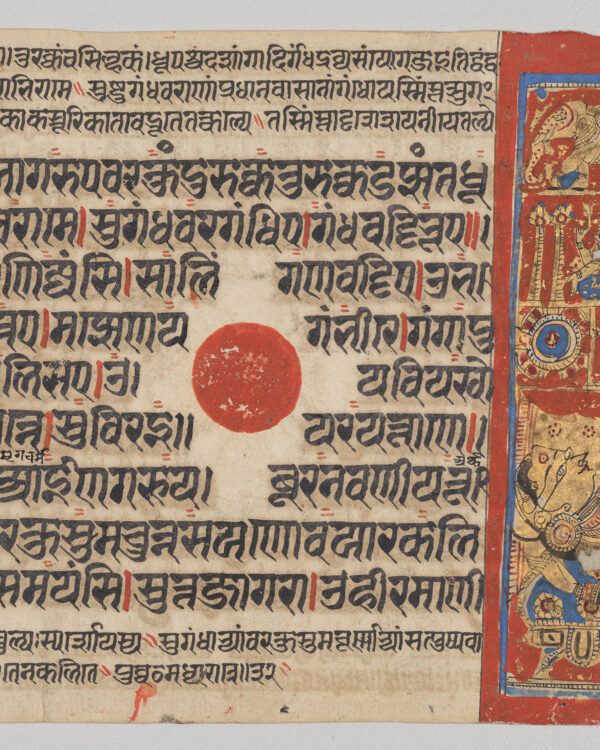
Maker not recorded — Western India, Gujarat
The Fourteen Dreams of Queen Trishala, folio 14 (recto), from a Kalpa-sutra
c. 1475–1500 · Cleveland Museum of Art
Discover the reproduction ↗Jain history joins an ancient South Asian tradition of renunciation to a living network of families, teachers, libraries and temples. Its paintings make visible a universe populated by souls and a liberation that no creator grants. Most manuscripts here come from Shvetambara settings; their narratives must not be mistaken for the doctrines of every Jain community. The dates of these medieval images are distinct from the much earlier lives they recount.
Ancient traditions
The twenty-four ford-makers
A tirthankara is a “ford-maker”: someone who discovers and teaches a passage out of rebirth. Jain traditions name twenty-four in the present cosmic age, beginning with Rishabha and ending with Mahavira. These figures are perfected teachers, not a creator god. Their immense traditional chronologies do not all belong to the same kind of evidence as historically datable inscriptions.
This manuscript places Rishabha inside an architectural shrine beside dense writing. Image and scripture belong together: the enthroned Jina offers a stable focus, while the reader follows a much longer history. A medieval manuscript thus preserves a community’s sacred memory rather than an eyewitness portrait of antiquity.

Maker not recorded — Western India, Gujarat
Seated Jina Rishabha Enshrined, from a Jain Manuscript: Kalpa-Sutra
c. 1500 · Cleveland Museum of Art
Discover the reproduction ↗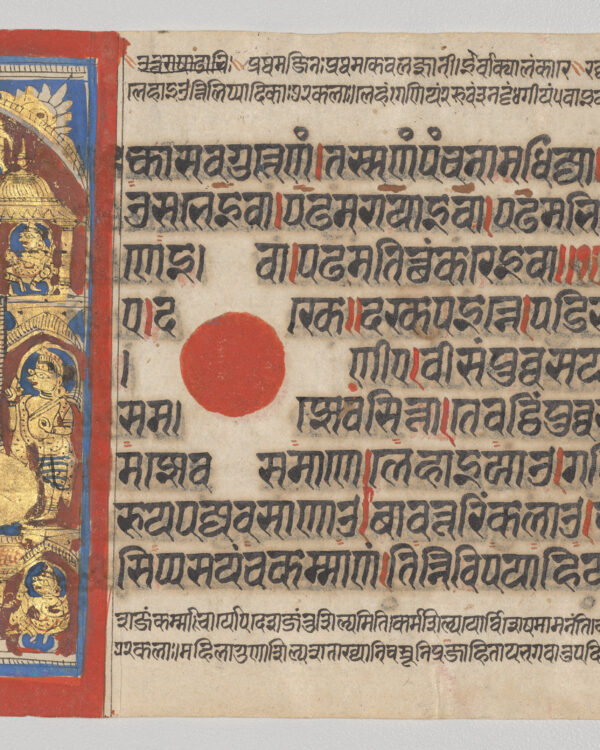
Maker not recorded — Western India, Gujarat
Nemi Enthroned, Folio 54 (verso), from a Kalpa-sutra
c. 1475–1500 · Cleveland Museum of Art
Discover the reproduction ↗6th–5th centuries BCE
Mahavira between history and sacred biography
Mahavira belongs to the world of wandering renouncers in northern India, also important to early Buddhism. Scholars debate his precise dates; the traditional dates 599–527 BCE should be identified as a religious chronology, not an uncontested modern finding. Accounts describe his abandonment of privilege, prolonged austerity, complete knowledge and teaching career.
Birth paintings tell this life through auspicious signs and carefully ordered rooms. Their royal setting does not cancel the later renunciation: it gives that departure its force. Two leaves showing the same birth are distinct historical objects, made centuries apart. Their differing layouts reveal how artists renewed an inherited narrative.

Maker not recorded — Western India, Gujarat
Birth of Mahavira, folio 40 (verso) from a Kalpa-sutra
c. 1400 · Cleveland Museum of Art
Discover the reproduction ↗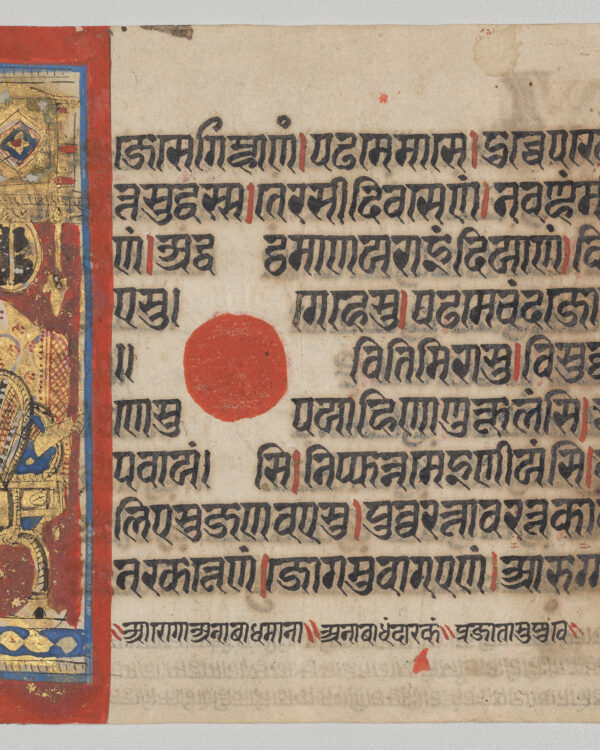
Maker not recorded — Western India, Gujarat
Birth of Mahavira, folio 30 (verso), from a Kalpa-sutra
c. 1475–1500 · Cleveland Museum of Art
Discover the reproduction ↗Sacred biography
Trishala’s dreams and the language of signs
In Shvetambara tellings, Trishala’s fourteen dreams announce an exceptional birth. Elephants, a lion, the moon and other auspicious images form a visual vocabulary recognizable to readers. Other Jain traditions count and explain these signs differently; one illustrated sequence should not be presented as a universal version.
The story also contains a transfer of the embryo from Devananda to Trishala, represented here as part of that specific sacred biography. The court then interprets the dreams. By distributing animals, royal figures and divine messengers across successive leaves, painters turn an unfolding narrative into moments that can be remembered and discussed.
Maker not recorded — Western India, Gujarat
The Fourteen Dreams of Queen Trishala, folio 14 (recto), from a Kalpa-sutra
c. 1475–1500 · Cleveland Museum of Art
Discover the reproduction ↗
Maker not recorded — Western India, Gujarat
Painting from a Kalpa-sutra: Indra Praises the Embryo of Mahavira in the Womb of the Brahman Woman Devananda
c. 1450–75 · Cleveland Museum of Art
Discover the reproduction ↗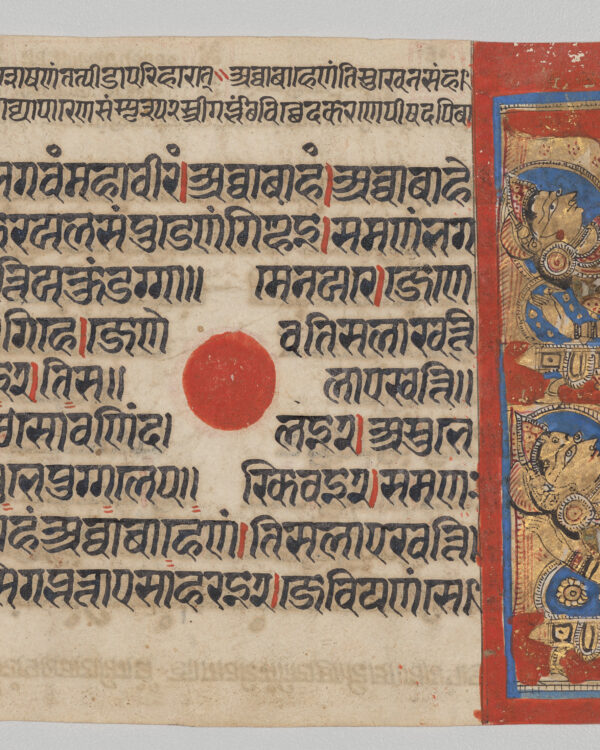
Maker not recorded — Western India, Gujarat
Transfer of the Embryo of Mahavira, Folio 12 (recto), from a Kalpa-sutra
c. 1475–1500 · Cleveland Museum of Art
Discover the reproduction ↗
Maker not recorded — Western India, Gujarat
King Siddhartha and Queen Trishala with the Dream Interpreters, Folio 25 (verso), from a Kalpa-sutra
c. 1475–1500 · Cleveland Museum of Art
Discover the reproduction ↗Teachings
Souls, karma and liberation
Jain thought distinguishes living souls, jiva, from nonliving realities. Human beings are not the only bearers of life: animals and much smaller beings matter ethically. Karma is understood as a real bondage affecting the soul, accumulated through action and passions. Liberation requires stopping new bondage and shedding what has already gathered.
Nemi’s painted ascent brings this otherwise abstract goal into view. A Jina may appear teaching in one register and liberated in another, without the page describing two ordinary earthly locations. Its vertical organization expresses a difference in spiritual condition. These are religious cosmological claims, presented here as such rather than as scientific diagrams.

Maker not recorded — Western India, Gujarat
Nemi's Omniscience and First Teaching (below) and Nemi in the Realm of Liberation (above), Folio 51 (recto), from a Kalpa-sutra
c. 1475–1500 · Cleveland Museum of Art
Discover the reproduction ↗Maker not recorded — Western India, Gujarat
Nemi Enthroned, Folio 54 (verso), from a Kalpa-sutra
c. 1475–1500 · Cleveland Museum of Art
Discover the reproduction ↗Ethics
Ahimsa: care becomes a discipline
Ahimsa, avoiding harm, is central to Jain life. It accompanies commitments concerning truthfulness, taking what is not given, sexuality and attachment to possessions. Monastic vows are more stringent than the smaller vows of householders. Dietary choices, professions, movement and everyday speech may all become matters of careful attention.
The teaching scene shows why this ethic is learned in a community. A teacher, disciples and lay supporters occupy different positions without being separate religious worlds. Practices vary across lineages and individual circumstances. To describe demanding renunciation accurately is not to prescribe it to every visitor, nor to reduce Jain ethics to one familiar dietary rule.
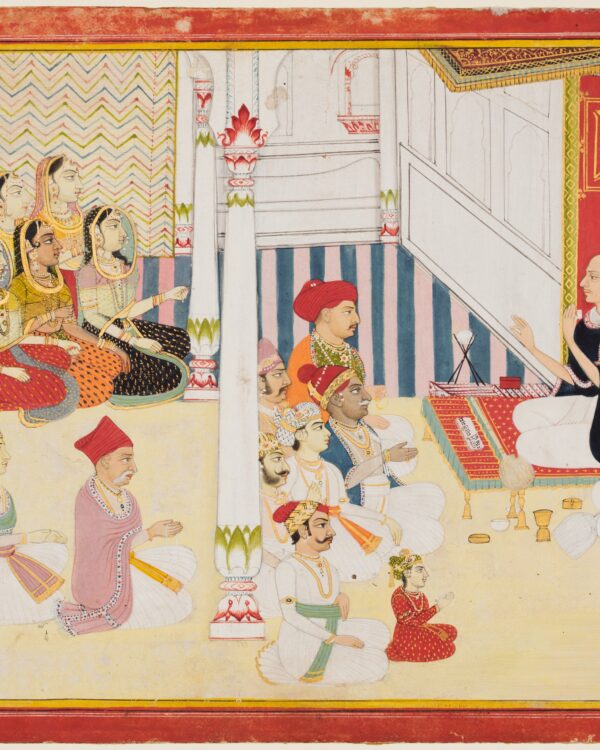
possibly by Sahib Ram (Indian, active 1745–1803)
Shvetambara Jain Teacher Giving Instruction
c. 1750–60 · Cleveland Museum of Art
Discover the reproduction ↗
Maker not recorded — Western India, Gujarat
Jain monk with disciple and two laymen, two nuns, and a laywoman, folio 22 (recto) from a Yoga-shastra of Hemachandra
c. 1275 · Cleveland Museum of Art
Discover the reproduction ↗Philosophy
Anekantavada: learning to qualify a claim
Anekantavada emphasizes that reality has many aspects and that a limited observer should qualify a statement. Related Jain logical traditions develop ways of expressing the conditions under which a proposition holds. This is a disciplined approach to knowledge, not the claim that every opinion is equally correct or that contradictions never matter.
The royal discussion of Trishala’s dreams offers an evocative image of interpretation, although the painting is not a technical illustration of Jain logic. The distinction matters: we can use an artwork to begin a philosophical conversation without falsely assigning it a subject its manuscript never names.

Maker not recorded — Western India, Gujarat, last quarter of the 15th century
King Siddhartha and Queen Trishala Sit Alone to Discuss Her Dreams, Folio 24 (recto), from a Kalpa-sutra
c. 1475–1500 · Cleveland Museum of Art
Discover the reproduction ↗Early centuries → medieval period
Digambara and Shvetambara histories
The distinction between Digambara, “sky-clad”, and Shvetambara, “white-clad”, formed over centuries. Disagreements concern monastic practice, scriptural transmission and aspects of the Jinas’ lives. It is misleading to treat this complex history as a single quarrel settled on one secure date.
The two traditions also differ on women’s capacity for liberation in a female body. Both include significant communities of female renouncers, whose lives cannot be summarized by that doctrinal disagreement alone. This illustrated Yoga-shastra leaf depicts monks, nuns and lay followers together. It comes from a particular manuscript setting and does not stand for the iconography of every Jain order.
Maker not recorded — Western India, Gujarat
Jain monk with disciple and two laymen, two nuns, and a laywoman, folio 22 (recto) from a Yoga-shastra of Hemachandra
c. 1275 · Cleveland Museum of Art
Discover the reproduction ↗13th–16th centuries
Libraries of colour and gold
Jain manuscript culture grew through the work of scribes, painters, teachers and donors. Libraries preserved religious learning, while commissioning a book could be an act of devotion and generosity. Changes from long palm-leaf formats to paper did not immediately erase inherited page proportions or the close partnership between text and image.
The Kalpa-sutra became especially important in Shvetambara illustrated traditions. Its stories of Jinas, teachers and monastic conduct were recited and revisited, particularly in the rainy-season religious calendar. Gold, blue and red organize hierarchies of attention. They also record material choices and patronage in a specific place and century, rather than an unchanging “Indian style”.
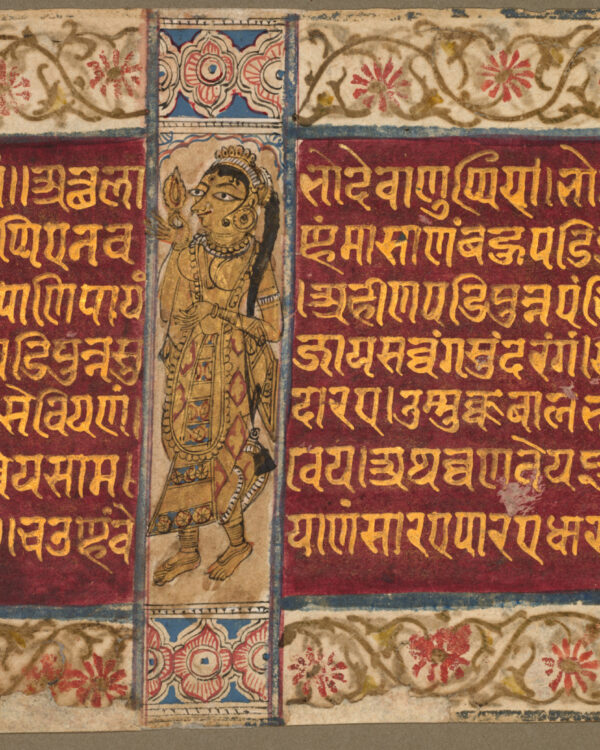
Maker not recorded — Western India, Gujarat
Celestial Dancers, folio 5 (recto), from Brahman Rishabhadatta's speech, from a Kalpa-sutra
c. 1475–1500 · Cleveland Museum of Art
Discover the reproduction ↗
Maker not recorded — Western India, Gujarat
The Lion's Cave with Sthulabhadra and His Sisters, Folio 60 (verso), from a Kalpa-sutra
c. 1450 · Cleveland Museum of Art
Discover the reproduction ↗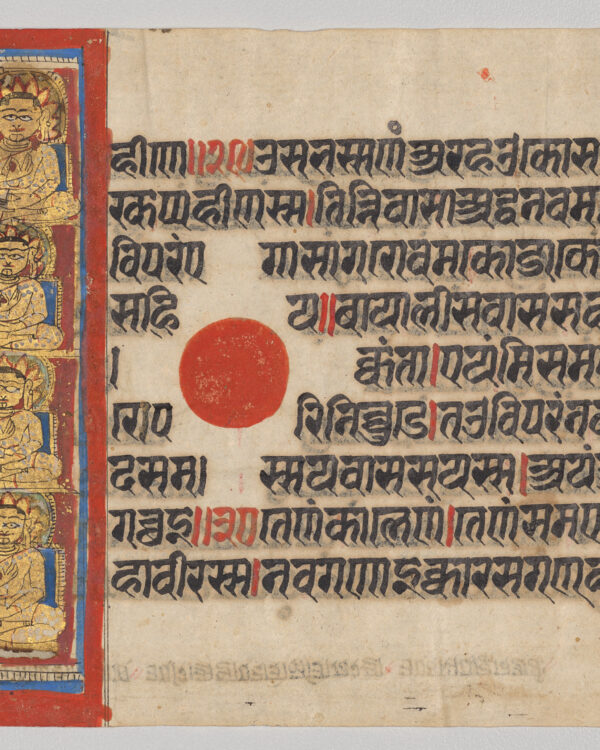
Maker not recorded — Western India, Gujarat
The Eleven Principal Disciples (Ganadharas) of Mahavira, Folio 57 (verso), from a Kalpa-sutra
c. 1475–1500 · Cleveland Museum of Art
Discover the reproduction ↗1613
Mapping a universe without a creator
Jain cosmology describes an uncreated universe with inhabited regions, celestial and infernal realms, and a place for liberated souls beyond the cycle of rebirth. Diagrams can map continents or give the cosmos a humanlike outline. They join ethical teaching to a strikingly precise visual order.
The 1613 painting brings several diagram types into one composition. It should be approached as a learned religious map, not as a modern geographical chart or evidence of a literal giant body. Reading its circles and stacked regions requires attention to the explanatory tradition that shaped it. The museum record identifies the surviving object and its date, not the antiquity of every idea it contains.
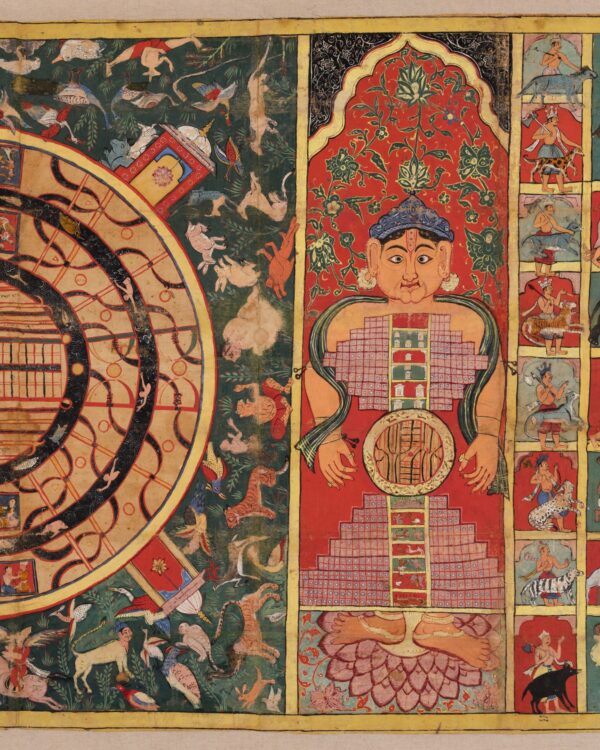
Maker not recorded — Western India, Gujarat
Diagrams of the Universe: The Two-and-a-Half Continents, the Universe in the Shape of a Person, and the Seven Levels of Hell
1613 · Cleveland Museum of Art
Discover the reproduction ↗Medieval period → today
Ritual, remembrance and the community
Temple worship, recitation, pilgrimage, giving and periods of intensified restraint connect householders and renouncers. Paryushana is a major season of reflection and forgiveness in Shvetambara communities; related observances take different forms in Digambara practice. Calendars express shared concerns without making every ritual identical.
The bath of Mahavira and the assembly of principal disciples make honour and transmission visible. These are episodes from sacred biography, not photographs of a contemporary festival. A present-day worshipper may approach the same story through a manuscript, temple image, spoken teaching or family practice. Painting is one participant in this wider religious life.

Maker not recorded — Western India, Gujarat
Ritual Bath of Mahavira, Folio 31 (recto), from a Kalpa-sutra
c. 1475–1500 · Cleveland Museum of Art
Discover the reproduction ↗Maker not recorded — Western India, Gujarat
The Eleven Principal Disciples (Ganadharas) of Mahavira, Folio 57 (verso), from a Kalpa-sutra
c. 1475–1500 · Cleveland Museum of Art
Discover the reproduction ↗
Maker not recorded — Western India, Gujarat
Queen Trishala's Grief and Happiness, Folio 29 (recto), from a Kalpa-sutra
c. 1475–1500 · Cleveland Museum of Art
Discover the reproduction ↗Early modern period
Not every Jain community worships images
The richness of Jain painting must not hide Jain criticism of image worship. Within Shvetambara histories, Sthanakavasi and later Terapanthi communities placed emphasis on practices without the worship of Jina images. “Jain art” therefore cannot be used as a synonym for the entire religion. Similar names in different branches also need careful handling.
A teacher instructing listeners is an apt starting point for this distinction, although this particular painting is not evidence that its maker or patron belonged to an image-rejecting movement. Religious histories include arguments about what an image can do. A gallery of beautiful objects should make room for those arguments rather than erase them.
possibly by Sahib Ram (Indian, active 1745–1803)
Shvetambara Jain Teacher Giving Instruction
c. 1750–60 · Cleveland Museum of Art
Discover the reproduction ↗19th–21st centuries
A living, travelling tradition
Jain communities now maintain institutions in India and across global diasporas. Migration changes how religious education, food, festivals and relations with renouncers are organized. Libraries and digitization projects also let manuscripts reach readers far from the communities that originally commissioned them.
Nonviolence informs contemporary discussions of animals, consumption and the environment, but Jain voices do not all frame those questions identically. The older paintings shown here remain sources for memory and study, not documentary images of modern migration or environmental movements. Their new museum and domestic settings add another chapter to their lives without replacing their original religious contexts.
Maker not recorded — Western India, Gujarat
Seated Jina Rishabha Enshrined, from a Jain Manuscript: Kalpa-Sutra
c. 1500 · Cleveland Museum of Art
Discover the reproduction ↗Maker not recorded — Western India, Gujarat
Celestial Dancers, folio 5 (recto), from Brahman Rishabhadatta's speech, from a Kalpa-sutra
c. 1475–1500 · Cleveland Museum of Art
Discover the reproduction ↗Keep exploring