Ancient South Asia → today
Hindu traditions: worlds within the image
From Vedic recitation to Krishna’s forests, Shiva’s ascetics and the power of the Goddess: a history with many centres.
12 chapters20 artworks
Begin the journey
Maker not recorded — Northern India, Himachal Pradesh, Pahari Kingdom of Kangra
Krishna Lifting Mount Govardhan
c. 1780–90 · Cleveland Museum of Art
Discover the reproduction ↗Hinduism names a family of traditions with no single founder, universal church or identical set of practices. Texts, temples, philosophical schools and household rites have developed through many languages and regions. The later paintings in this journey interpret much older narratives; they are not archaeological records of the events they portray. Their regional styles also remind us that a shared divine name never makes every image interchangeable.
Ancient roots
A history with more than one beginning
The word “Hindu” acquired religious meanings gradually, from an older geographical vocabulary associated with the Indus. The traditions it now gathers grew through interactions among ritual specialists, local communities, courts and renouncers. Archaeological cultures of the Indus cannot simply be equated with a fully formed later Hinduism: proposed identifications of particular seals or figures remain debated.
Our opening painting is much later. Krishna receiving worship shows one historically developed devotional world, not the origin of every Hindu practice. Beginning with that distinction lets us appreciate continuity without pretending that beliefs and institutions have remained unchanged for thousands of years.

Maker not recorded — Northern India, Pahari kingdoms
Adoration of young Krishna
c. 1720–25 · Cleveland Museum of Art
Discover the reproduction ↗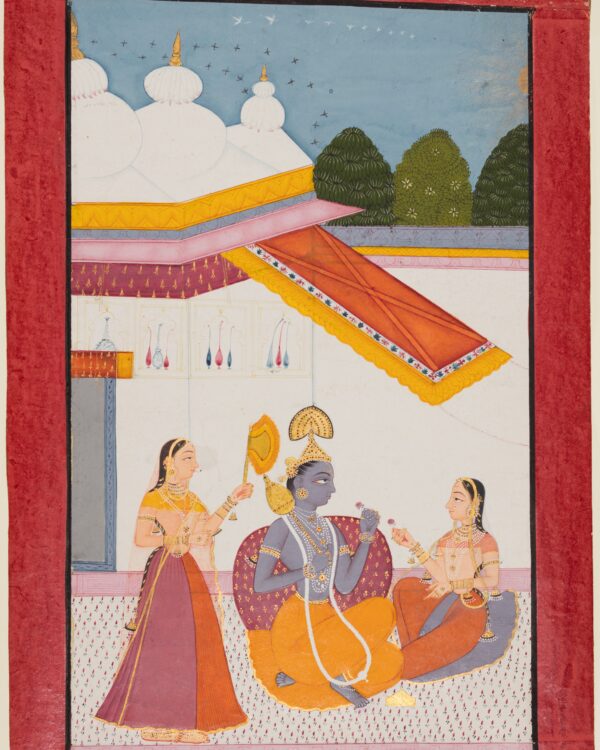
Maker not recorded — Northwestern India, Rajasthan, Rajput Kingdom of Raghogarh
Krishna Under a Canopy
c. 1680 · Cleveland Museum of Art
Discover the reproduction ↗Second–first millennia BCE
The Vedas: sound before the painted page
Vedic traditions developed collections of hymns, ritual formulations and interpretations preserved through highly disciplined oral transmission. Fire offerings and the authority of specialized recitation were central to many settings. The Vedas are not one illustrated storybook, and a later image of a shrine should not be described as a direct picture of a Vedic ceremony.
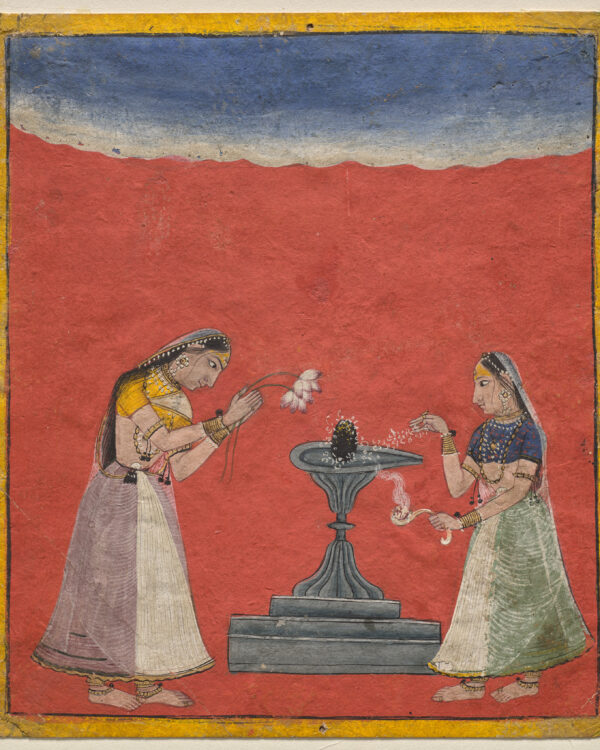
Women worshipping a Shiva linga demonstrate another, later form of ritual attention. Offerings, gestures and a sacred focus connect bodily action with religious presence. Comparing these practices opens a history of changing worship; it does not make the Vedic sacrificial altar and a Shiva shrine equivalent institutions.
Maker not recorded — Northern India, Pahari kingdoms
Women worshiping a Shiva linga: Devagandhari Ragini of Hindol Raga, from a Ragamala
c. 1700 · Cleveland Museum of Art
Discover the reproduction ↗First millennium BCE onward
What is the self? What is liberation?
The Upanishads explore self, ultimate reality, knowledge and release from rebirth. Later philosophical schools disagree over how the self relates to the ultimate, and over the roles of reasoning, devotion and action. Nondual Vedanta is influential, but it must not be made the only philosophical voice of Hindu traditions.
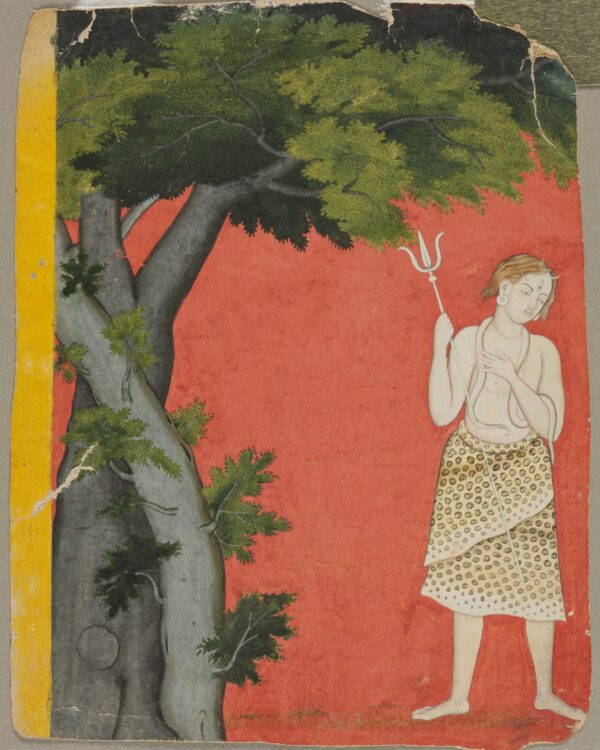
Shiva beneath trees offers an image of withdrawal and concentrated presence. It is not a portrait of a named Upanishadic author or a diagram proving one metaphysical doctrine. Painted asceticism can nevertheless help us see why the forest, the teacher and the body became powerful settings for questions about knowledge and freedom.
Maker not recorded — Northern India, Pahari kingdoms
Shiva under trees
c. 1780 · Cleveland Museum of Art
Discover the reproduction ↗
Maker not recorded — Northern India, Pahari kingdoms
Shiva Seated on a Throne in a Landscape
c. 1755 · Cleveland Museum of Art
Discover the reproduction ↗Epic traditions
Rama, Sita and the difficult work of dharma
The Ramayana and Mahabharata developed through long textual and performance histories. Their versions vary by language, region and religious community. Rama’s exile, Sita’s ordeal, Hanuman’s devotion and the war against Ravana have inspired worship, theatre and debate. “Dharma” can involve duties and right order without making every dramatic decision ethically simple.
This painting shows Rama and Lakshmana fighting Ravana within a series of Vishnu’s incarnations. Its crowded combat compresses epic time into a surface of opposing forces. The date belongs to the eighteenth-century painting, not to a securely dated battle reconstructed by historians. Later readers have also challenged whose viewpoint an inherited epic privileges.

Maker not recorded — Northern India, Pahari Region, Himachal Pradesh, Rajput Kingdom of Chamba, Court of Raj Singh (reigned 1764–94)
Rama and Lakshmana Fighting Ravana, from a Dashavatara (Ten Incarnations [of Vishnu]) series
c. 1765 · Cleveland Museum of Art
Discover the reproduction ↗Puranic narratives
Krishna: childhood, danger and protection
Vishnu’s descents, or avatars, take different forms in narratives of cosmic and moral renewal. Krishna can appear as a mischievous child, a protector of cowherds, a lover and a teacher. The Bhagavata Purana became particularly important for stories of his early life; the Bhagavad Gita presents another setting, within the Mahabharata.
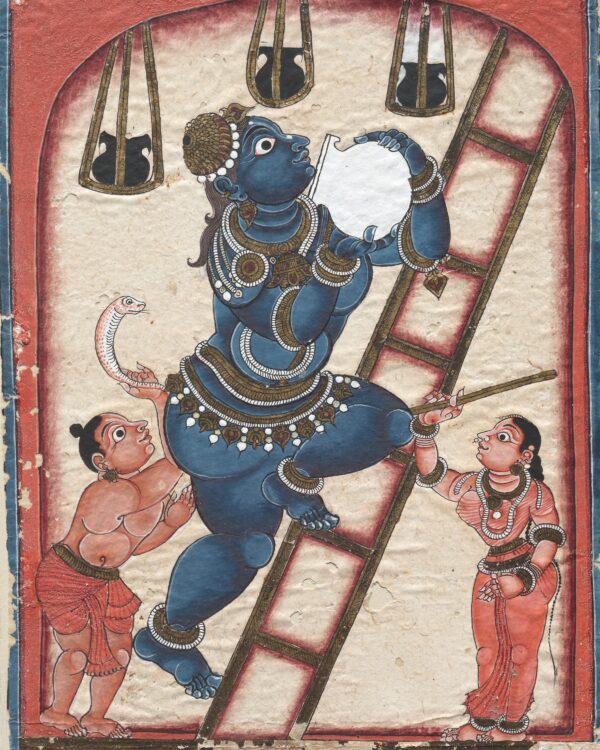
The stolen curds, the serpent Kaliya and the lifted mountain belong to distinct episodes. In the Govardhan image, Krishna shelters a community rather than simply displaying physical strength. Read together, these pictures move between intimacy and overwhelming power. They do not require us to reduce a complex deity to one fixed emotional role.
Maker not recorded — Southern India, Andhra Pradesh, Tirupati
Krishna Stealing Curds
late 1700s · Cleveland Museum of Art
Discover the reproduction ↗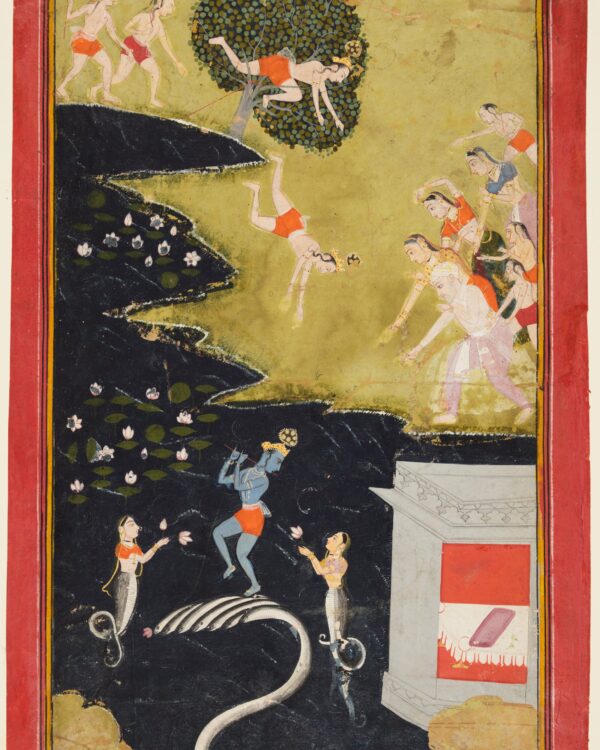
Maker not recorded — Northwestern India, Rajasthan, Rajput Kingdom of Mewar
Krishna Quells the Serpent Kaliya, from a Bhagavata Purana
c. 1710 · Cleveland Museum of Art
Discover the reproduction ↗Maker not recorded — Northern India, Himachal Pradesh, Pahari Kingdom of Kangra
Krishna Lifting Mount Govardhan
c. 1780–90 · Cleveland Museum of Art
Discover the reproduction ↗
Maker not recorded — Nepal, Kathmandu
Krishna and Satyabhama Storm the Citadel of Naraka, folio 97 from a Bhagavata Purana
c. 1775 · Cleveland Museum of Art
Discover the reproduction ↗Medieval and early modern devotion
Radha, longing and the language of devotion
Bhakti traditions cultivate a personal relationship with the divine through song, poetry, worship and remembered stories. They grew in many regions and languages, with important contributions from women and from voices outside elite learned settings. They are neither one organization nor a uniform social reform movement.
Radha’s longing, a confidante’s intervention and a quarrel with Krishna give painters a vocabulary of closeness and separation. Some images draw on poetry and theories of love rather than illustrating a single scriptural passage. Divine love and human emotion can illuminate one another, while the specific literary source still matters. The artist’s garden is therefore also a place of interpretation.

Maker not recorded — Northern India, Pahari kingdoms
Krishna Awaiting Radha
c. 1750–60 · Cleveland Museum of Art
Discover the reproduction ↗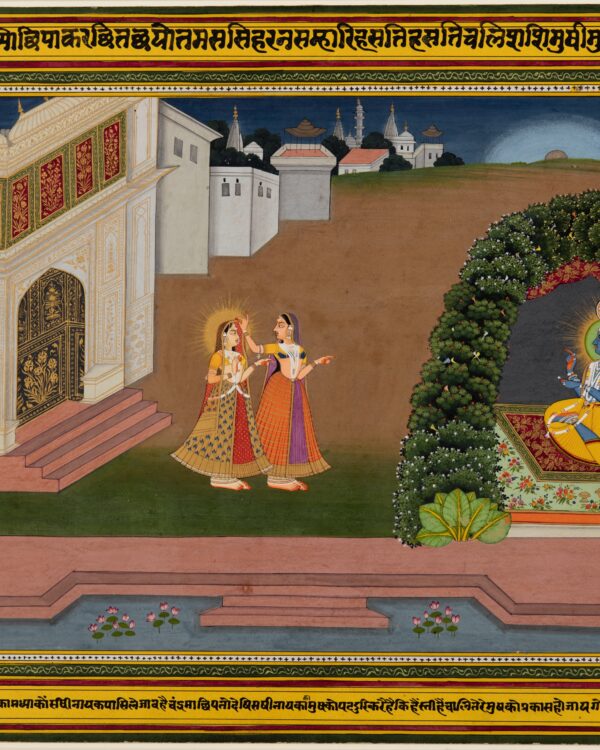
Maker not recorded — Northwestern India, Rajasthan, Rajput Kingdom of Jaipur
Radha’s Confidante Brings Her to Krishna, based on poetry of Bihari (Indian, 1595–1663)
c. 1790–1800 · Cleveland Museum of Art
Discover the reproduction ↗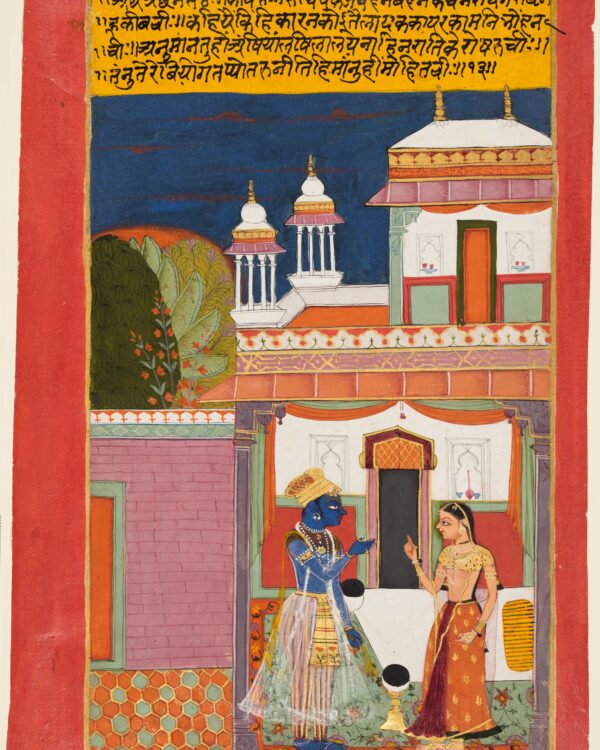
Maker not recorded — Northwestern India, Rajasthan, Rajput Kingdom of Bundi
Krishna and Radha Quarreling: Shatha Nayaka, from a Rasikapriya
c. 1680 · Cleveland Museum of Art
Discover the reproduction ↗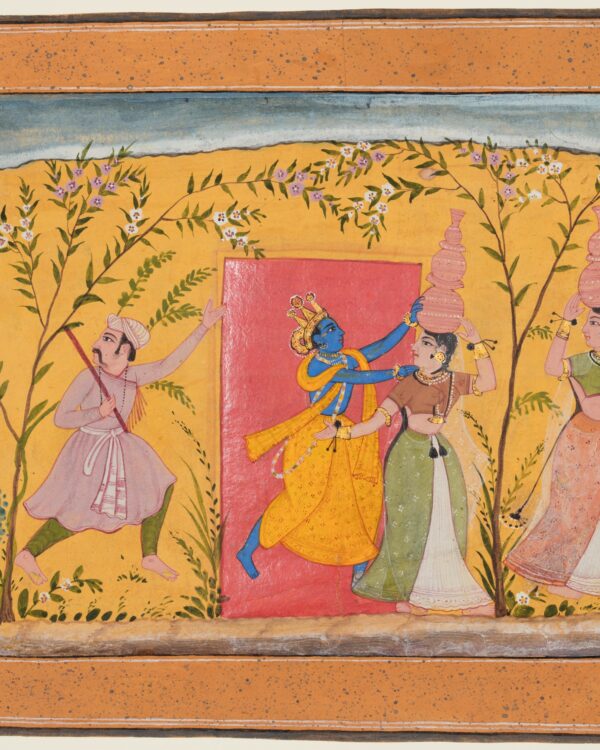
Maker not recorded — Northwestern India, Rajasthan, Rajput Kingdom of Bikaner
Krishna Exacts a Toll from the Milkmaids: Dana-Lila, from a Bhagavata Purana
c. 1600 · Cleveland Museum of Art
Discover the reproduction ↗Shaiva traditions
Shiva: stillness, family and transformation
Shaiva traditions give Shiva many interconnected forms: ascetic, lord, husband, dancer and a presence approached through the linga. Texts and ritual lineages explain these forms in different ways. The familiar label “destroyer” is too narrow to encompass their philosophical and devotional meanings.
An enthroned Shiva, worshippers approaching Shiva and Devi, and a fierce dancing Mahakala do not show contradictory portraits that must be reconciled into one appearance. Each makes a different religious relationship visible. Mahakala here follows the museum’s identification of a Hindu image of Shiva; the name also occurs in Buddhist contexts, where it needs a different explanation.
Maker not recorded — Northern India, Pahari kingdoms
Shiva Seated on a Throne in a Landscape
c. 1755 · Cleveland Museum of Art
Discover the reproduction ↗
Maker not recorded — Northwestern India, Rajasthan, Rajput Kingdom of Bikaner
Worship of Shiva and Devi
early 1700s · Cleveland Museum of Art
Discover the reproduction ↗
Maker not recorded — Northwestern India, Rajasthan, Rajput Kingdom of Mewar
God Shiva in His Ferocious Aspect as Mahakala Dancing
c. 1700–1710 · Cleveland Museum of Art
Discover the reproduction ↗Shakta traditions
The Goddess: protection and power
Shakta traditions place the Goddess, Devi, at the centre of religious life and understand divine power, shakti, in multiple ways. Durga, Kali, Lakshmi, Sarasvati and regional goddesses cannot simply be treated as decorative alternatives to a single standardized figure. Their stories, festivals and local relationships matter.
Durga’s defeat of the buffalo demon Mahisha turns the painted surface into a field of concentrated force. Her multiple arms communicate capacities beyond an ordinary human body. This image represents a sacred narrative, not a record of violence by historical worshippers. Other images of Devi beside Shiva invite a different register of relationship, presence and shared power.

Maker not recorded — Northern India, Pahari kingdoms
Durga Slaying Mahisha
c. 1700–1710 · Cleveland Museum of Art
Discover the reproduction ↗Maker not recorded — Northwestern India, Rajasthan, Rajput Kingdom of Bikaner
Worship of Shiva and Devi
early 1700s · Cleveland Museum of Art
Discover the reproduction ↗Temple and household
Darshan: looking as an encounter
A consecrated image, murti, may be approached as a living divine presence, not merely an illustration. Darshan involves seeing and being seen by the deity. Offerings, lamps, dressing, sound and procession make the image part of a relationship sustained by ritual specialists and devotees. Domestic worship brings related practices into different scales of space.
The night puja and the nobleman at a Vishnu shrine reveal particular encounters rather than a universal Hindu ceremony. A reproduction on a domestic wall does not automatically acquire the ritual status of a consecrated temple image. Understanding that difference deepens appreciation of the artwork without making promises about sacred efficacy.
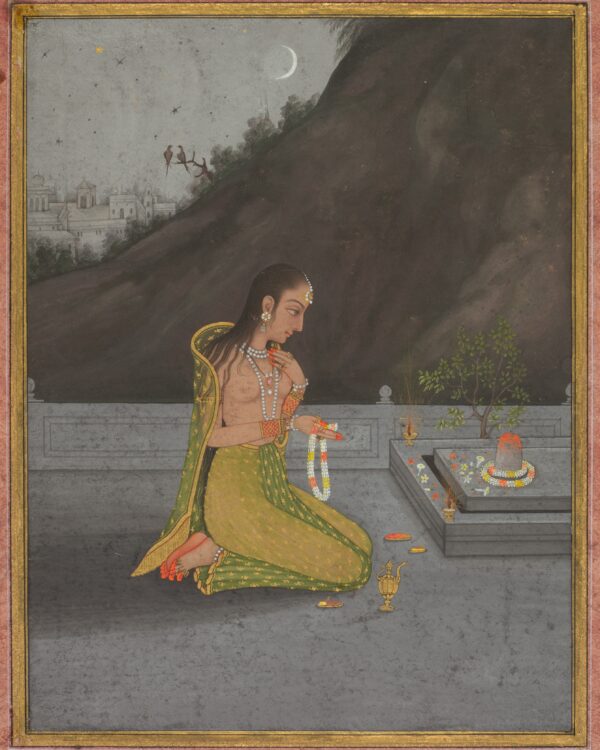
attributed to Muhammad Rizavi Hindi (Indian, active mid-1700s)
A Night Scene of Shiva Puja (recto)
c. 1760–70 · Cleveland Museum of Art
Discover the reproduction ↗
Maker not recorded — Northwestern India, Rajasthan, Marwar
A Rathor Noble Visiting a Holy Man at a Vishnu Shrine
c. 1760 · Cleveland Museum of Art
Discover the reproduction ↗Maker not recorded — Northern India, Pahari kingdoms
Women worshiping a Shiva linga: Devagandhari Ragini of Hindol Raga, from a Ragamala
c. 1700 · Cleveland Museum of Art
Discover the reproduction ↗16th–19th centuries
Paintings across courts, languages and communities
Many surviving paintings come from courts and workshops in Rajasthan, the Himalayan foothills and other South Asian regions. Artists, patrons, techniques and manuscripts travelled. Contacts with Persianate and Mughal visual cultures contributed to changing styles, without making every shared motif evidence of a single blended religion.
Krishna’s river games and the elaborate citadel of Naraka reveal distinct ways of building space. A workshop could serve devotional, literary and courtly purposes at once. Names attached to a poem may identify its author, not the painter: distinguishing those roles avoids inventing an artist for an anonymous page. Regional attributions remain more precise than a sweeping label such as “Hindu miniature”.

Maker not recorded — Northern India, Pahari kingdoms
Krishna Playing with the Gopis in the Yamuna
c. 1770 · Cleveland Museum of Art
Discover the reproduction ↗Maker not recorded — Nepal, Kathmandu
Krishna and Satyabhama Storm the Citadel of Naraka, folio 97 from a Bhagavata Purana
c. 1775 · Cleveland Museum of Art
Discover the reproduction ↗Maker not recorded — Northwestern India, Rajasthan, Rajput Kingdom of Jaipur
Radha’s Confidante Brings Her to Krishna, based on poetry of Bihari (Indian, 1595–1663)
c. 1790–1800 · Cleveland Museum of Art
Discover the reproduction ↗19th–20th centuries
Reform, colonial categories and contested society
Colonial scholarship, print culture, religious reform and anti-colonial movements reshaped how Hindu traditions described themselves. Figures and organizations emphasized different combinations of scripture, devotion, service or universal philosophy. Modern yoga also developed through changing institutions; its global forms should not be treated as an untouched survival from antiquity.
Debates about caste, gender and religious authority were central, with critics and reformers speaking from different social positions. Caste is neither a harmless aesthetic detail nor something that every Hindu interprets identically. The older devotional paintings remain relevant to these histories of reception, but they are not documentary images of nineteenth- or twentieth-century political events.
Maker not recorded — Northern India, Pahari kingdoms
Adoration of young Krishna
c. 1720–25 · Cleveland Museum of Art
Discover the reproduction ↗Maker not recorded — Northern India, Pahari kingdoms
Women worshiping a Shiva linga: Devagandhari Ragini of Hindol Raga, from a Ragamala
c. 1700 · Cleveland Museum of Art
Discover the reproduction ↗Today
Many living homes for the same stories
Hindu communities maintain temples, associations and family practices across the world. Older migrations linked South Asia to the Indian Ocean, Africa and the Caribbean; later movements created other institutions in Europe, North America and elsewhere. Languages, caste histories, local law and generational change shape these settings differently.
Krishna and Radha continue to appear in worship, performance, printed images and contemporary art. Their survival does not make every modern use devotional, nor does a shared image erase differences among Vaishnava, Shaiva, Shakta and other communities. Returning to the paintings with that plurality in mind allows an encounter with living traditions rather than an imaginary, finished past.
Maker not recorded — Northern India, Pahari kingdoms
Krishna Playing with the Gopis in the Yamuna
c. 1770 · Cleveland Museum of Art
Discover the reproduction ↗Maker not recorded — Northwestern India, Rajasthan, Rajput Kingdom of Raghogarh
Krishna Under a Canopy
c. 1680 · Cleveland Museum of Art
Discover the reproduction ↗Maker not recorded — Northern India, Pahari kingdoms
Krishna Awaiting Radha
c. 1750–60 · Cleveland Museum of Art
Discover the reproduction ↗Keep exploring