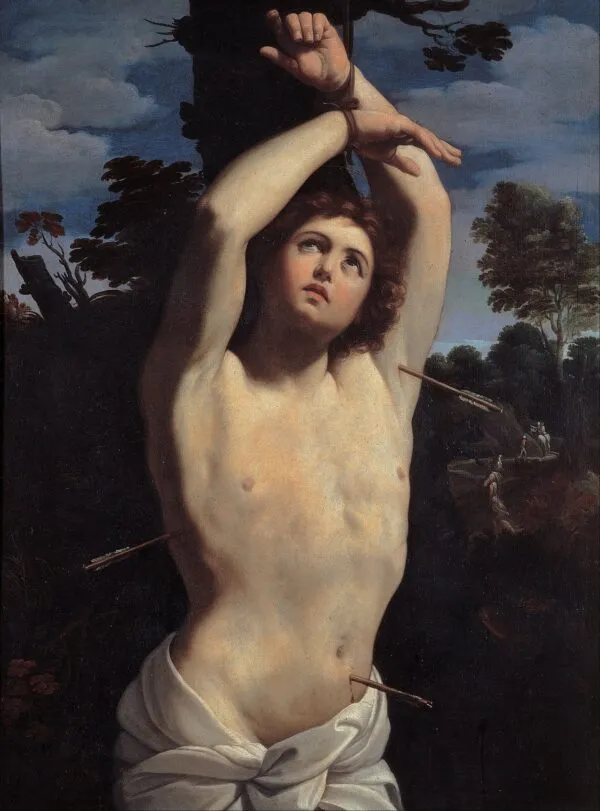
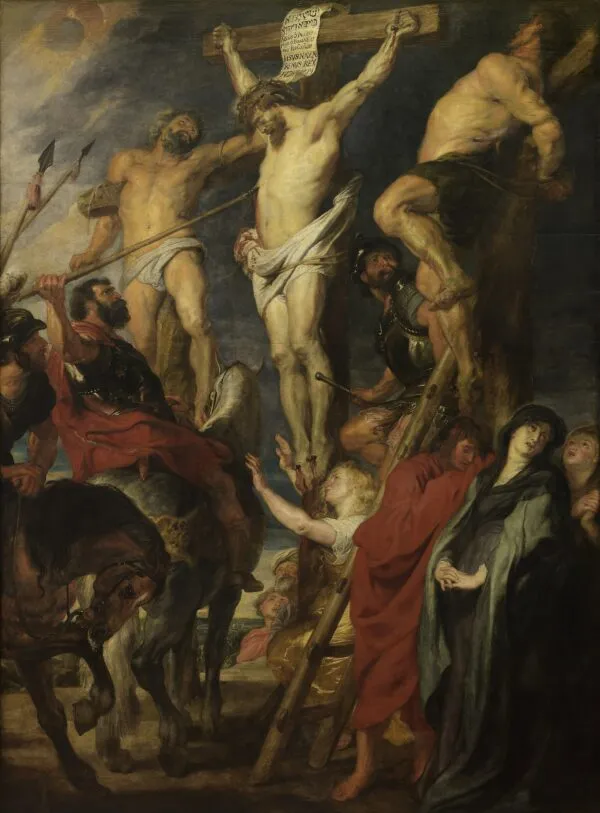
A hand reaches across a table. A sleeping body is exposed to danger. A company of guards is still finding its direction. Baroque painting often catches people at a moment when a gesture carries consequences. The energy comes from that human situation as much as from the sweep of a composition.
The National Gallery’s explanation of the term Baroque emphasises the drama, diagonals and illusionistic effects found in many seventeenth-century works. It is a useful point of departure for this collection. The term covers different painters and different emotional registers; each painting deserves to be approached through the scene it actually presents.
At the edge of someone else’s discovery
In Caravaggio’s Supper at Emmaus of 1601, the disciples recognise Christ during a meal. The National Gallery explains how their arms, a projecting elbow and the insistent light give bodily force to that recognition. The revelation takes place around food and a table, among people whose astonishment has a physical shape. A sacred event becomes close enough for the viewer to feel included in its space.
There is a useful question to carry into other paintings here: what changes because a person has moved a hand or turned a head? A reaching arm may join two figures, direct our attention or make us conscious of the distance between them. Following those relationships can reveal more than attaching a single emotion to the whole picture.
Strength at its most vulnerable
Rubens’s Samson and Delilah, dated about 1609–10 by the National Gallery, turns a powerful body into a vulnerable one. Samson sleeps while his hair is cut and soldiers wait beyond. The museum’s discussion follows the uncertain expression on Delilah’s face and the tenderness suggested by her hand. It leaves room for feelings that do not settle into a simple verdict.
That uncertainty is part of what can make a dramatic painting intimate. Knowing the story lets us see the danger; looking at a hand or a sleeping face can make us hesitate over the people inside it. The large event and the small gesture need each other.
Public confidence, individual movements
In Rembrandt’s Night Watch, light and overlapping gestures animate a civic group portrait. A captain gives direction, but the company has not yet become a single orderly movement. Compare the officers’ central presence with the figures emerging behind them. The drama grows out of people trying to occupy a shared public space.
These examples offer different ways into the Baroque collection: recognition, vulnerability, collective display. Let the particular work determine the pace of looking. Sometimes the most telling moment is a broad movement across the canvas; sometimes it is a hand resting where its owner’s expression gives little away.