Northern Netherlands · 17th century
The Dutch Republic, close up
Cities, interiors and faces: enter the seventeenth century through the spaces its painters made visible.
4 chapters9 artworks
Begin the journey
Johannes Vermeer
View of Delft
1661 · Mauritshuis
Discover the reproduction ↗A society cannot be reduced to its most celebrated paintings. This route follows a small group of Dutch works to ask how civic identity, household labour, belief and imagination inhabit the same artistic world. The familiar phrase “Golden Age” describes extraordinary cultural production, not prosperity shared equally by everyone.
Around 1660–1661
A city becomes a subject
In View of Delft, Vermeer makes water, sky and architecture share the painting. The city is not only a backdrop to a ruler or a sacred story. It becomes the subject of sustained attention, seen from across the water.
Look at the unequal distribution of light. The buildings form a rhythm rather than an inventory. Reading the work as an image of civic place is useful; treating it as an exact statistical portrait of all Delft’s inhabitants would ask more of it than it can provide.
Johannes Vermeer
View of Delft
1661 · Mauritshuis
Discover the reproduction ↗Around 1660
The dignity of an ordinary action
A woman pours milk in a quiet room. Vermeer’s limited setting concentrates attention on hands, vessels and the narrow stream between them. The apparent simplicity is a carefully organised pictorial effect.
Genre painting opens a route into ordinary activity, but it is not an unedited social recording. Domestic service, the viewer’s position and the labour behind the scene are worth considering together. The person in the painting is doing something; she is more than an arrangement of beautiful objects.
Pieter de Hooch’s courtyard opens the domestic world to a sequence of thresholds. Doors, paving and the passage towards the street guide the eye between private and shared spaces. Set beside The Milkmaid, it makes the organisation of a household visible through architecture as well as through a person’s task. The two painters construct different rhythms of daily life.

Johannes Vermeer
The Milkmaid
1660 · Rijksmuseum
Discover the reproduction ↗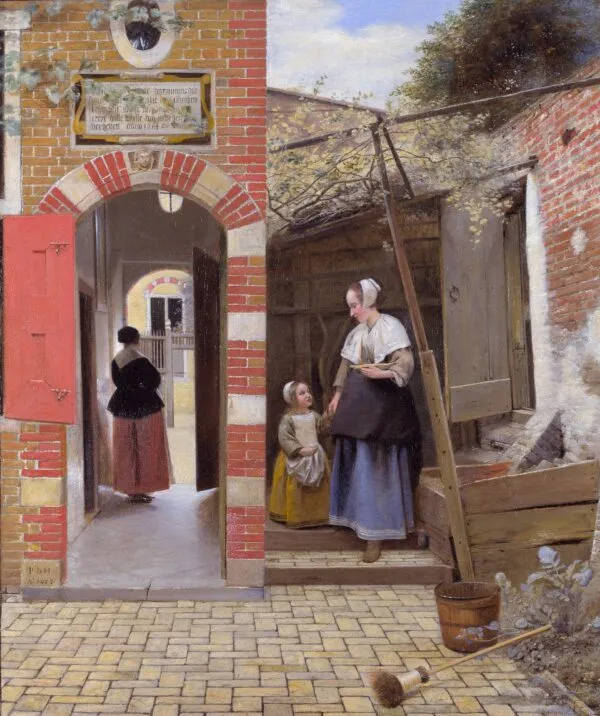
Pieter de Hooch
The Courtyard of a House in Delft
1658 · National Gallery
Discover the reproduction ↗1624–1665 · portraits & tronies
A face, without a complete biography
The Mauritshuis identifies Girl with a Pearl Earring as a tronie: a study of a character or head rather than a commissioned portrait of a named sitter. The distinction matters. A compelling face does not give us permission to invent a documented life for its model.
The turning head and parted lips create the impression of a brief encounter. Her costume belongs to the painting’s imaginative construction. Let that uncertainty remain productive: the work offers an unusually immediate experience while withholding the identity we may want to assign.
Hals’s so-called Laughing Cavalier and Leyster’s Self-Portrait sharpen the distinction. The first work carries a later, memorable title rather than the sitter’s name. In the second, the painter presents herself at work, turning towards the viewer with brushes and palette in hand. An imaginary character, an unidentified sitter and a professional self-image invite three different relationships with a painted face.

Johannes Vermeer
Girl with a Pearl Earring
1665 · Mauritshuis
Discover the reproduction ↗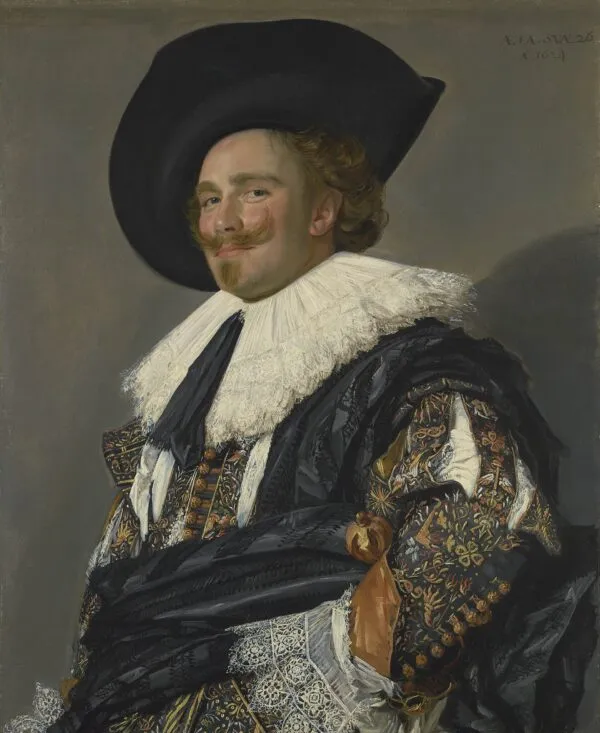
Frans Hals
The Laughing Cavalier
1624 · Wallace Collection
Discover the reproduction ↗
Judith Leyster
Self-Portrait
c. 1630 · National Gallery of Art, Washington
Discover the reproduction ↗17th century
Public roles and inward lives
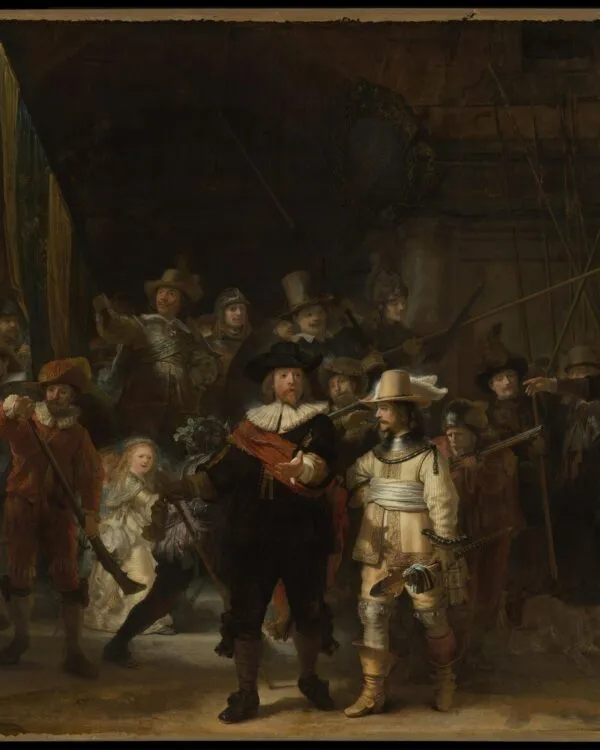
Rembrandt’s group portrait commonly called The Night Watch and his Return of the Prodigal Son lead in different directions: civic visibility and a biblical encounter. Their coexistence resists the idea that Dutch art was exclusively secular or exclusively domestic.
The museum category “Dutch painting” gathers portraits, landscapes, still lifes, everyday scenes and religious or mythological narratives. Moving between them reveals changing uses of an image. Ask who might commission it, where it might hang, and whether it asks for recognition, reflection or devotion.
The Anatomy Lesson of Dr Nicolaes Tulp brings another professional group into view. Rembrandt painted the surgeons in 1632, arranging attention around an anatomical demonstration. Compare their different lines of sight with the movements of the civic group in The Night Watch. These group portraits offer identities through membership and activity, while the biblical painting turns towards a personal encounter.
Rembrandt
The Night Watch
1642 · Rijksmuseum
Discover the reproduction ↗
Rembrandt
Return of the Prodigal Son
1668 · Hermitage Museum
Discover the reproduction ↗
Rembrandt
The Anatomy Lesson of Dr Nicolaes Tulp
1632 · Mauritshuis
Discover the reproduction ↗Keep exploring