The Painter
Henri de Toulouse-Lautrec
1864–1901 · French · Post-impressionism
Painter of Montmartre cabarets, dance halls and brothels in thin oil on cardboard, and maker of the lithographed posters of 1890s Paris.
Henri Marie Raymond de Toulouse-Lautrec-Montfa was born on 24 November 1864 in Albi, in southern France, into an old aristocratic family. His parents, Count Alphonse and Adèle Tapié de Céleyran, were first cousins, and a younger brother died in infancy. In 1878–79 he broke one thigh bone and then the other; the fractures healed badly, his legs stopped growing, and he never exceeded about 1.52 m. He took up drawing and learned from the animal painter René Princeteau, a friend of his father. In 1882 he moved to Paris, entering the studio of Léon Bonnat and then that of Fernand Cormon, where he met Louis Anquetin, Émile Bernard and Vincent van Gogh. From 1884 he lived in Montmartre, a district he rarely left. Drinking heavily, he was committed to a clinic at Neuilly in 1899, and he died on 9 September 1901 at his mother's château of Malromé, in Saint-André-du-Bois, aged 36.
His painting is built on drawing: Degas, Japanese prints and the Impressionists shaped his taste for sharp outlines, bold cropping and modern subjects. He often worked in thinned oil on unprimed cardboard, letting the brown ground show through the fluid colour. At the Moulin Rouge: The Dance (about 1890, Philadelphia Museum of Art) shows the dancer Valentin le Désossé at the cabaret that had just opened, and the owners hung it above their bar. At the Moulin Rouge (1892–95, Art Institute of Chicago) groups friends, dancers and the artist himself around a table. In the Salon in the Rue des Moulins (1894, Musée Toulouse-Lautrec, Albi) watches women waiting for clients in a brothel, while The Clowness Cha-U-Kao (1895, Musée d'Orsay, Paris), on cardboard, catches a performer at her dressing. From 1891 he also made lithographed posters, beginning with the Moulin Rouge, which carried his flat colour and line into the streets.
After his death, his dealer Maurice Joyant and his mother worked to keep his output together, and the Musée Toulouse-Lautrec opened in 1922 in the Palais de la Berbie at Albi, the world's largest public collection of his work. He founded no school and kept no formal atelier; his influence passed through the poster and through the lasting image of Montmartre night life. The catalogue by Madeleine Grillaert Dortu counts 737 paintings, 275 watercolours and 369 lithographs. For a painter working in oils, these pictures offer a lesson in economy: a few thin, matte layers over a warm neutral ground, quick contours in a loaded brush, flat accents of red, yellow and green, and the glow of gaslight set against deep shadow.
Reproducing this painter
The Post-Impressionists kept the pure colour and dropped the optical realism, using distortion and heavy paint to carry feeling and structure. The surface is often thick enough to hold the mark of the brush, which is precisely what a print cannot give you.
Biographical details on Wikipedia.
Works by Henri de Toulouse-Lautrec we reproduce
-

At the Moulin Rouge by Henri
Henri de Toulouse-Lautrecfrom €85,00 – €719,00 -
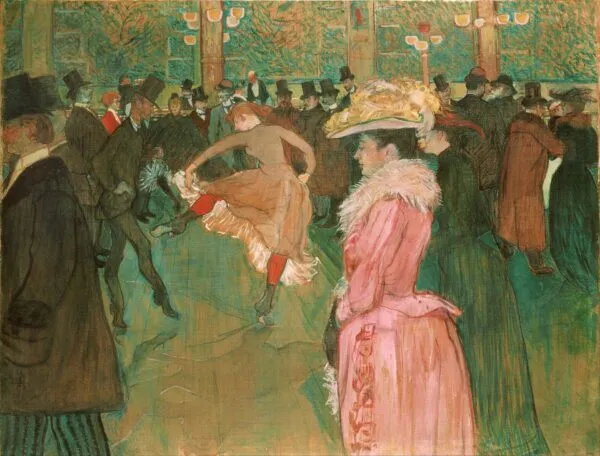
At the Moulin Rouge, The Dance by Henri
Henri de Toulouse-Lautrecfrom €98,00 – €832,00 -

La Toilette by Henri
Henri de Toulouse-Lautrecfrom €96,00 – €787,00 -
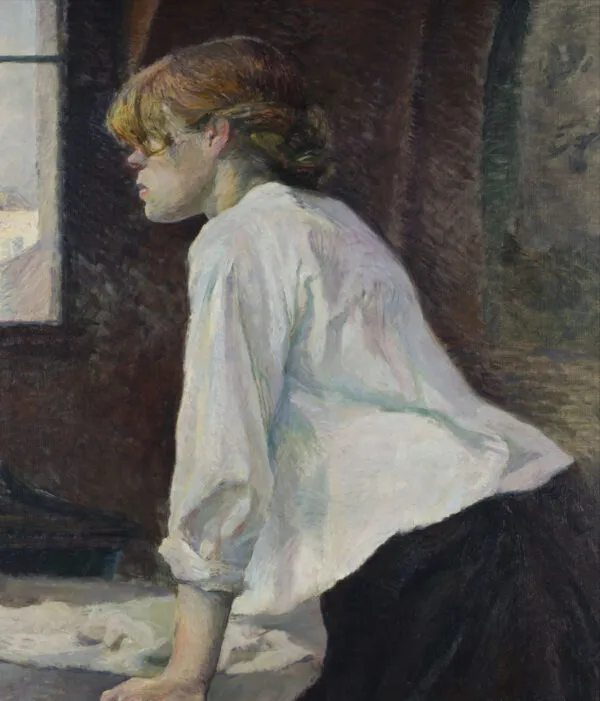
La Blanchisseuse by Henri
Henri de Toulouse-Lautrecfrom €89,00 – €737,00 -

The Hangover (Suzanne Valadon) by Henri
Henri de Toulouse-Lautrecfrom €89,00 – €737,00 -

Equestrienne (At the Cirque Fernando) by Henri
Henri de Toulouse-Lautrecfrom €121,00 – €1 002,00 -

In the Salon at the Rue des Moulins by Henri
Henri de Toulouse-Lautrecfrom €89,00 – €744,00 -
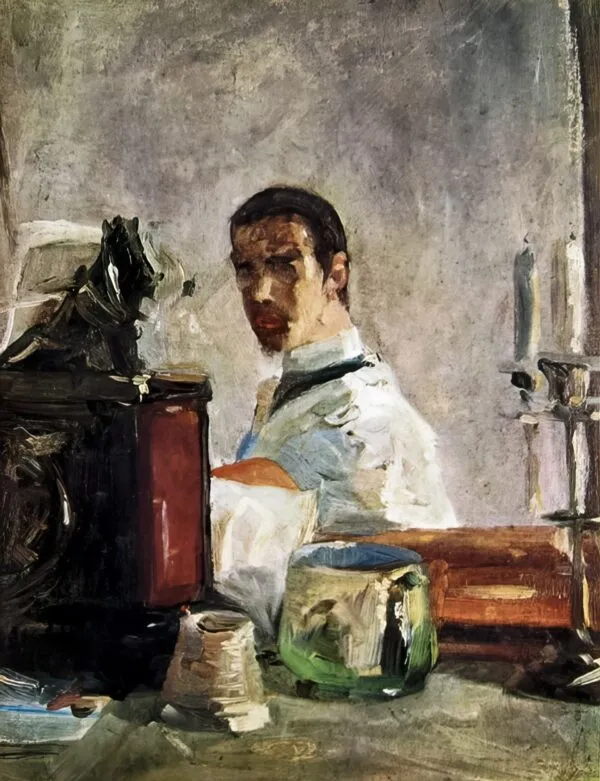
Self-portrait in front of a mirror by Henri
Henri de Toulouse-Lautrecfrom €98,00 – €820,00 -

Le Lit by Henri
Henri de Toulouse-Lautrecfrom €98,00 – €820,00 -

Alphonse de Toulouse-Lautrec-Monfa Driving his Mail-Coach in Nice by Henri
Henri de Toulouse-Lautrecfrom €98,00 – €820,00 -
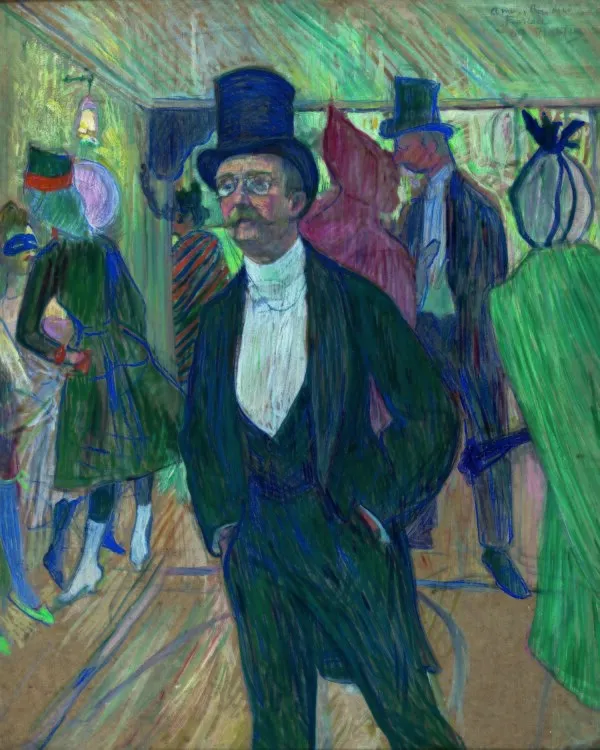
Monsieur Fourcade by Henri
Henri de Toulouse-Lautrecfrom €94,00 – €787,00 -
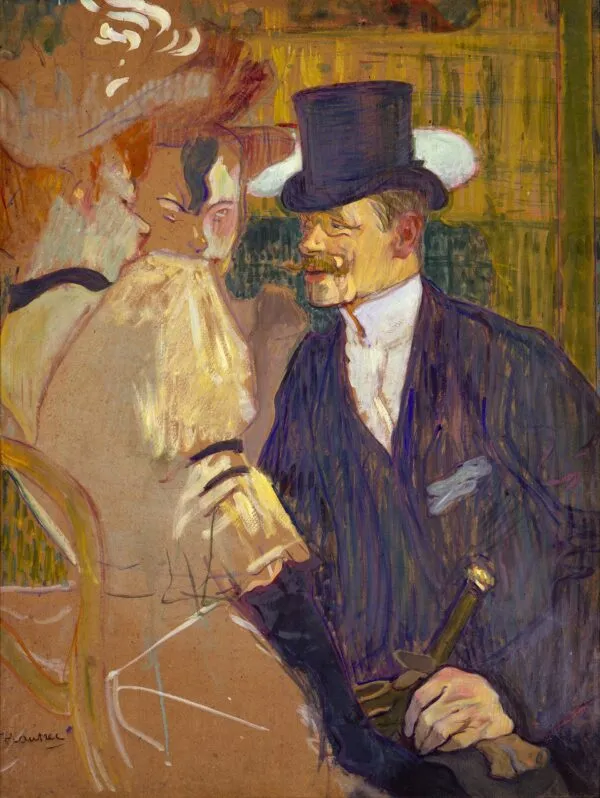
The Englishman (William Tom Warrener, 1861–1934) at the Moulin Rouge by Henri
Henri de Toulouse-Lautrecfrom €101,00 – €838,00
Paintings by Henri de Toulouse-Lautrec available to order
Any of these can be painted for you by hand. Tell us which one and the size you want, and we will send a quote within 48 hours.
- At the Moulin Rouge
- At the Moulin Rouge, The Dance
- La Toilette
- La Blanchisseuse
- In the Salon at the Rue des Moulins
- Equestrienne (At the Cirque Fernando)
- Self-portrait in front of a mirror
- The Hangover (Suzanne Valadon)