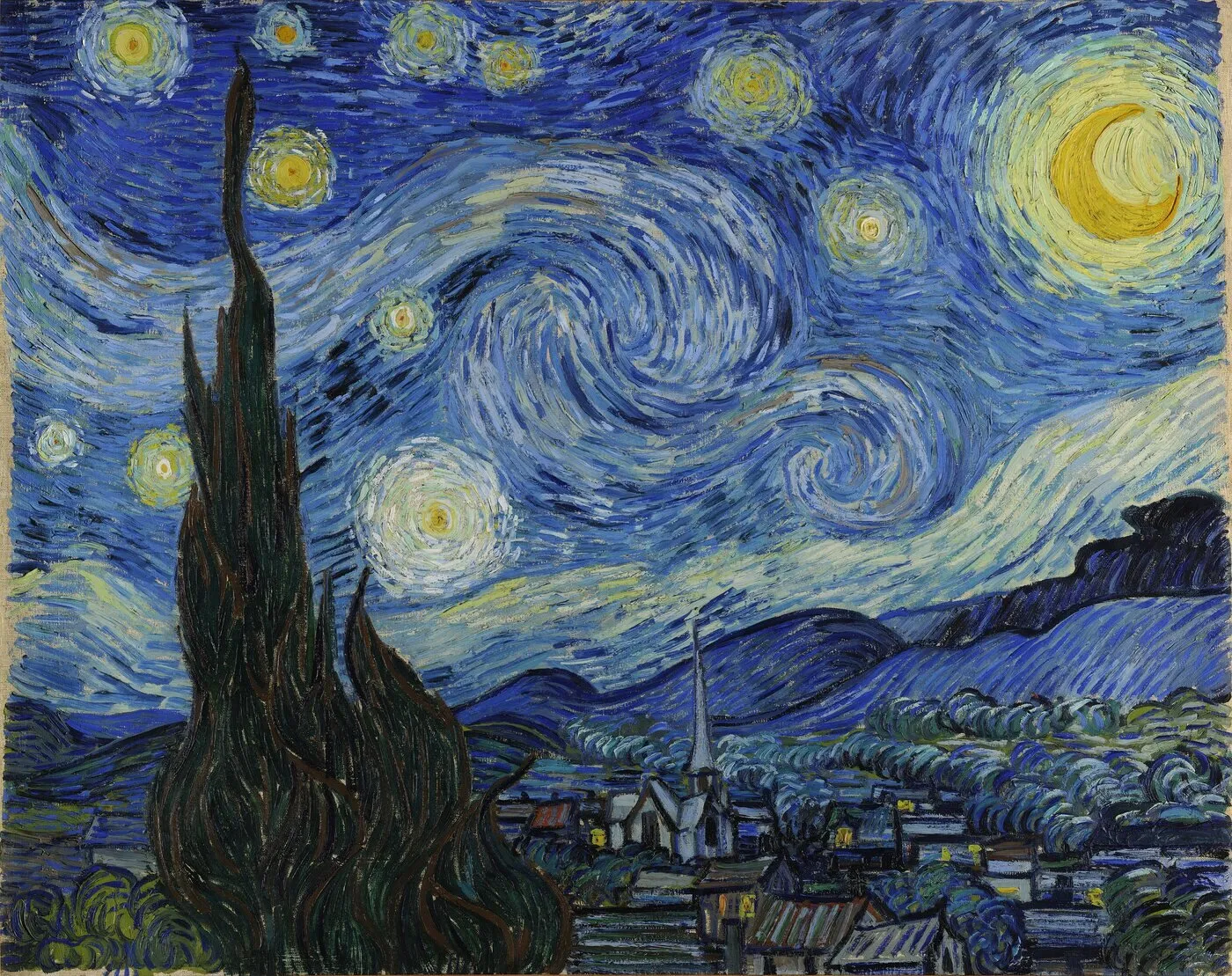
Description
A few windows are still yellow in this village. They are small things beside the swollen stars and the long blue waves crossing the sky. Yet they make the houses feel inhabitable. A lighted room, someone behind a wall: the imagination can settle there for a moment before the sky pulls the eye away again.
The cypress reaches almost the full height of the picture. Its dark mass has the shape of a flame that has taken root. It brings earth and sky close together while keeping us at a distance from the houses. There is a peculiar feeling in that arrangement: a place we recognise, surrounded by a world whose scale keeps escaping us.
A night assembled from more than one view
MoMA’s collection record dates the painting to June 1889 and helps explain this dislocation. Van Gogh drew on the view from Saint-Paul-de-Mausole in Saint-Rémy, but also worked during the day and brought together elements that were not all visible from his window. The village is part of that reconstruction.
The clustered houses and the great curves overhead hold two scales of experience in the same frame: somewhere one might live, and a night too large to contain. Richard Thomson’s study published by MoMA places these choices within Van Gogh’s experiments as a painter. The freedom of the composition emerges as sustained work, with its own trials and questions.
Back to the cypress
The Metropolitan Museum’s essay on Van Gogh offers a route towards his daylight Cypresses of 1889. Returning from that picture, the nearly black silhouette here becomes harder to overlook: its weight in the foreground, its sharp point, the space it takes between us and the village.
The cypress occupies the way towards the houses and draws us upward. It holds us at the edge of a place we recognise while the curves overhead keep moving. This night leaves room for solitude, and for the persistence of an inhabited world.



Reviews
There are no reviews yet.