Description
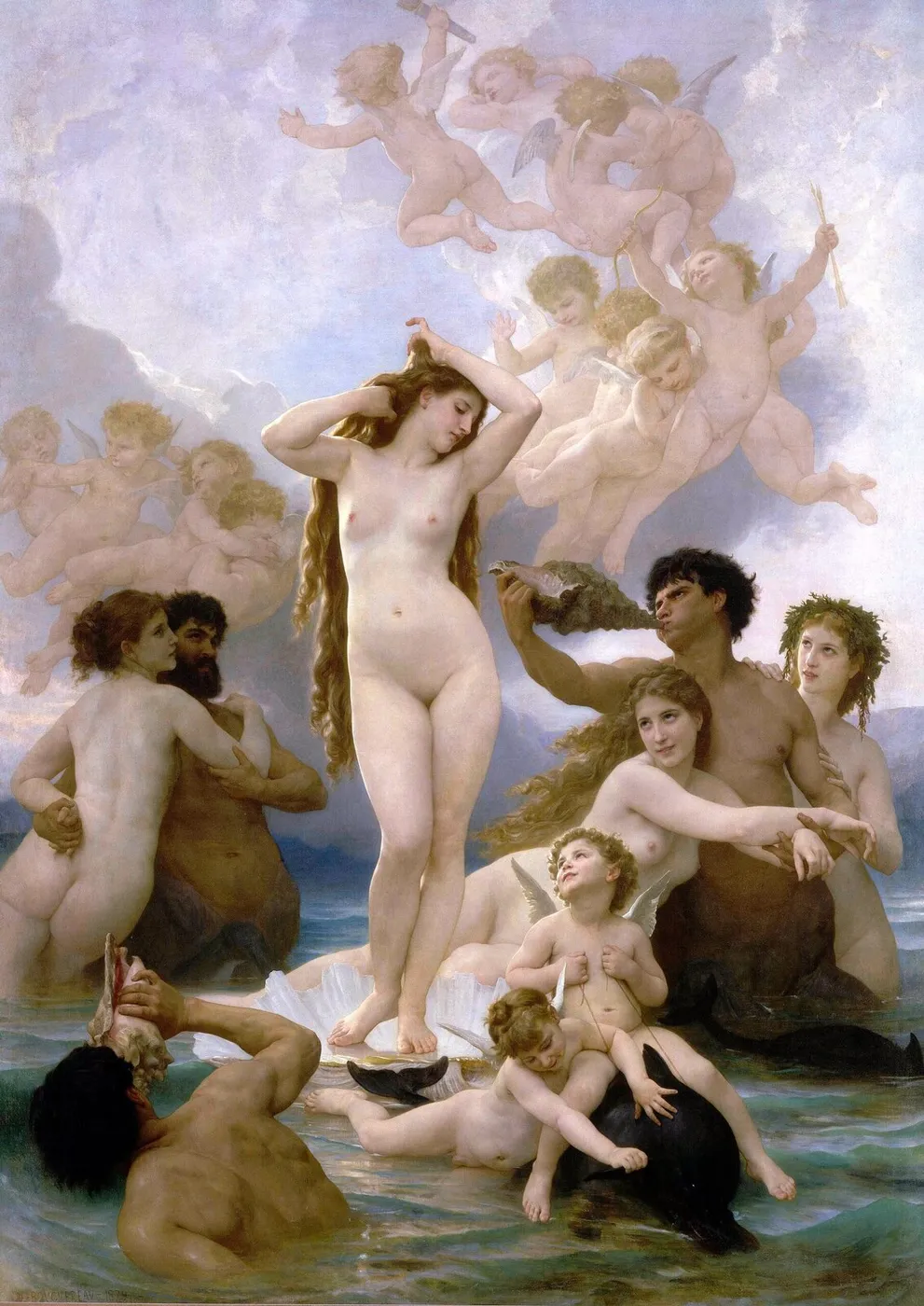
Venus gives this crowded picture its still centre. A horn is lifted, bodies turn towards her and winged children gather overhead. She raises her arms to her hair, inclines her head and lowers her eyes. The sea is full of movement around a gesture that feels almost private.
Follow the painting from its lower edge. A reclining child lies close to the water. From there, the embracing figures on the right lead the gaze higher. Their arms and faces draw the gaze upward, into the pale spiral of airborne children. Venus interrupts that circling movement with the long, nearly vertical line of her body. Her smooth silhouette stays legible while the surrounding limbs overlap.
Beauty as a public arrival
Bouguereau painted The Birth of Venus in 1879. The Musée d’Orsay’s collection record identifies the original as an oil painting on canvas, three metres high, and records its purchase from the artist by the French State that same year. It was also shown at the Salon of 1879. At that scale, the gathering can occupy a substantial field of vision.
The figures make that entrance feel ceremonial. At the left, two bodies hold one another while turning towards the goddess. At the right, a raised shell becomes an instrument; above, wings, small feet and reaching arms fill the sky. Their attention collects around Venus. The scene can be read as beauty being acclaimed by a community, while the person at its centre remains absorbed in her own quiet movement.
There is a particular sensuality in how the colours meet. Pale flesh passes into cool lilac cloud, then into the green-blue water. Dark hair, shadowed skin and the sea creatures give weight to this light palette. The surface in this image appears carefully smoothed, so the eye follows transitions of tone more readily than separate strokes. That continuous modelling gives the figures their rounded, almost sculptural presence.
Two Venuses, two kinds of attention
Compare the work with Botticelli’s Birth of Venus. In that wide composition, a cloak waits across a small gap; here, bodies and gestures have already gathered around the goddess. The Uffizi’s notice of Botticelli’s original provides a useful starting point for the comparison. The shared subject brings their differences into focus: fine, flowing contours in one, soft volumes and a rising crowd in the other.
Bouguereau’s painting rewards a second look at the relationships around its central figure. The lowered eyes, the embracing pair and the upward glance of a child give this grand spectacle smaller, human exchanges. Those details are where its warmth can emerge.


Reviews
There are no reviews yet.